The Easter Offensive Proved the South Vietnamese Army Could Fight. The Same Battles Proved It Couldn't Fight Alone
7 min read
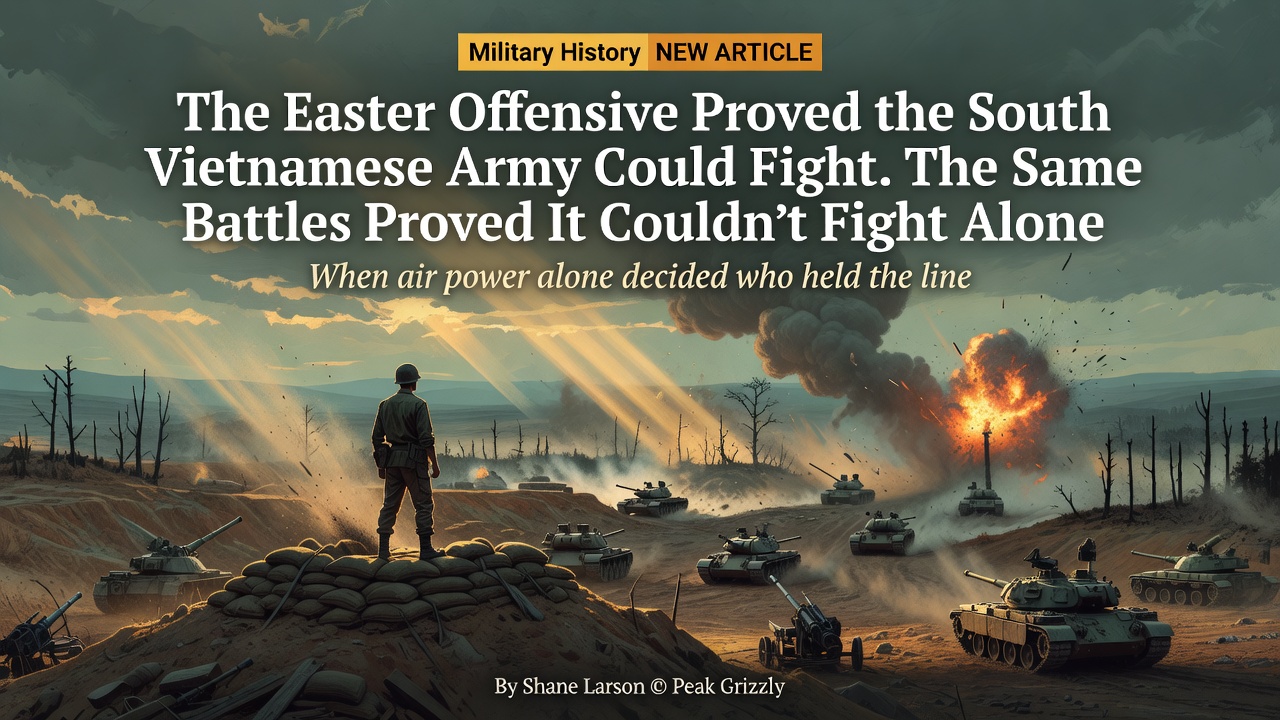
At about noon on March 30, 1972 — the Thursday before Easter — the heaviest artillery preparation of the Vietnam War came down on a line of South Vietnamese firebases just below the Demilitarized Zone. The date was not chosen for the holiday. It was chosen for the weather: the cloud ceiling that morning sat low enough to ground the tactical aircraft that were the defense's whole insurance policy. Behind the barrage came tanks, in regimental columns, across an international demarcation line in daylight. Within a fortnight the invasion had three fronts — the northern provinces, the highlands around Kontum, and, sixty miles from Saigon, a rubber-plantation town called An Loc. Fourteen divisions and some two dozen separate regiments were committed before it was over: the largest offensive any army had launched in Asia since the Chinese crossed the Yalu in 1950.
The United States had entered Vietnam, by the reasoning of two administrations, precisely to stop a conventional communist invasion of the South. When the invasion finally came, the Americans were nearly gone — the force that had stood at over half a million men in 1969 was falling past ninety-five thousand that morning, on a published schedule, and the last American division had gone home earlier the same month. What was left on the ground was two brigades guarding air bases, an advisory structure, and the airmen.
What happened next produced the strangest result in the historiography of the war: a single campaign that constitutes the strongest evidence anyone has ever assembled for two opposite conclusions.
The proof that it worked
Start with what the South Vietnamese army did, because for a force that had been written off after the Laos operation a year earlier, it is remarkable.
It held its cities. Every one of them. The northern front collapsed in the first weeks and Quang Tri fell — and then a fired commander's replacement rebuilt the shattered front in a fortnight, and in the summer the army took the Quang Tri Citadel back by frontal assault, eleven weeks of it, against a defense ordered to hold to the last man. In the highlands, a defense pulled together in days broke the attack on Kontum. And at An Loc, a garrison of soldiers who had been told their hand-held rockets would not stop tanks killed tanks with them at thirty meters in the streets, and stood in the rubble for sixty-six days of siege under bombardment without parallel in the war, and did not break.
No army that will not fight does any of those things. That is the case, argued most fully by the revisionist school of the war's historians, that Vietnamization — the transfer of the war to Saigon's army — had worked: that the force built between 1969 and 1972 was real, and that what it later lost was taken from it rather than lacking in it.
The proof that it didn't
Now look at how the cities were held.
Every front that held was a front where American aircraft delivered the margin. B-52 strikes were walked around An Loc's perimeter at intervals of under an hour, breaking up assault echelons the garrison could not have survived meeting. The town was fed for two months entirely by American parachute after the road closed. At Kontum, the same pattern. At the Citadel, a fleet's guns and an air force's tonnage unmade the objective ahead of the infantry. And at the joints of all of it stood a handful of American advisors on American radios, calling for things no South Vietnamese officer could request and no South Vietnamese aircraft could deliver — including strikes brought in danger-close, within a few hundred meters of their own trenches, in weather the South Vietnamese air force could not fly.
The commanders on the ground said so at the time, in reporting that survives. Nothing in the South Vietnamese inventory could replace what the Americans were about to remove, and everyone on both sides knew the aircraft were leaving. That is the orthodox case: that Vietnamization had built a dependency and called it an army.
Both are true, and that is the problem
Here is the part worth slowing down for. These are not two readings of different evidence. They are two readings of the same evidence — the same battles, the same weeks, the same men. The garrison at An Loc genuinely stood, and it genuinely could not have stood without the bombers. Both halves of that sentence are the argument, and the decades of dispute between the two schools have consisted mostly of emphasizing one half of a record that contains both.

The Easter Gamble
The reason the question cannot be settled from 1972 is structural, and it generalizes well beyond Vietnam. The army and the air force were never separated during the campaign, so the campaign cannot testify about the army alone. When a system succeeds only while an external support is present, the test that proves its capability and the test that proves its dependency can be the same test — and no amount of arguing over the result will pry them apart. The only thing that separates them is removing the support, and that is not an experiment anyone runs on purpose.
In Vietnam it was run anyway, by treaty and by appropriation. In January 1973 the aircraft left under the sixty-day withdrawal clause of the Paris agreement. In August 1973 Congress forbade their return. And in March 1975 an offensive rolled south down the same axis that had been tried and stopped at Kontum, against an army that still would fight and no longer had the other half of what had saved it. 1975 is not a refutation of either proof of 1972. It is what happens when only one of them still applies.
The other question the evidence won't close
The campaign's second half moved from the battlefield to Paris, and it ends at the other great unsettled argument of the war: whether the eleven days of B-52 operations against Hanoi and Haiphong in December 1972 — bombing that, by the North's own published count, killed a little over sixteen hundred civilians — compelled the agreement signed a month later. One school says the bombing broke the North's defenses and its will. The other says the January agreement is substantially the document negotiated the previous October, and that what changed in between was mostly Saigon's willingness to sign it.
The decisive documents are public: the October draft and the January text. A reader can compare them, article by article, and measure exactly what changed between the collapse of the first settlement and the signature on the second — which is to say, measure what the eleven days actually purchased. That comparison is rarely laid out in full, and it is the kind of evidence that deserves to be handed to the reader rather than summarized past. A history that gives you the verdict without the exhibits is asking to be taken on faith; the exhibits, in this case, fit in an appendix.
What the settlement unambiguously delivered was the return of 591 American prisoners of war in the weeks that followed — the one part of the agreement performed as written. What it left standing was roughly a hundred and fifty thousand North Vietnamese troops on South Vietnamese soil, under a text that never asked them to leave. Hanoi lost the campaign of 1972 on every front, and kept the position the campaign had bought. Both of those, too, are true at once.
The year nobody remembers
In the popular American memory the war effectively ends around 1970 and resumes only for the helicopters on the embassy roof. Yet the largest battles of the entire war were fought in 1972, after most Americans had stopped watching; the most concentrated air campaigns in history to that date were flown in 1972; and the negotiation that ended America's war was concluded in 1972. The year deserves better than to be remembered as an epilogue — not least because it contains, in its two incompatible proofs, the most honest answer the war ever gave to the question of what a decade of American effort had built.
This article draws on the research behind The Easter Gamble: Hanoi's 1972 Offensive, Linebacker, and the Paris Accords, 1972–1973, the seventh volume of The Vietnam War Chronicles from Peak Grizzly Publishing. The book runs the campaign front by front — the collapse and recovery in the north, the two days that broke a division in the highlands, the sixty-six-day siege of An Loc — alongside the air war over the North, a chapter written from Hanoi's side of the hill, the October breakthrough that came apart in November, the eleven days of December, and Operation Homecoming. Command statistics are reported as claims, contested figures as ranges with a named source at each end, and the October draft and the January agreement are printed side by side, article by article, so the reader can weigh the change against the cost without taking anyone's word for it — including this book's.
The Easter Gamble
New posts and releases, straight to your inbox. No spam, unsubscribe anytime.