The Handshake That Finished the Alaska Highway, and the Fifty Years It Spent Out of the Story
November 7, 2026 · 7 min read
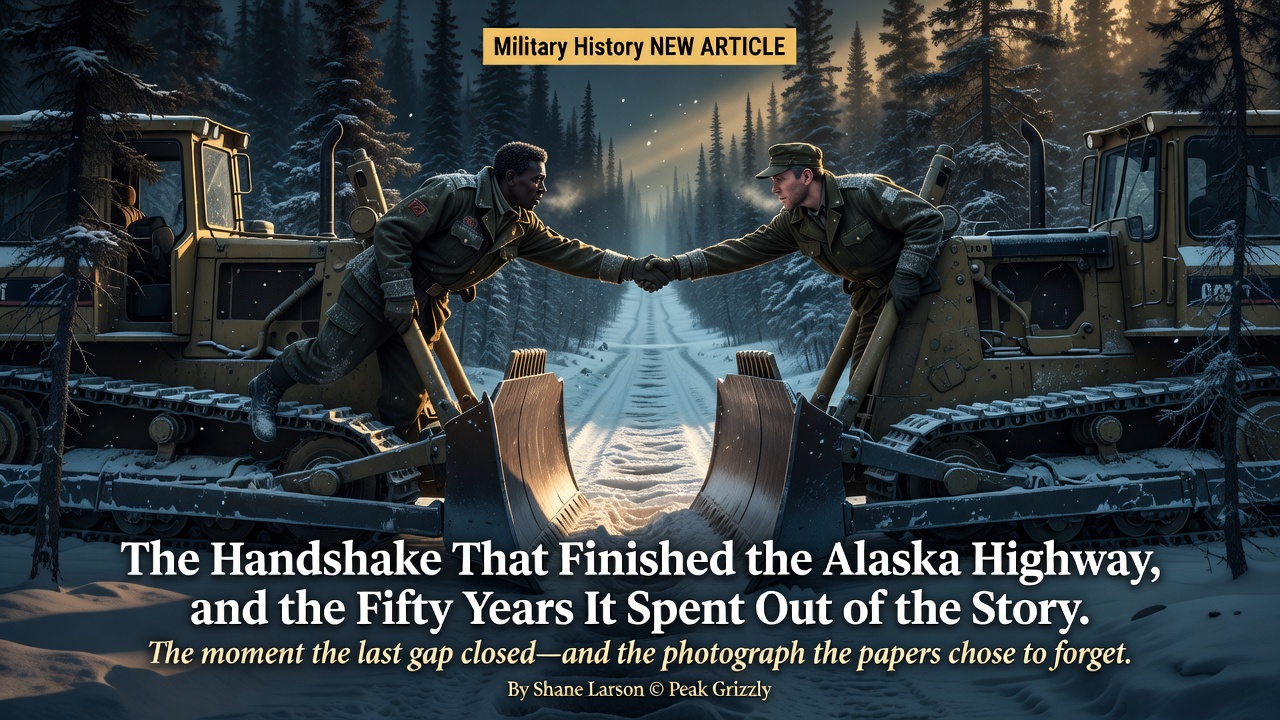
There is a photograph from the Alaska Highway that almost everyone who has driven the road has seen, and almost nobody can date. Two bulldozers sit nose to nose in a cut through black spruce, blades nearly touching. Two soldiers lean out across the gap between the machines and shake hands. The ground is bare and frozen.
The man on the left is Corporal Refines Sims Jr. of the 97th Engineer General Service Regiment, a Black soldier from Philadelphia. The man on the right is Private Alfred Jalufka of the 18th Engineer Combat Regiment, a white soldier from Kennedy, Texas. The date is October 25, 1942. The place is a few miles inside the Yukon near a stream called Beaver Creek, close to the Alaska border. Sims's regiment had been cutting southeast from Slana, in Alaska, since late spring; Jalufka's had been building northwest out of Whitehorse since April. When the last trees between them went down, two pieces of road that had not existed in February became one road, and the Alaska Highway was joined.
A photographer made the picture, and it went out, and the newspapers ran it. That is the part everyone knows. Here is the part that takes longer to explain: for roughly the next fifty years, the story of the highway was told, in newsreels and magazine features and the postwar books, mostly without the man on the left in it.
What the photograph is a picture of
Start with the road, because the picture only makes sense at the end of it.
In February 1942, two months after Pearl Harbor, the United States decided to build a road to Alaska through Canada. There was no road. There was a railhead at Dawson Creek, British Columbia, and a gravel road at the Alaska end. Between them lay something like 1,500 miles of muskeg, river, mountain pass and permafrost, with a handful of new Canadian airfields strung along the route and the trails of the people who already lived there under the surveyors' lines. The first troops reached Dawson Creek in March. The last gap closed at Beaver Creek on October 25. The ribbon was cut on November 20. Call it eight months.
About 10,000 soldiers did it, in seven engineer regiments. Three of the seven, the 93rd, the 95th and the 97th, were Black: about 3,700 men, commanded by white officers almost without exception, housed in separate camps, fed separately, and kept largely out of Whitehorse and Fairbanks and Dawson Creek. In the early months they were issued less heavy equipment than the white regiments working beside them, and they were issued it later.
They were also not supposed to be there at all. Through 1942 the Army in Alaska was commanded by Major General Simon Bolivar Buckner Jr., and when the War Department proposed to send Black engineer regiments north, Buckner objected in writing. His concern, as the historians who have read the correspondence summarize it, was not whether the men could build a road. It was that some of them might stay when the war ended, settle in the territory, and marry into the local population, and he regarded that as a problem the Army should not create. He lost. He lost not on principle but on arithmetic: the Army needed every engineer it had, and three of the seven regiments it could spare for the road were Black.
The 97th drew the far northern end. It was landed at Valdez, marched up the Richardson Highway to Slana, and set to work from there with the thinnest equipment of any regiment on the project, through permafrost and river crossings and the approach of winter, cutting new road toward the Yukon border. By October the muskeg that would have swallowed a bulldozer in July was frozen hard, which is one reason the gap could be closed at all. The photograph is a picture of the 97th arriving.
Soldiers Summit, November 20
Then came the ceremony, and the ceremony is where the picture starts to slip.
On November 20, 1942, at a bluff above Kluane Lake that the Army named Soldiers Summit, officials of two governments cut a ribbon in cold the Army's own history puts at about fifteen below; wartime censorship kept the figure off the radio. A Canadian cabinet minister and the secretary of the Territory of Alaska held the scissors. There were speeches, a radio broadcast, a band, and then the first convoys began to run north. Four soldiers held the ribbon, by the Federal Highway Administration's account: Sims and Jalufka among them, with Master Sergeant Andrew Doyle and Corporal John T. Reilly. Two of the four were Black. That, and nothing more, was the Black regiments' presence at the official opening. The speeches named governments, generals and the Corps of Engineers.
The Pioneer Road
That ceremony, not the handshake, became the official end of the story, and the story that grew out of it was for the most part a story about white soldiers and the Corps. The Black press printed the Beaver Creek photograph in 1942 and gave the three regiments more space than the white papers did. The mainstream version, the one that hardened over the following decades into the thing everyone knows, kept the eight months and the ten thousand men and the engineering marvel and the handshake at the end, and quietly lost track of who was in the handshake.
It is worth being exact about what kind of forgetting this was, because the exactness matters. Nothing was suppressed. The Army's own unit histories said which regiments built which sectors. The negative sat in the files. The men themselves went home and told their families. The silence was not an act. It was a choice made many times by many people who had a story and knew its shape and reached, each time, for the same picture of it. That is a less dramatic explanation than a cover-up and a more uncomfortable one, because it is how most history goes missing.
The same exactness has to run the other way. One version of the story that came back in the 1990s says the Black regiments were handed shovels and nothing else. The record does not support that. What it supports is bad enough: the 97th started thin and stayed thin longest; the 95th spent much of the summer on lighter work behind a white regiment before it got heavy equipment of its own, and when it did it built bridges that white officers had not expected it to build. The documented version is damning. The absolute version is legend, and the trouble with legend is that it gives a skeptical reader a way out of the documented version too.
How the picture came back
The men in the photograph did not come back into the story on their own. Veterans of the three regiments kept it, and so did their families. Historians who went through the Army's archives in the 1980s and 1990s put the regiments back where the unit histories had always had them. The fiftieth anniversary of the highway in 1992 brought recognition events on both sides of the border and honors for men who were by then in their seventies, and later commemorations in Alaska and the Yukon have kept the names in view.
There is a larger claim sometimes made for the three regiments, that their record on the highway helped move the Army toward the desegregation order of 1948. The honest version is narrower. Three Black regiments did a third of the hardest construction job the Army took on in 1942, under officers and in conditions designed to make doing it well as difficult as possible, and they did it well. That record went into the files alongside the records of a great many other Black units in a great many other places, and the sum of those records is part of why the Army desegregated, slowly and under political pressure, beginning in 1948. The highway did not cause that. It was part of the evidence. That is enough to say, and it is more than the story said for fifty years.
Drive the highway now and the photograph is everywhere the road's story is told: on the interpretive panels at Soldiers Summit, where the ceremony that left it out is explained beside it; in the museums at Dawson Creek, Whitehorse and Fairbanks; at the roadside near Beaver Creek, where travellers stop, read about the day the road was joined, and drive on into Alaska over the ground the two regiments closed. The road carried the picture back into the story. It took about fifty years, and it took people choosing, over and over, to reach for a different picture than the one they had been handed.
A photograph does not stay in a story by being true. Someone has to keep picking it up.
The Pioneer Road: The Black Engineers, the Alaska Highway, and 1,500 Miles Built in Eight Months of 1942 tells the construction of the Alaska Highway as the adventure it was, from a railhead in British Columbia to the frozen spruce at Beaver Creek, and then stays for the rest of the project: the civilian rebuild of 1943, the Canol pipeline, the airfields that passed nearly 8,000 Lend-Lease aircraft to Soviet crews, the American army that alarmed Ottawa and the price Canada paid to buy its north back, and the First Nations and Alaska Native communities whose country the road ran through. The three Black regiments are at the centre of it, where the record puts them, with every legend about them checked in both directions.
The Pioneer Road
New posts and releases, straight to your inbox. No spam, unsubscribe anytime.