The Body Count Was Not a Moral Failure. It Was a Measurement Failure — and That Is Worse
October 25, 2026 · 7 min read
The most reviled number of the twentieth century began as a reasonable answer to a hard question.
The question was this: how do you know whether you are winning a war against an enemy who refuses to hold ground? In a conventional war, progress is a line on a map. The line moves, and everyone from the theatre commander to the newspaper reader can see which way. But the enemy the United States faced in Vietnam from 1965 onward fought when he chose, broke contact when he chose, and let the ground go, because holding it had never been his object. A hill carried by assault in November was enemy ground again by December. There was no line to move, and there was never going to be one.
And yet the war had to be reported. To a president deciding, month by month, whether to send the next increment of men. To a Congress appropriating the money. To a public supplying the soldiers and paying the bill, which in a democracy is entitled to be told whether the thing is working. Reporting requires a measure, and the natural measure of war — territory — had been ruled out by the nature of the enemy. When the American command looked at what was left to count, the only quantity that moved in the right direction when the war went well, and could be gathered from the field in something like real time, was enemy dead.
From that fact — not from callousness, and not from stupidity — came the body count.
The theory was coherent. Say that first.
It is worth stating the case for attrition at its strongest, because the popular version never does. The caricature runs: a general who understood nothing mistook a political war for a conventional one and set out to win it by counting corpses. Serious scholarship over the last two decades — Gregory Daddis's work on Westmoreland's command in particular — has taken that caricature apart. The command's own contemporary records show a headquarters that thought hard about the war it was in and devoted far more attention to pacification, the village-level struggle for security and governance, than the caricature allows.
More important, the constraints that produced attrition were imposed from Washington, not chosen in Saigon. No invasion of the North. No ground operations against the sanctuaries in Laos and Cambodia, through which the enemy's men and supplies flowed. No mobilization of the reserves. Strike those options from the board and what remains is a war fought inside South Vietnam against forces that could rest, refit, and reinforce beyond reach. Attrition was very nearly the only strategy left, and it carried a coherent theory of victory: kill the enemy faster than Hanoi could replace him, and there exists a point — the command called it the crossover point — past which the war becomes unsustainable for the other side.
The theory was not stupid. The metric was fatal. Those are different claims, and the difference is the whole story.
What happens to a number nobody can check
Consider what the body count actually was, as a piece of information architecture. It was a figure produced at company level, by the same units whose performance it graded. It was aggregated upward through a chain of command in which every rank had an interest in its size. It could not be verified — the enemy removed his dead when he could, the battlefield reverted to him within days, and no independent count was ever taken. And it determined real things: promotions, reinforcement decisions, and ultimately the case the United States government made to its own citizens about whether it was winning.
A number produced under those conditions will inflate. Not because the men producing it were liars — most were not — but because that is a property of the system. When judgments are ambiguous, ambiguity resolves upward. When a probable kill might be counted or not counted, the count gains. No individual has to act in bad faith for a thousand small upward resolutions to compound into a figure that no longer describes the war. Two features of the American war made the pressure worse: the one-year individual rotation and the six-month command tour, which handed every officer a short window in which to show visible, quantifiable results, in a system where the only visible, quantifiable result was the count.
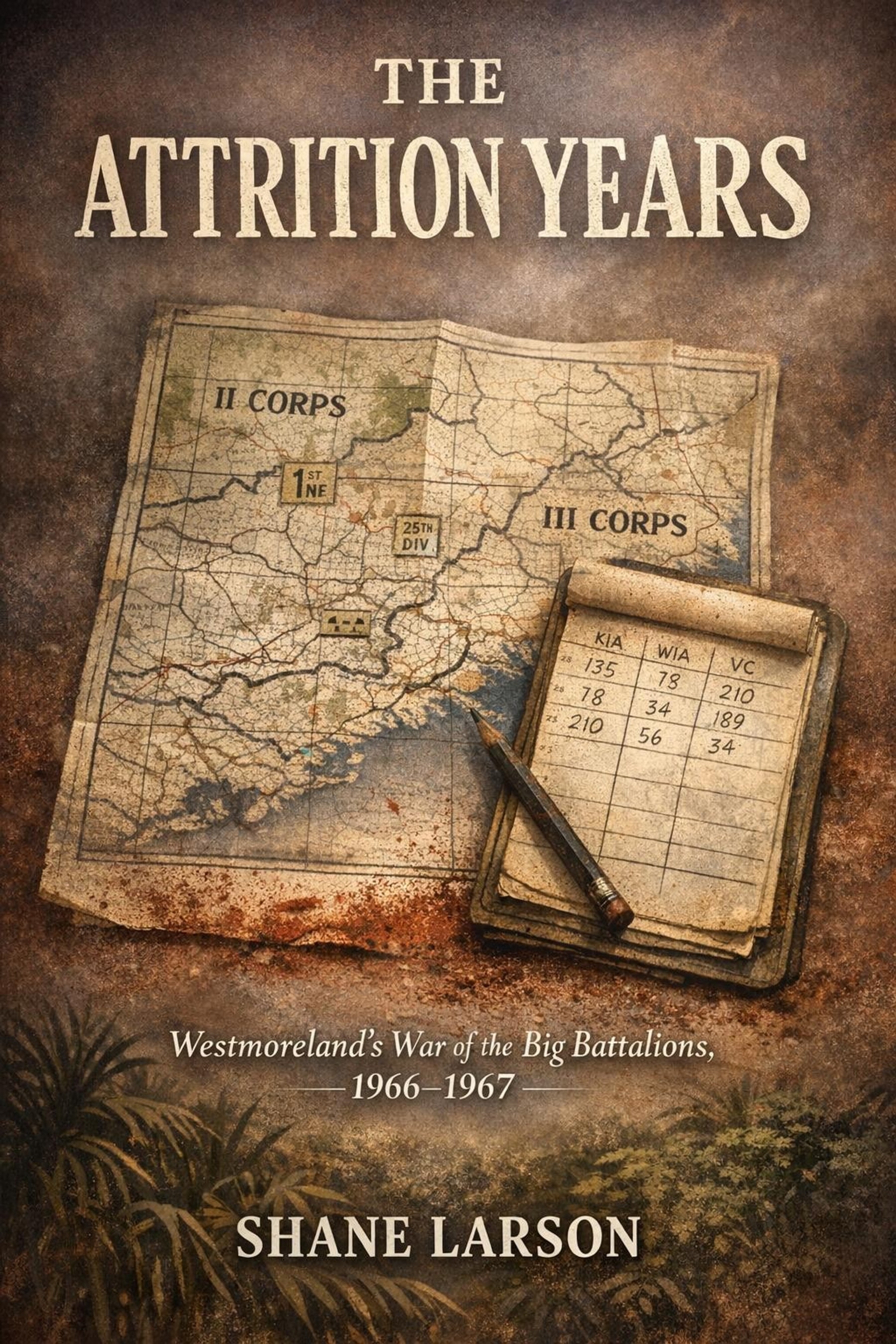
The Attrition Years
By how much did it inflate? Honest answer: nobody knows, and nobody knew then, which is precisely the problem. Estimates of the overstatement range widely, and any careful account gives them as a range. What matters is not the size of the error but its direction — always one way — and its position. This was not a bad statistic buried in a filing cabinet. It was the input to national strategy.
The argument over who counts as an enemy
Then came the second-order failure, and it is the one worth remembering.
Attrition's arithmetic needs two numbers: how fast the enemy is dying, and how fast he is being replaced. The second number requires knowing how many of him there are — the order of battle. And through 1967, the military command in Saigon and the Central Intelligence Agency could not agree on that number, because they could not agree on a question that sounds administrative and is actually foundational: who counts as an enemy?
The dispute centered on the irregulars — village self-defence militia and the political apparatus that sustained the insurgency in the hamlets. The CIA's analysts argued they belonged in the enemy strength figures: they laid mines, gathered intelligence, and were part of the war. The command's position was that part-time village forces were not a military threat in the sense the order of battle existed to describe. This was a genuine definitional dispute, not simply a dishonest one — both positions could be argued by serious people, and were. But note what hung on it. Include the irregulars and enemy strength was far larger, and the crossover point receded toward the horizon. Exclude them and the arithmetic of attrition looked close to paying off.
The dispute was resolved. It was resolved downward, and the smaller number went forward.
In the autumn of 1967 the administration mounted a deliberate campaign — historians call it the Progress Offensive — to persuade the American public that the war was being won. Westmoreland was brought home to say publicly that the end had begun to come into view. The claim rested on figures showing the crossover point reached: enemy strength falling, losses (as the command claimed them, from body counts that could not be verified) exceeding replacement.
Eleven weeks later, at the end of January 1968, roughly a hundred communist attacks erupted across South Vietnam in a single night — the Tet Offensive. As a military operation it failed nearly everywhere within days, at terrible cost to the attackers. It did not matter. An enemy who had officially been counted down to the edge of collapse had just attacked everywhere at once, and the gap between the reported war and the actual war closed on live television. The measurement system did not merely fail to predict the shock. It manufactured the shock, by certifying a picture of the war that the war then contradicted in public.
The lesson that outlived the war
Strip away the setting and the mechanism is portable. An organisation that cannot measure what it cares about will measure what it can. The proxy will be produced by the people it grades. It will drift in the direction their incentives point. Decisions will be built on the drifted number. And — this is the part the Vietnam case teaches better than any other — the organisation will defend the metric hardest at exactly the moment it is most wrong, because by then careers, reinforcements, and public claims have been stacked on it, and the cost of doubting the number has become the cost of doubting everything.
Anyone who has watched a company steer by a dashboard, a school system teach to a test, or a police department manage its crime statistics has seen the small version. Vietnam is the full-scale demonstration, run over two years, with the ending arriving on schedule. The men inside the system were not fools, and most were not liars. The number did not care.
This article draws on the research behind The Attrition Years: Westmoreland's War of the Big Battalions, 1966–1967, the fourth volume of The Vietnam War Chronicles from Peak Grizzly Publishing. The book covers the two years the popular account skips — the biggest operations of the war, the air campaign, the rebuilding of pacification, and the order-of-battle dispute in full — with every command casualty figure reported as the claim it was, and every contested number given as a range with a named source at each end. On Kindle, in paperback, and in hardcover.
The Attrition Years
New posts and releases, straight to your inbox. No spam, unsubscribe anytime.