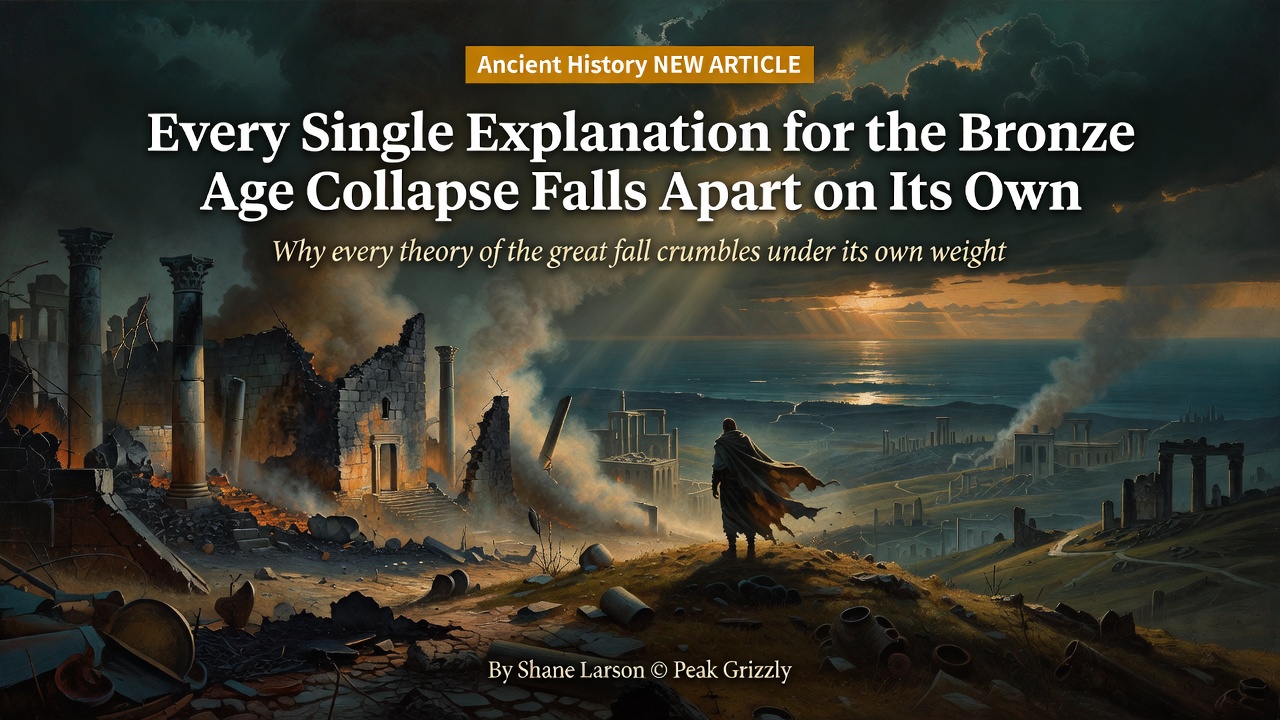
Every Single Explanation for the Bronze Age Collapse Falls Apart on Its Own
August 5, 2026 · 5 min read
Somewhere around 1200 BC, most of the major civilizations of the eastern Mediterranean stopped existing within roughly a two-generation window.
The Hittite empire vanished. The Mycenaean palaces burned and were not rebuilt. Ugarit was destroyed and never reoccupied. Egypt survived but shrank drastically and never regained its former reach. Cities across Anatolia, the Levant, Cyprus, and Greece were destroyed, abandoned, or reduced to villages. Literacy disappeared in some regions entirely. International trade in the region collapsed.
For a century, historians have been proposing the cause. The problem is that every candidate, examined properly, fails.
The Candidates, and Why Each One Breaks
Earthquakes. There is real evidence for seismic activity in the period, and some destruction layers show signs consistent with it. But earthquakes are local and recurrent. This region had been having earthquakes for millennia without civilizations ending, and no plausible seismic sequence covers the whole geography. Earthquakes destroy buildings; they do not explain why nobody rebuilt.
Drought. The strongest single candidate, and the evidence has improved substantially — pollen cores from the Levant and elsewhere indicate a serious, extended dry period. But these societies had survived droughts before. Egypt in particular had thousands of years of practice managing bad years. Drought explains stress convincingly. It does not by itself explain simultaneous, permanent, region-wide political extinction.
The Sea Peoples. The Egyptian inscriptions describe coalitions of foreign peoples attacking by land and sea, and it is tempting to make them the answer. But the more you examine it, the more they look like a symptom. Something displaced them. Groups of people do not spontaneously abandon their homelands and migrate en masse into a war zone unless conditions where they came from have already failed. Naming them as the cause pushes the question back one step and leaves it unanswered.
Iron. The old theory held that iron weapons made bronze armies obsolete and shifted power to peoples who had them. The chronology does not cooperate: iron becomes widespread after the collapse, not before, and the earliest iron was not superior to good bronze. Iron is a consequence of the tin trade failing, not a cause of the failure.
Internal revolt. Plausible — these were extractive palace economies and the archaeology shows the palaces burning, not the villages. But revolt requires an explanation for why it happened everywhere at once, in societies with different structures, and why no successor elite reassembled the system.
Trade network failure. The most structurally satisfying answer, and still incomplete. It explains why the effects propagated and why recovery was impossible. It does not explain what broke first.
Notice the pattern. Each theory explains part of the evidence and collapses when asked to explain the whole. That has been the state of the field for decades.
The Answer Is That the Question Is Wrong
The reason no single cause works is that the search for a single cause is misconceived, and the shape of the failure tells you what actually happened.
Ancient Apocalypse
The Late Bronze Age was not a set of separate kingdoms. It was an integrated system — arguably the first genuinely international one. Diplomatic correspondence between great kings, treaties, dynastic marriages, standardised gift exchange, and above all a trade network that every participant depended on and none controlled.
Bronze itself is the clearest illustration. It requires tin, tin came from thousands of miles away through chains of intermediaries, and the entire military and economic basis of every kingdom in the region depended on that flow continuing. Egypt needed Cypriot copper. Everyone needed timber, grain, and luxury goods moving on schedule.
A system that interdependent has a property the participants could not see: it converts local failures into general ones. A drought in one region reduces the surplus that fed a trading partner. A destroyed port removes a link that three kingdoms used. A migration triggered by a failed harvest becomes a military problem for someone two hundred miles away, who diverts resources from something else.
Under those conditions you do not need a large cause. You need several ordinary ones arriving close enough together that the system cannot absorb them, at a point when it has no slack left.
That is what the evidence supports: a cascade. Drought, seismic activity, disrupted trade, internal unrest, and population movement, feeding each other over decades, in a system that had grown too interlocked to fail locally.
Why We Keep Looking for a Villain
The instinct to find one cause is not stupidity. It is how narrative works, and it is reinforced by how sources survive.
The Egyptian inscriptions name enemies, because that is what royal inscriptions do — they describe a pharaoh defeating identifiable foes. There is no genre of ancient text that says "our trade network degraded over forty years and our institutional capacity eroded." Nobody carves that into a temple wall, and yet it is probably closer to what happened.
So the sources hand us villains, and the villains get promoted to causes, and the slow structural story stays invisible because it never had anyone to write it down.
What Makes It Genuinely Unsettling
The Bronze Age powers were not fragile in any way visible to themselves. They were at their peak — the largest palaces, the widest trade, the most elaborate diplomacy, the greatest wealth these societies ever achieved. The collapse follows the high point immediately.
That is the actual lesson, and it is not the comfortable one about hubris. Interconnection produces prosperity and produces exposure, and the same measurements register as both. A network dense enough to make everyone rich is dense enough to transmit everyone's failures.
Nobody in 1250 BC would have identified their world as vulnerable. They would have pointed at the shipping and the correspondence and the treaties as evidence of how far they had come.
Ancient Apocalypse: The Fall of the Bronze Age works through all of it — the pre-collapse system, the timeline of decline, the contemporary accounts, every proposed contributing factor, and what the archaeology actually supports.
Ancient Apocalypse
New posts and releases, straight to your inbox. No spam, unsubscribe anytime.