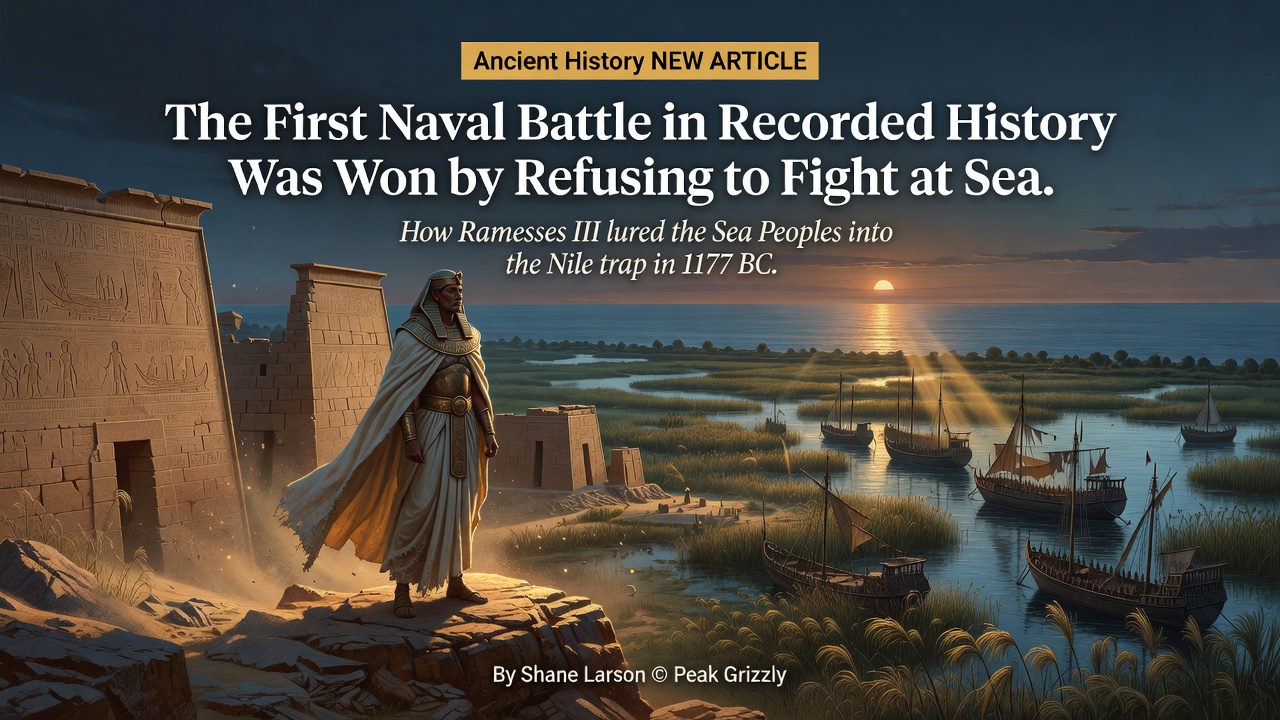
The First Naval Battle in Recorded History Was Won by Refusing to Fight at Sea
August 5, 2026 · 6 min read
Title: "The First Naval Battle in Recorded History Was Won by Refusing to Fight at Sea"
On the walls of the mortuary temple at Medinet Habu, near modern Luxor, there is a carving of a sea battle. It is the earliest depiction of one that survives anywhere, and it records an engagement fought at the mouths of the Nile in roughly 1177 BC.
By the time it was fought, most of the eastern Mediterranean had already ended. Trade routes that once carried tin from Anatolia, copper from Cyprus, and grain from Egypt had broken down. Palace archives from Hattusa to Ugarit had gone silent. The relief at Medinet Habu is therefore not simply a record of one fight; it is a snapshot of the moment when the last intact power tried to hold the line.
What the Inscription Admits
The Year 8 inscription of Ramesses III is propaganda in the ordinary sense — commissioned by a pharaoh, carved on his temple, designed to establish his divine competence. That is the genre and nobody should read it as a dispatch.
But it contains an admission that no propagandist would invent.
It names the lands that had already fallen: the Hittite empire, Cilicia, Carchemish, Arzawa in western Anatolia, Cyprus. A pharaoh, in a monument to his own glory, is stating plainly that the great powers of his world have been destroyed and that he is the last one standing. The text lists these places in sequence, as though the destruction had moved like a wave along the established trade and military corridors. That ordering is itself evidence; it matches the archaeological pattern of burned palace sites stretching from the Aegean coast eastward.
That is not boasting. Boasting inflates the enemy, and this inflates the catastrophe — which is a different thing, and considerably more alarming.
The text goes on to describe the invaders establishing a base in Amurru, in the northern Levant, and using it to stage an advance on Egypt. Whatever else the sources are unreliable about, that detail describes planning rather than opportunistic raiding. The establishment of a forward base implies supply lines, leadership capable of holding disparate groups together, and an understanding that Egypt’s delta was the next logical target once the northern kingdoms were gone.
The Problem Ramesses Faced
Egypt's military was formidable on land — chariots, massed infantry, professional command. At sea it was competent but unremarkable, because Egypt had never needed a great navy. Its wars were fought up the Nile and across the Sinai. Riverine vessels were built for troop transport and towing, not for sustained combat against purpose-built warships from the Aegean or the Levant.
Meeting a large seaborne force in open water would have meant fighting an enemy in its own element with a fleet built for other purposes. It was the obvious thing to do and it would probably have lost. The Egyptians had watched the same coalition destroy the Hittite and Cypriot fleets; there was no reason to believe their own ships would fare better in deep water.
So the Egyptians did not do it.
Fighting a Sea Battle on Land
The plan visible in the reliefs is elegant and slightly ruthless.
Rather than intercepting the fleet at sea, the Egyptians allowed it into the mouths of the Nile — narrow, shallow, constrained water where a sailing vessel cannot manoeuvre freely and where the current and the banks do half the work of an enemy. The delta channels shift with the seasons and are littered with sandbars; a fleet that entered them lost the ability to form a battle line or to escape quickly if the wind dropped.
Then they lined the banks with archers.

The Sea Peoples
This is the decisive element. In the carvings, the Egyptian archers are on shore, shooting down into the crowded ships from firm ground, in numbers, without the pitching deck that ruins accuracy at sea. The invading vessels are shown as sailing ships, dependent on wind, in a channel where wind is unreliable and there is nowhere to turn. The reliefs depict vessels packed so closely that oars from one ship foul another, and men are shown falling between hulls. Egyptian ships closed in with grapnels to hold the enemy in place and complete the work. The reliefs show capsized hulls and men in the water, which is the specific detail that tells you the engagement was decided by immobilisation rather than by seamanship.
The whole design amounts to selecting the ground so carefully that the naval battle becomes a land battle in which one side happens to be standing on boats. The tactic exploited the invaders’ dependence on open water and wind while denying them both. That principle — do not fight the enemy's fight — is one of the oldest ideas in warfare, and this is the first time we can watch someone execute it on water.
Egypt Won and It Did Not Matter Much
The invasion was stopped. Egypt was not conquered, and Ramesses III got a temple wall out of it.
Then the New Kingdom ended anyway.
Within a century Egypt had lost its Levantine possessions, its central authority had fractured, and it entered a long period of division and foreign rule from which it never re-emerged as a first-rank power. The last great pharaoh of the New Kingdom won the battle that the entire era had been building toward, and the decline continued regardless. Royal tombs were robbed within decades; the office of pharaoh itself became a prize contested by Libyan warlords and later by Nubian kings.
This is the part worth taking from the whole episode. The military threat was real and was defeated. The thing actually killing these societies was not the military threat — it was the collapse of the trade system, the agricultural stress, and the loss of the interdependence that had made all of them wealthy. You cannot win that with archers on a riverbank.
Egypt survived the invasion and did not survive the conditions that produced it.
And Then They Settled
The other half of the aftermath undermines the framing even further.
Groups from the coalition — the Peleset in particular — appear shortly afterward in the southern Levant, in cities, with distinctive pottery, farming and trading. Within a few generations they are simply one of the peoples of the region, with towns and temples and local politics, and they show up in the biblical narrative as the Philistines. Their pottery shows clear Aegean stylistic roots yet was produced locally, indicating they arrived with skills and then adapted them to new resources.
They were not exterminated and they did not sail home. They stopped somewhere and stayed.
Which suggests that what Egypt met at the Nile was not an army seeking conquest but a population seeking somewhere to live, and that the fighting ended when the survivors found a place that was not Egypt. The reliefs record only the moment of refusal at the delta; they do not record the later movement of the same groups a short distance up the coast into what became Philistia.
The first recorded naval battle in history was fought against people who were looking for a home, and the empire that won it was gone within a century.
The Sea Peoples: Raiders of the Bronze Age covers the whole crisis — the world at its peak, the cracks that appeared first, the identification problem, the trail of destruction, the Battle of the Delta, and the long argument about whether the Sea Peoples caused the collapse or were produced by it.
The Sea Peoples
New posts and releases, straight to your inbox. No spam, unsubscribe anytime.