The General Strike That Built the Roman Republic
August 10, 2026 · 7 min read
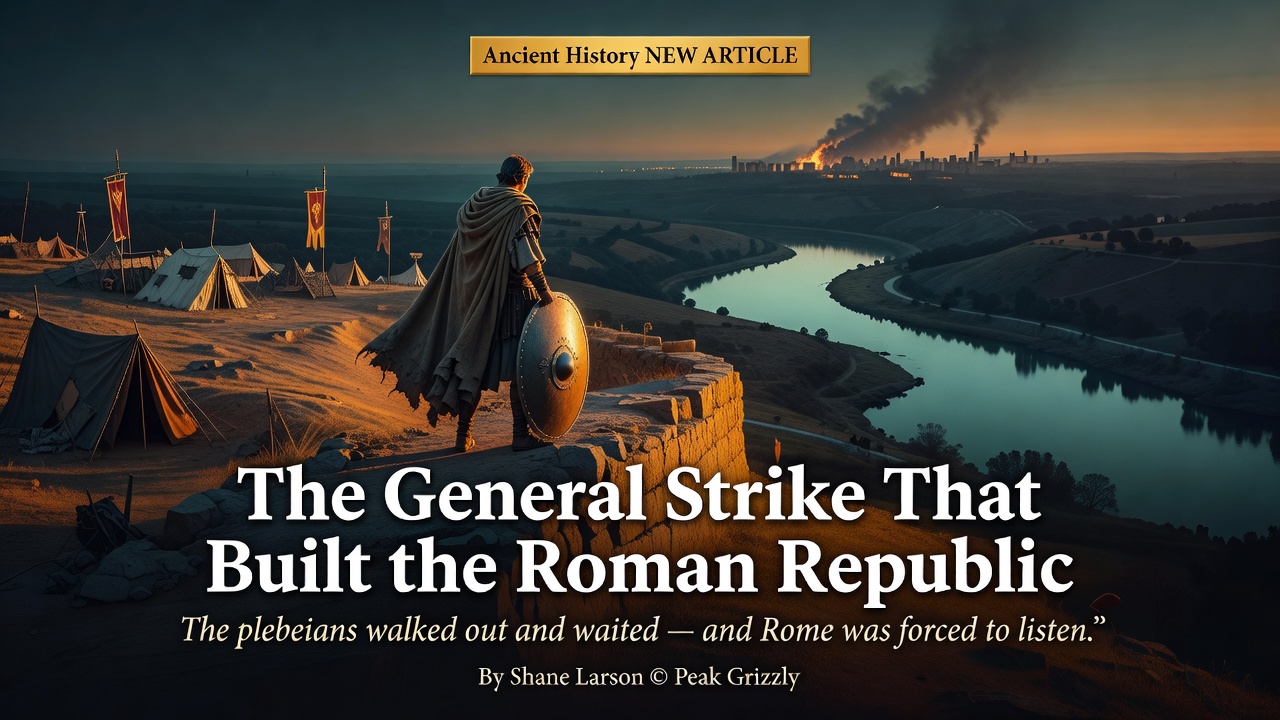
In 494 BC the Roman army was ordered out of the city to fight a war, and it went — through the gate, into column, up the road. Then it kept going. It crossed the river Anio about three miles out, climbed a hill, dug a ditch, raised a rampart, and stopped. The men issued no demands. They harmed no one. They took nothing from the countryside beyond the food they needed. They sat on their fortified hill in sight of the smoke of Rome and waited to be missed.
It is one of the strangest events in ancient history, and one of the most successful. The plebeians of Rome — the whole labouring order of a society permanently at war — had invented the general strike roughly 2,300 years before anyone coined the term. Understanding why they did it, and why it worked, tells you more about how the Roman Republic actually functioned than any battle you learned in school.
The problem: citizens in chains
The grievance behind the walkout was not taxes or the vote. It was debt — a specific, mechanical, legal institution the Romans called nexum, "the binding."
Early Rome ran on smallholders working a few acres of Latin hill country, and those same men were the army: you qualified for the legions by owning a farm. But a farm of a few acres has no reserves, and Rome's campaigning season and growing season were the same months. A citizen could be marched off to war exactly when his fields needed him, come home to a burned farm — the hill tribes raided Latium nearly every year — and then find the war tax due on top of the losses. So he borrowed. And when the land, the oxen, and the tools were gone, Roman law offered one final form of collateral: himself. A man could pledge his own body against a loan, at a formal ceremony with scales and witnesses, and on default his creditor could seize him.
The result, by the 490s BC, was a city in which Roman citizens — veterans of Rome's wars — were held in chains in the private cellars of other Roman citizens, worked as bond-slaves in their fields, and in the worst cases sold abroad. All of it legal. Livy opens his account of the crisis with an image he never needed to explain: an old centurion stumbling into the Forum in rags, pulling open his shirt to show his battle scars, then turning around to show the whip marks on his back. The front of his body was the state's ledger. The back was his creditor's.
There was nowhere to appeal, and the nowhere was structural. The consuls who judged debt cases came from the same narrow aristocracy that did the lending. The law was unwritten, held in the memory of patrician priests. The Senate was the creditor interest. A plebeian in default faced one class of men wearing four faces in rotation: his general in summer, his magistrate in autumn, his judge at trial, and his creditor throughout.
The options they refused
Put yourself in the army camp of 494, because the men there worked through the options out loud. Livy reports that the soldiers discussed killing the consuls — the commanders dead, the reasoning ran, the military oath sworn to them would die too. They could have done it in an afternoon. The consuls had a dozen attendants; the army had the army.
They decided against it, and every other violent script was just as bad. Riot, and the aristocracy's retainers put you down in the streets. Seize the city, and you must then hold it against everyone, including every foreign enemy who smells blood. Violence anywhere ended with the plebeians fighting Rome — and the plebeians did not want to fight Rome. They considered themselves, with some justice, to be Rome. What they wanted was to stop being farmed by it.
So they found the one manoeuvre that pressed their full weight without striking a blow: they subtracted themselves.
Why absence worked
The arithmetic of labour. Rome was a city of farmers and soldiers, and the plebeians were both. Remove them and the fields go unworked, the workshops go quiet, and — decisively — the legions cease to exist. The patricians could field their households and clients; they could not field an army.
The Early Republic
The geography of authority. Roman power had edges, and the plebs stepped across one. Inside the city boundary, a citizen stood under the magistrates' authority; under the standards on campaign, under military discipline. The men on the hill were in neither place. They were not in revolt — they had simply, collectively, stepped out of the room where the state's writ ran. There was no name for what they were, and that was their protection. A state confronted with disobedience knows what to do. A state confronted with absence has to think.
The clock. Rome's enemies did not pause for Rome's domestic difficulties. Every day the standoff lasted, the fields stood empty toward harvest, the hill tribes armed, and the city ate its stores behind walls held by old men and gentlemen. The strikers never had to threaten Rome. The enemy was the threat; the plebs had merely arranged to stop standing between Rome and it — and then let the Senate contemplate the view.
What they won
The Senate blinked. It sent a negotiator the plebs trusted, and the settlement he carried back created something no lower order in the ancient Mediterranean had ever extracted: officers of their own. The tribunes of the plebs held no army, no insignia, no power of command — nothing but the right to physically stand between a citizen and the state's officers, and a veto whose Latin says everything about it: veto, "I forbid." One syllable of pure negation.
And because a man whose job is obstruction is the easiest man in the world to drag aside, the plebs protected him with the only instrument they had: an oath. Whoever harmed a tribune was declared forfeit to the gods — killable by anyone, without guilt or trial. No court enforced this. No magistrate stood behind it. The tribune's entire security was the credible promise of tens of thousands of people to destroy whoever touched him. It held for three and a half centuries.
Here is the detail worth sitting with: the strike won almost no immediate relief. Debt bondage stayed legal for another 168 years. The public land stayed with the men who occupied it. What the plebs won was leverage — a permanent institutional foothold from which everything else was extracted over the next two centuries: published law, the right of intermarriage, pay for soldiers, and finally the consulship itself. They used the walkout again, and again; the tradition counts as many as five secessions, and the tactic worked every single time. For long stretches the mere possibility did the work.
Compare what the poor did everywhere else in these same generations. Across the Greek world, a crushed lower order raised up a champion, who seized power on the promise of debt relief and ruled as a tyrant until the cycle spun again. The Roman plebs — who had commanders, arms, and every incentive to do the same — built an office instead. Not a man but a renewable, replaceable, plural institution. It was a colder solution and a slower one, and it compounded for two hundred years while the Greek versions burned off in a generation.
The men came down from the hill and went home, and Rome behind them was different — not because of anything anyone had suffered, but because of what everyone now knew. The state had learned it could not chain its farmers and field its army out of the same set of bodies. The plebs had learned they never needed to strike a blow, because they were the thing the blows were struck with.
That standoff, and the two-century argument it opened, is the subject of my book The Early Republic: How Rome Learned to Rule Itself — the story of how a state improvised in a panic processed a class war through walkouts, vetoes, and published law, and built the machine the rest of Roman history runs on. It is Book Two of the series Rome: From Village to Empire.
The Early Republic
New posts and releases, straight to your inbox. No spam, unsubscribe anytime.