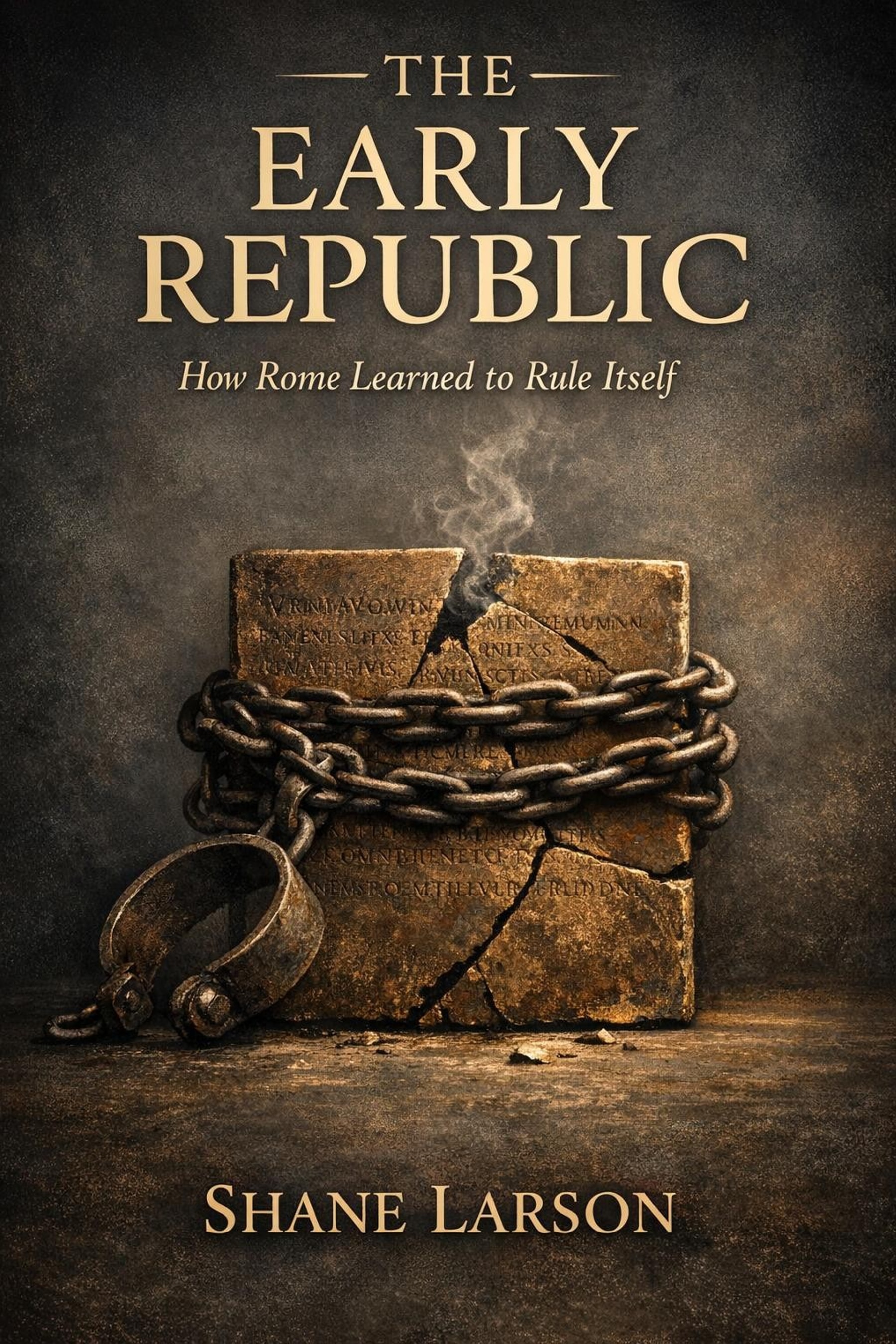
The Early Republic
How Rome Learned to Rule Itself
By Shane Larson · Rome: From Village to Empire (Book 2)
About This Book
In 495 BC an old man stumbled into the Roman Forum in rags, and the crowd went quiet because they recognized him. He had been a centurion; men around him could name his campaigns. He pulled open his shirt and showed the scars on his chest, front-of-the-body scars, the honourable kind. Then he turned around and showed his back, fresh with the marks of the whip.
The front of that man's body was the state's ledger. The back belonged to his creditor. While he was away fighting Rome's wars, his farm had been raided and burned; the war tax fell due anyway; he borrowed; the interest ate his land, then his tools, then his body. All of it legal: under the institution the Romans called nexum, a citizen could pledge his own flesh as security for a loan — and Roman veterans were being held in chains in the cellars of other Roman citizens, with everyone's knowledge, because the law said they could be.
A year later, the men like him did something no lower class in the ancient world had ever done. They did not riot or kill anyone — Livy says the army openly discussed murdering the consuls and decided against it. Instead they left: through the gates, across the river Anio, onto a hill, where they dug a ditch, raised a rampart, and simply stopped. A society at permanent war had a vulnerability its rulers had never examined — its poor were its army — and its poor examined it first.
The Argument
Nobody drafted the Roman constitution. The aristocrats who expelled the last king in 509 BC had no theory, no precedent, and no plan beyond reversing everything the monarchy had been — every royal power split between two holders, shortened to twelve months, and set against itself, so that either magistrate could cancel the other's every act. What that arrangement conspicuously ignored was the crisis grinding the citizens beneath it: the men who wrote the new rules were the creditor class, and the rules said nothing about debt.
That crisis, not the famous battles, drove the next two centuries. Every durable institution in this book was extracted under duress by people who needed it from people who had refused it: the tribunes conceded to an army that walked away, the Twelve Tables published to end a decade of agitation, intermarriage legalized, soldiers put on the payroll, the consulship itself pried open at last. Nothing was given. Everything was taken — slowly, through procedure, without civil war.
And that is the book's real subject. Early Rome fought its longest internal war — poor against rich, debtor against creditor, in a heavily armed society — with strikes, statutes, and negotiated settlements instead of weapons, and finished those two centuries with more citizens inside the state than it began with. When the same argument over land and debt returned four centuries later, the Republic answered with clubs and proscription lists. The capacity this book watches Rome learn is the one whose loss killed it.
Why I Wrote This
What hooked me was a coincidence I couldn't let go of: the famous stories everyone half-knows — Horatius at the bridge, Cincinnatus at the plough, the geese saving the Capitol, "woe to the conquered" — all sit inside one century, and almost nobody reads them as one story. Put them in sequence and something surfaces underneath: a debt crisis. Citizens chained in other citizens' cellars, legally, for two hundred years — and every constitutional landmark of the period traces straight back to it. The heroic anecdotes are the furniture; the debt is the house. Once I saw that, the early Republic became the most interesting political story Rome ever produced: an argument between people who hated each other, conducted almost entirely without killing, that accidentally built the machine the rest of Roman history runs on.
Frequently Asked Questions
Did Horatius really hold the bridge against the Etruscan army?
Almost certainly not as told, and possibly not at all. The episode is one of three flawless heroic tableaux in a single short war, each attached to a family that benefited from the telling — and they stand exactly where the tradition needed to bury the possibility that Porsenna actually captured Rome.
Do I need to read The Founding of Rome first?
No. This book stands alone — the introduction recaps the fall of the monarchy in a paragraph, and nothing later assumes you know Book One. If you have read it, you'll recognize its central idea — Rome absorbs rather than destroys — here turned inward on Rome's own excluded class.
What was the Conflict of the Orders?
The two-century struggle between Rome's hereditary aristocracy, the patricians, and everyone else, the plebeians — over debt, land, law, marriage, and finally office-holding. Usually told as dry constitutional sequence, it was a class conflict in a heavily armed society that, astonishingly, produced almost no corpses.
Do the Twelve Tables still matter?
Yes — they are the root of the Western legal tradition, the first Roman assertion that law should be published where anyone can read and argue from it. The bronze is lost; the text survives in quotations by later authors. Appendix A reconstructs what they said, subject by subject.
How much of this actually happened?
The institutions are solid: the consular lists, the tribunate, the Twelve Tables, the fall of Veii, and the Gallic sack are as well attested as anything in the fifth century BC. The anecdotes are another matter — the speeches are compositions, the battle numbers rhetoric, and for some episodes the honest answer is that we don't know and never will. The book flags which kind of claim is in hand, every time.
If You Liked This, You Might Like
- The Etruscans — Veii, the city Rome besieges and destroys in this book, was Etruscan; this is the civilization Rome dismantled on its way up.
- Hannibal's War — the paid, wintering, alliance-fed war machine assembled in this book, tested two centuries later against the one enemy who nearly broke it.
- Julius Caesar — the far end of this story: the Republic that once settled a class war with a walkout and a fable, tearing itself apart because it no longer could.
- The Fall of Rome — how the state that learned to survive its own destruction in 390 BC finally, eight centuries on, stopped surviving it.
The chained veteran, the empty hill, the bronze tablets in the Forum: this is how a city with no plan argued itself into becoming a state — and what it knew then that it later forgot. Rome: From Village to Empire, Book Two.
What You'll Learn
- Why a self-paralysing executive cannot fight a war — and how Rome invented the dictatorship, absolute power hard-capped at six months, as the legal emergency exit.
- Horatius at the bridge, Mucius Scaevola in the fire, and Cloelia in the Tiber — told at full strength, then weighed as three perfect propaganda tableaux attached to families who profited from them.
- The mechanics of nexum, step by step: the bronze weighed at the scales, the fifteen-pound fetters, the three market-day auctions, and the sale "across the Tiber" that let Rome export the citizens it would not officially enslave.
- The first secession examined seam by seam — the arithmetic of labour, the geography of authority, the clock — and why organized absence succeeded where every violent option would have failed.
- The tribunate: an office with no army, no insignia, and no power except the word no, protected by nothing but a mass oath to destroy anyone who touched its holder.
- The Twelve Tables provision by provision, including the clause permitting creditors to divide an insolvent debtor's body — and why publication made the law arguable rather than fair.
- Appius Claudius using his own published law to claim a free girl as a slave in his own court, and the second walkout that brought his regime down.
- The budget line of 406 BC — pay for soldiers — that quietly converted a seasonal militia into an instrument of conquest, dated to the exact year the ten-year siege of Veii began.
- The Gallic catastrophe entire: the rout at the Allia, senators motionless as statues, the geese of Juno, the rigged scales, vae victis — and the serious debate about abandoning Rome for Veii's empty houses.
Included with Kindle Unlimited — read it free if you're a member.
New Ancient History releases and free chapters — no spam, unsubscribe anytime.
More in Rome: From Village to Empire
View series →
More in This Genre
View all →