Who Tried to Delete Egypt's Most Powerful Female Pharaoh from History?
August 5, 2026 · 7 min read
Sometime around 1458 BCE, one of the most powerful rulers in the ancient world died.
She had reigned as pharaoh of Egypt for more than two decades. Under her rule, Egypt was stable, prosperous, and ambitious. She had commissioned extraordinary building projects, launched a legendary trading expedition, and maintained peace across a kingdom that stretched from the Nile Delta to the borders of Nubia. Trade routes flourished, temple treasuries grew, and construction crews worked steadily on monuments that would outlast the dynasty itself. Her name was Hatshepsut. And within a generation of her death, someone tried to make sure nobody would ever remember her.
The Campaign of Destruction
It didn't happen right away. That's one of the most puzzling aspects of the whole story.
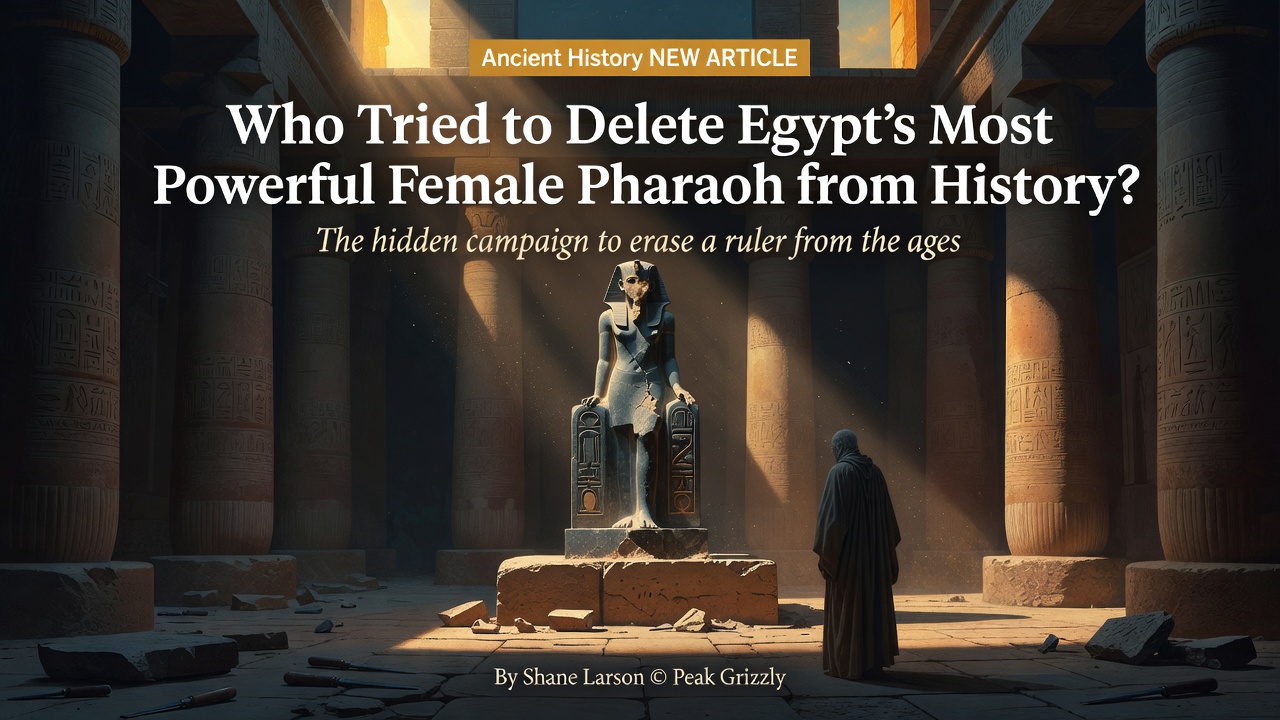
Hatshepsut's stepson and successor, Thutmose III, ruled for roughly twenty years after her death before the destruction began. During those years he led repeated military campaigns into the Levant and Nubia, expanding Egyptian influence while her monuments remained untouched. When the erasure finally started, it was methodical. Workers were dispatched to temples and monuments across Egypt. They chiseled Hatshepsut's name off inscriptions, sometimes replacing it with that of Thutmose I or II. They smashed her statues, toppling colossal figures and dragging the pieces away. They hacked her image out of carved reliefs on temple walls, leaving awkward empty spaces where her figure had once stood beside the gods.
At her great mortuary temple at Deir el-Bahri — one of the most architecturally stunning buildings in the ancient world — her statues were torn down and buried in pits. Some were smashed so thoroughly that archaeologists spent decades reassembling the fragments. At Karnak, her obelisks were partly walled over so the inscriptions could no longer be read from the ground. The work was thorough but not total; in a few hidden corners, workers missed a cartouche or two.
The question isn't whether it happened. The physical evidence is overwhelming. The question is why.
The Old Theory vs. The New One
For a long time, the standard explanation was straightforward: Thutmose III hated Hatshepsut. She had usurped his throne. He had spent years waiting in her shadow. Once he had the chance, he took revenge.
It's a satisfying narrative. It's also probably wrong.
The twenty-year gap is the problem. If Thutmose III was consumed by hatred for his stepmother, why wait two decades? He became sole pharaoh immediately after her death. He had the power to begin the erasure campaign on day one. He didn't. Instead he allowed her name to remain on monuments while he consolidated his own military reputation and prepared the succession for his son.
Modern Egyptologists have proposed a more nuanced explanation. The destruction campaign may not have been about personal revenge at all. It may have been about succession. Thutmose III was aging. He was preparing his own son, Amenhotep II, to take the throne. The problem was the precedent that Hatshepsut had set. She had demonstrated that a woman could rule as pharaoh — not as a regent, not as a placeholder, but as the full divine king. In a culture where the stability of the kingdom depended on an orderly royal succession, that precedent was dangerous. A young prince might look at Hatshepsut's example and wonder whether another capable woman in the royal family could claim the same authority. The erasure wasn't about anger. It was about politics.
How a Woman Became Pharaoh
To understand why Hatshepsut's reign was so extraordinary, you need to understand the world she operated in.
Ancient Egypt was not as rigidly patriarchal as many ancient civilizations, but the role of pharaoh was fundamentally male. The pharaoh was the living embodiment of Horus, a male god. The pharaoh performed religious rituals that were coded as masculine. The entire theological framework assumed a male ruler. Women could serve as regents or even hold significant administrative power, but the double crown and the title of king carried expectations that no woman had openly defied for centuries.
Hatshepsut navigated this by essentially becoming male — in official representation, at least. Early in her reign, she was depicted as a woman wearing the pharaonic regalia. But over time, her official portraits shifted. She was shown with broad shoulders, a flat chest, and the ceremonial false beard. Her inscriptions used male pronouns. This wasn't confusion about gender. Everyone at court knew Hatshepsut was a woman. It was political strategy. She was adapting herself to the existing framework of power rather than trying to change it.
Hatshepsut
She also built a sophisticated legitimacy campaign. She commissioned inscriptions describing a divine birth — the god Amun himself visiting her mother in the form of her father, Thutmose I, to conceive Hatshepsut. She was not just a pharaoh. She was a pharaoh chosen by the gods before she was born. The claim was carved in stone at Deir el-Bahri and repeated in other temples, anchoring her right to rule in divine will rather than human precedent.
Deir el-Bahri and the Expedition to Punt
Two achievements define Hatshepsut's reign more than any others.
The first is her mortuary temple at Deir el-Bahri, on the west bank of the Nile near modern Luxor. It's a stunning piece of architecture — three terraced levels cut into the base of towering limestone cliffs, connected by long ramps and lined with colonnades. Even today, after three and a half millennia, it's one of the most impressive structures in Egypt. The temple was designed by Senenmut, Hatshepsut's most trusted official. Senenmut is one of the most intriguing figures of the period. He was a commoner who rose to extraordinary power, holding dozens of titles and serving as tutor to Hatshepsut's daughter. Graffiti found in unfinished tombs has led some scholars to speculate about the nature of his relationship with the pharaoh. The truth is that we don't know — and probably never will.
The second defining achievement was the expedition to Punt. Hatshepsut sent five ships south along the Red Sea coast to a land the Egyptians called Punt — a place so distant and exotic that it had taken on almost mythological status. The expedition returned with incense, gold, ebony, exotic animals, and live myrrh trees, which were planted at Deir el-Bahri. Hatshepsut was so proud of this expedition that she had the entire journey carved in detailed relief on her temple walls. These carvings are among the most famous in Egyptian art, depicting everything from the ships to the landscape of Punt to the notably stout queen of that foreign land.
The Rediscovery
The erasure campaign was effective. For three thousand years, Hatshepsut was essentially invisible. The few references that survived were misunderstood or ignored.
The recovery began in the 19th century, as European archaeologists started systematically studying the temples and tombs of the Theban necropolis. At Deir el-Bahri, they found the evidence of destruction — the defaced inscriptions, the smashed statues, the cartouches with names chiseled away. Slowly, they began to piece together that someone had been deliberately removed from the record. The full picture took decades to assemble. Fragments of statues were recovered from pits. Inscriptions that the ancient workers had missed were discovered in obscure corners of temples. The name Hatshepsut emerged from the gaps.
In 2007, a team led by Egyptian archaeologist Zahi Hawass identified Hatshepsut's mummy through a remarkable piece of forensic detective work. A CT scan of an unidentified female mummy matched a single molar tooth found in a canopic box inscribed with Hatshepsut's name. After three thousand years of erasure, she had a face again.
Why It Matters
Hatshepsut's story is compelling on its own terms — a woman who navigated impossible political constraints to seize the most powerful position in the ancient world and held it for two decades. That would be enough.
But the erasure adds another dimension. It's a case study in how power controls memory. The people who destroyed Hatshepsut's monuments weren't acting out of rage. They were acting out of cold political calculation. They understood that controlling the past is a way of controlling the future.
They also failed, eventually. The monuments they tried to destroy survived in fragments. The inscriptions they missed told the story they tried to silence. Modern technology — CT scans, DNA analysis, digital reconstruction — filled in the gaps that three thousand years of deliberate forgetting had created.
Hatshepsut ruled Egypt. She built temples that still stand. She sent ships to the edge of the known world. Someone tried to make you forget all of that, and they almost succeeded.
Almost.
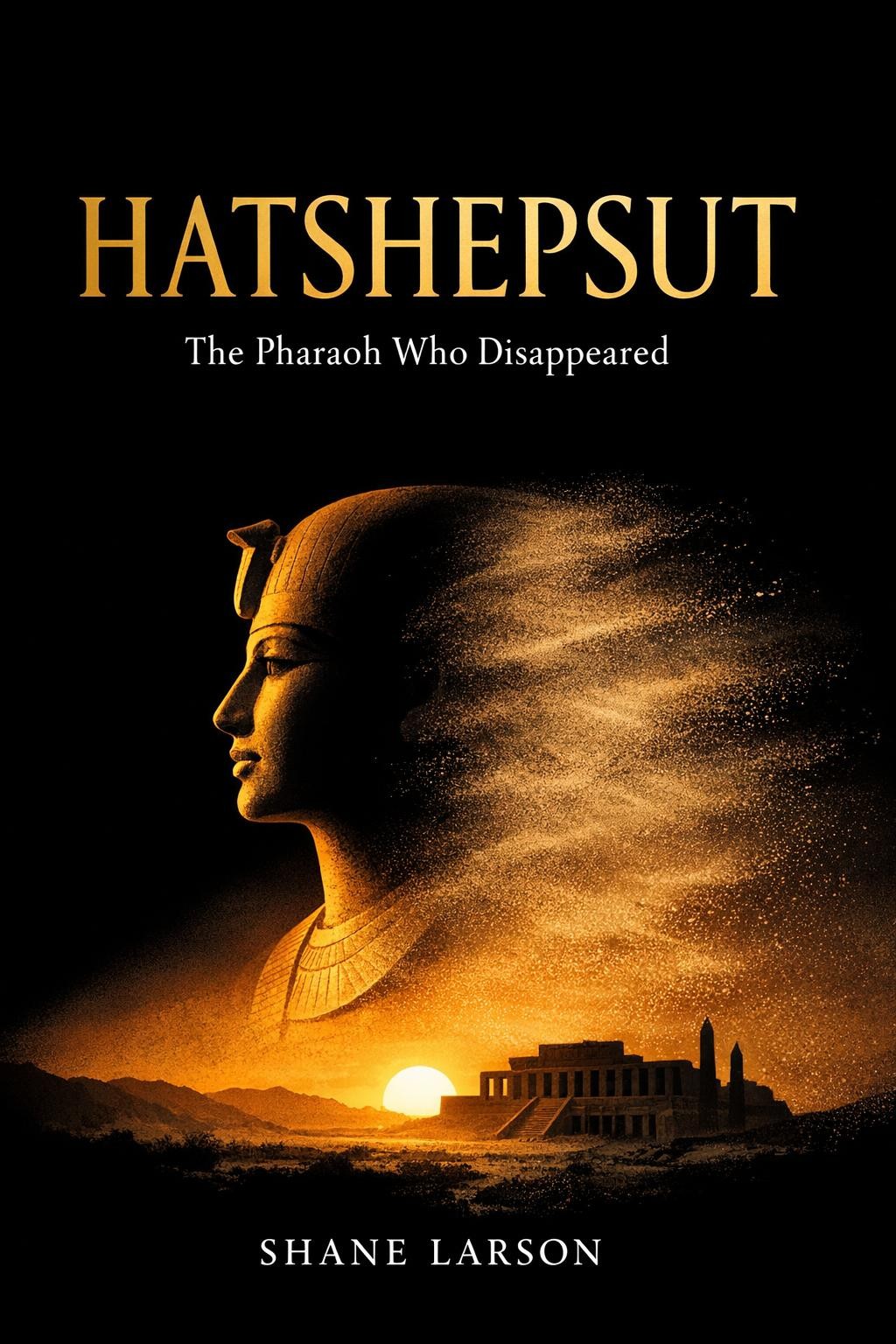
Hatshepsut: The Pharaoh Who Disappeared tells the full story — her rise to power in Egypt's 18th Dynasty, the twenty-year silence before the chisels came out, and the modern detective work that brought her back.
Hatshepsut
New posts and releases, straight to your inbox. No spam, unsubscribe anytime.