The Hyksos Never Existed: How a Translation Error Invented Egypt's Barbarian Invaders
September 24, 2026 · 7 min read
Open almost any survey of ancient Egypt and you will find the same sentence, in some form: around 1650 BC, a people called the Hyksos invaded Egypt and ruled the north for a century. It is one of the fixed landmarks of Egyptian history — the humiliation between the Middle Kingdom and the New Kingdom, the foreign occupation that Egypt's warrior pharaohs avenged.
Nearly every word of that sentence is wrong. There was no people called the Hyksos. There was, on the current evidence, no invasion. And the error that produced both mistakes can be traced to a specific act of translation — one Egyptian priest, writing in Greek, getting one word wrong about thirteen centuries after the fact.
A Title, Not a People
Around 1890 BC, an Egyptian provincial governor named Khnumhotep II had a scene painted in his tomb at Beni Hasan: a caravan of thirty-seven traders from the east, in striped wool, with donkeys, weapons, and a lyre, arriving to sell galena — the ore Egyptians ground into black eye paint. Above the bearded leader of the group, the painters wrote his name, Abisha, and his rank: heka khasut, "ruler of foreign lands."
That phrase is the original of "Hyksos," and the tomb painting shows what it actually meant. It was a title — an old one, used by Egyptian scribes since the Old Kingdom for any ruler beyond the Nile valley. A prince of Byblos was a heka khasut. So was a chief in the Sinai hills. So was Abisha, a caravan leader with goods to sell, painted onto a tomb wall two and a half centuries before any foreigner sat on an Egyptian throne. The phrase named an office the way "chieftain" names an office. Nobody in the Bronze Age would have read it as the name of an ethnic group, because it was not one.
The corruption happened in stages. In the third century BC, the Egyptian priest Manetho wrote a history of Egypt in Greek. When he reached the foreign kings who had once ruled the Delta, he carried their title into Greek as Hyksos — and glossed it, wrongly, as "shepherd-kings," deriving the second syllable from an Egyptian word for shepherd instead of from khasut, "foreign lands." Manetho's history is lost; the passage survives only in quotation by later writers. From there the word passed into European scholarship, and somewhere along the road it changed grammatical categories entirely. A title held by six or so individual kings became the name of a nation. "The Hyksos" entered the textbooks as a people — a race, a horde — that no one in the second millennium BC had ever heard of.
The Invasion That Came With the Name
The name arrived packaged with a story. In the account transmitted from Manetho, invaders of obscure origin swept into Egypt from the east in the days of a weak king, burned the cities, razed the temples, massacred and enslaved the population, and installed their own king at a Delta capital called Avaris — until the princes of Thebes rose, fought a war of liberation, and drove the shepherds out.
It was not foolish to believe this. When hieroglyphs were deciphered in the nineteenth century, Egyptian sources seemed to confirm the outline: the war proclamations of Kamose, the Theban king who fought the foreign dynasty, rage against an Asiatic ruler squatting in the north; Queen Hatshepsut, decades after the expulsion, boasted of repairing ruins left from when "the Asiatics" ruled in the Delta. And to nineteenth-century scholarship, migration and conquest were the default explanations for any abrupt cultural change. The horse and the war chariot appear in Egypt in precisely this period — surely conquerors brought them. For the better part of two centuries, serious scholars held some version of the invasion model.
But notice what all those sources have in common. Every surviving narrative of Hyksos rule was written by the dynasty's enemies, or its enemies' heirs, or writers working from their traditions centuries later. The Kamose texts are wartime propaganda, carved by the kingdom that destroyed Avaris while it was destroying it. Not one account was written by the foreign kings, or for them, or during their rule. The winners wrote the history — and then the history got translated by a man who did not understand the losers' title.
What the Ground Actually Says
Since 1966, Austrian archaeologists have been excavating Tell el-Dab'a, a mound in the eastern Nile Delta identified as Avaris itself. If the invasion story were true, the site should show a conquest horizon: destruction, ash, a foreign military caste stamped suddenly onto an Egyptian town.
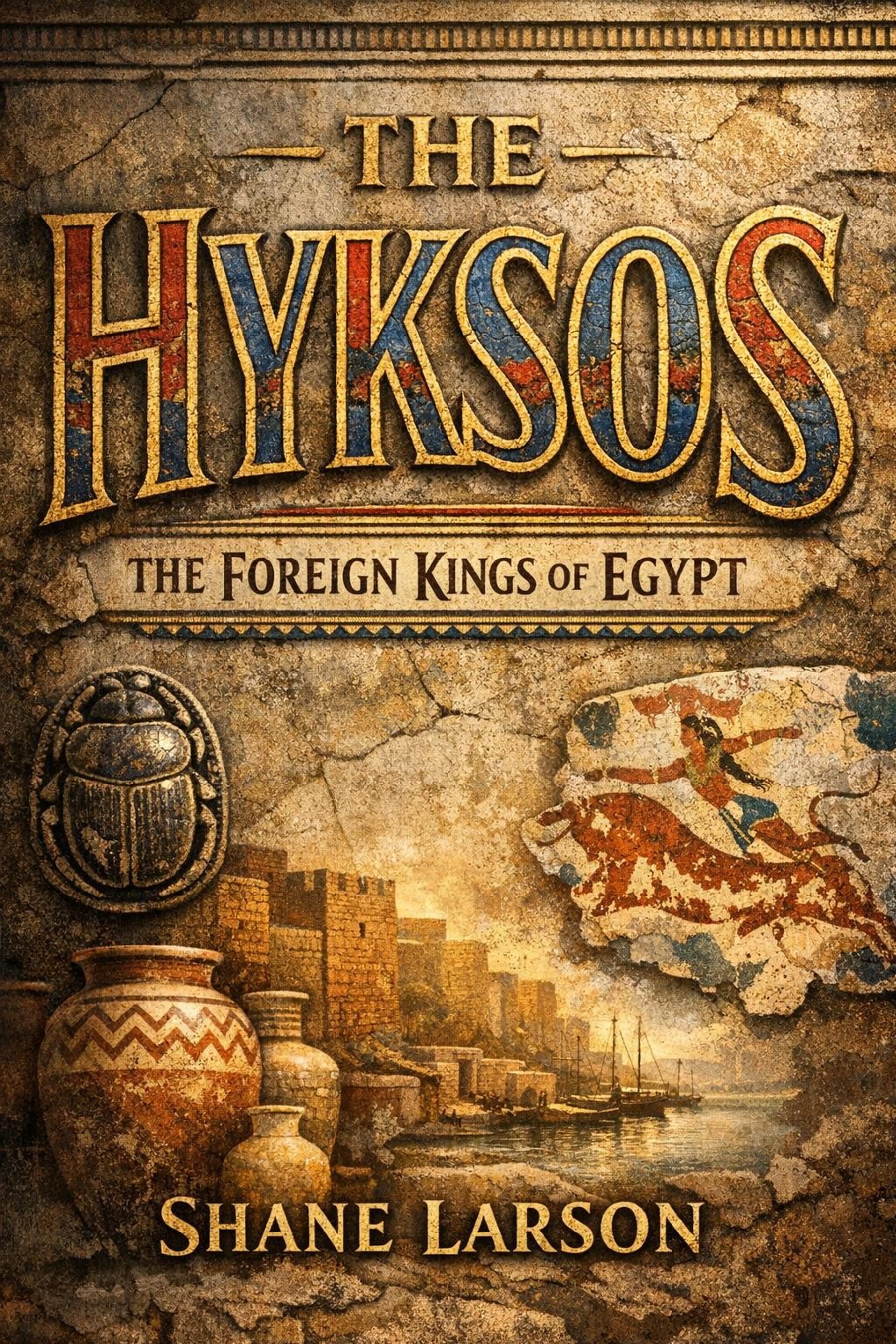
It shows nothing of the kind. What the excavation found instead is a city where people from the Levant had been settling for generations before any foreign king existed — neighborhoods growing house by house, graves accumulating in the Levantine style, imported pottery from Canaan, Cyprus, and the Aegean filling the harbor district. There are Canaanite temples built on Egyptian soil, warriors buried with donkeys at their tomb entrances, and, most famously, fragments of Minoan-style bull-leaping frescoes — the art of the palaces of Crete — on the walls of a palace in the Nile Delta. There is no destruction layer where the invasion should be. The temples that were supposedly burned show no burning.
Then the chemistry arrived. In 2020, a research team analyzed strontium isotopes in the tooth enamel of seventy-five people buried at Avaris across the city's whole lifespan. Tooth enamel locks in a chemical signature of the geology where a person spent childhood, so it can distinguish someone raised on the Nile floodplain from someone raised abroad. An invasion around 1650 BC should produce a spike of foreign-born adults right at the takeover.
The data ran exactly backwards. The generations buried before the foreign dynasty took power were mostly foreign-born — immigrants in the plain sense. The generations buried during foreign rule were increasingly born and raised in Egypt. The arrivals came first, over a century or more; the kings came later, from among the settlers' descendants. On the evidence of the ground and the teeth, this was not an invasion. It was a takeover from within, by a community that had been living in Egypt for generations — and whose kings then ruled as pharaohs, with cartouches, Egyptian throne names, and Egyptian scribes.
Why One Wrong Word Mattered So Much
Words like "Hyksos" do quiet work. Once a royal title becomes an ethnic label, every question about the period gets asked wrong. "Where did the Hyksos come from?" assumes a bounded people with a homeland, and scholars spent two centuries proposing candidates — Arabs, Phoenicians, Hurrians — for the referent of a translation error. "When did the Hyksos invade?" assumes an invasion, and generations of archaeologists read ambiguous evidence in its light.
And the mistranslation had help, because the story it carried was useful. The New Kingdom — the empire of Thutmose III and the great warrior pharaohs — was founded on the expulsion of the foreign dynasty, and its ideology needed that dynasty to be chaos incarnate rather than what the evidence suggests it was: a competent immigrant ruling house governing Egypt in Egypt's own style. The final irony is material. The Hyksos century is when the horse, the light war chariot, and the composite bow reached Egypt. The empire that spent fifteen centuries denouncing the foreign kings was built with their military toolkit.
The lesson generalizes well beyond Egyptology. The Second Intermediate Period is an extreme case of something historians deal with everywhere: a period known almost entirely through the writings of its winners, corrected only when evidence turned up that nobody thought to falsify — floor levels, pot styles, and the chemistry of teeth.
Going Deeper
This article is drawn from research for my book *The Hyksos: The Foreign Kings of Egypt*, which tells the full story: the unraveling of the Middle Kingdom, the excavation of Avaris, the divided Egypt of Thebes, the Delta, and Nubia, the chariot revolution, the war of expulsion through its surviving sources, and the fifteen-century campaign to write the foreign kings out of history. If the century Egypt tried to erase sounds like a story worth having in full, that is where it lives.
New posts and releases, straight to your inbox. No spam, unsubscribe anytime.