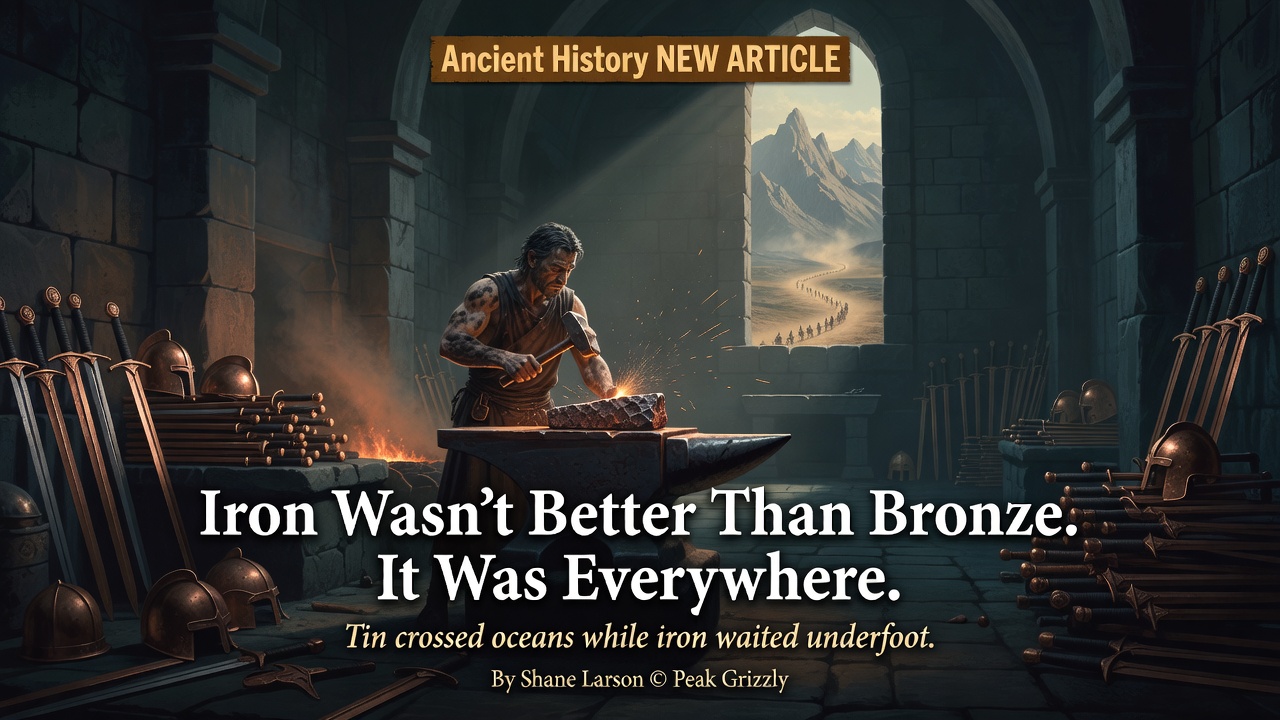
Iron Wasn't Better Than Bronze. It Was Everywhere.
August 5, 2026 · 6 min read
The great Bronze Age powers — Egypt, Mycenae, the Hittites, Assyria, Babylon — projected permanence. Enormous palaces, terrifying armies, trade networks spanning continents. Their scribes recorded victories on stone and clay, their artisans shaped gold into ritual objects, and their engineers moved massive blocks of stone across hundreds of miles. All of it rested on a soft grey metal that almost none of them could produce at home.
The Tin Problem
Bronze is not a metal you find. It is an alloy, roughly nine parts copper to one part tin. Copper on its own is too soft to be useful for serious work — it bends, dulls, and will not hold an edge. Add that tenth of tin and you get something dramatically harder that can be cast into complex shapes, sharpened properly, and polished to a gold sheen. The resulting material held an edge through repeated use and resisted corrosion far better than copper alone.
For nearly two thousand years, from about 3300 to 1200 BC, bronze was the most important material in the world. It made the weapons that took kingdoms and the tools that built monuments. Societies with it dominated societies without it. Armies equipped with bronze spear points and axe heads could shatter formations armed only with stone or wood, while palace workshops used bronze chisels and saws to shape everything from temple doors to royal furniture.
Copper was the manageable half. Deposits are reasonably widespread across the ancient Near East — Cyprus above all, along with Anatolia, the Sinai, and parts of Arabia. Difficult to work, but obtainable. Smelting copper required wood or charcoal for fuel and basic furnaces, but the ore itself could be mined and transported without crossing the entire known world.
Tin was the problem. Tin deposits are rare and unevenly distributed, and essentially none of the major Bronze Age powers had a usable source nearby. The tin reaching the Mediterranean came from enormous distances — Afghanistan, Central Asia, possibly Cornwall — moving through chains of intermediaries across thousands of miles. Archaeologists have traced specific ingots and artifacts showing that tin traveled in stages, changing hands at caravan stops and port cities, each leg adding cost and risk. A single broken link in that chain could idle forges in Egypt or Hattusa for months.
Which means the defining material of the age could only exist as long as an intricate long-distance trade system kept functioning. Every palace, every army, every monument depended on a supply line no single kingdom controlled and no single kingdom could repair. Rulers sent diplomatic letters begging for tin shipments and recorded the arrival of each convoy as a major event.
That is not strength. That is a single point of failure dressed in gold leaf.
What Happened When It Stopped
Around 1200 BC, the Late Bronze Age system came apart, and among everything else that failed, the tin routes failed. Cities burned from the Aegean to the Levant, palace bureaucracies collapsed, and the regular movement of goods across the eastern Mediterranean largely ceased for generations. The consequence is easy to state and was catastrophic to live through: you cannot make bronze without tin, and you cannot make weapons or good tools without bronze. Kingdoms that had defined themselves by their metal found that the metal had a foreign dependency, and the foreign dependency was gone.
This is where iron enters, and the standard telling — that iron was a superior technology that replaced an inferior one — gets it backwards.
Early Iron Was Worse
People had known about iron for centuries before the Iron Age. Meteoric iron was worked as a prestige material long before anyone smelted ore, and it was rare enough to be treated as more precious than gold. Egyptian and Mesopotamian texts list iron objects among royal gifts, often alongside lapis and ivory.
Iron Age Dawn
Smelted iron, when it arrived, was not obviously an upgrade. Iron requires much higher temperatures to work than bronze and cannot simply be poured into a mould the way bronze can. Early iron objects were frequently softer than good bronze, prone to rust in a way bronze is not, and demanded a completely different and more laborious set of techniques — heating, hammering, folding, repeating. A bronzesmith accustomed to casting spearheads in a single pour had to learn an entirely new rhythm of labor that produced one usable tool only after hours of repetitive work.
A skilled bronzesmith handed early iron would have regarded it as a downgrade, and would have been right.
It won anyway, and the reason has nothing to do with quality.
Iron Ore Is Everywhere
That is the entire explanation, and it is geological rather than technological.
Iron is one of the most abundant elements in the earth's crust. Workable ore exists nearly everywhere people live — bog iron, ironstone, ores accessible without deep mining or long-distance trade. Anywhere with fuel and knowledge could produce iron locally, permanently, without asking anyone's permission or crossing anyone's territory. A community needed only surface deposits or shallow pits, plus charcoal from nearby woodland, to begin smelting.
Metal stopped being a monopoly. Bronze required access to a trade network, and trade networks were controlled by palaces. Whoever controlled the tin controlled who was armed. Iron removed that lever entirely — a village could make its own tools, and a village that can make its own tools does not need the palace in the same way. Local smiths could repair or replace a broken hoe without waiting for a royal shipment, which gradually shifted economic power outward from the old centers.
Ordinary farming got better. This mattered more than the weapons. Bronze was too valuable to be spent on agricultural implements for common farmers, so most farming was done with wood and stone. Iron was cheap enough to put a real edge on the tools of ordinary people, which raised yields, allowed heavier soils to be worked, and let people settle land that had not been worth farming. An iron plowshare could turn soil that wood or stone could barely scratch, extending cultivation into clay-rich valleys and previously marginal hillsides.
New powers could emerge. Peoples on the margins of the old Bronze Age world were no longer excluded by geography from the material that mattered. The reorganised eastern Mediterranean of the following centuries — the Phoenician city-states, the emergence of Israel, the recovery of Greece, the terrifying efficiency of the Assyrian military — all took shape in a world where metal was no longer scarce. Groups that had once imported finished bronze goods could now produce their own iron weapons and implements on their own territory.
The Pattern Worth Taking Away
The technology that wins is frequently not the best one. It is the one whose inputs are available.
Bronze was superior for centuries and lost to a material that was initially inferior in nearly every measurable respect, because bronze's supply chain was fragile and iron's was not. When the system that delivered tin failed, the quality advantage became irrelevant — an excellent technology you cannot obtain loses to a mediocre one you can make yourself. The same pattern appears whenever a critical material depends on distant sources that can be interrupted by war, weather, or political change.
Which is worth holding onto when looking at any technology that depends on a small number of rare inputs moving through a long chain of intermediaries. The Bronze Age powers did not think of themselves as fragile. They thought of themselves as rich, and the two conditions turned out to be the same thing viewed from different distances.
Iron Age Dawn: How a New Metal Rebuilt Civilization runs the whole transition — the tin problem, the collapse, learning to smelt, the early adopters and the holdouts, the democratisation of metal, and the new world it produced from Phoenicia to Assyria.
Iron Age Dawn
New posts and releases, straight to your inbox. No spam, unsubscribe anytime.