How Do You Write the Life of a Killer Who Wrote It First? The Problem of John Wesley Hardin
July 3, 2026 · 6 min read
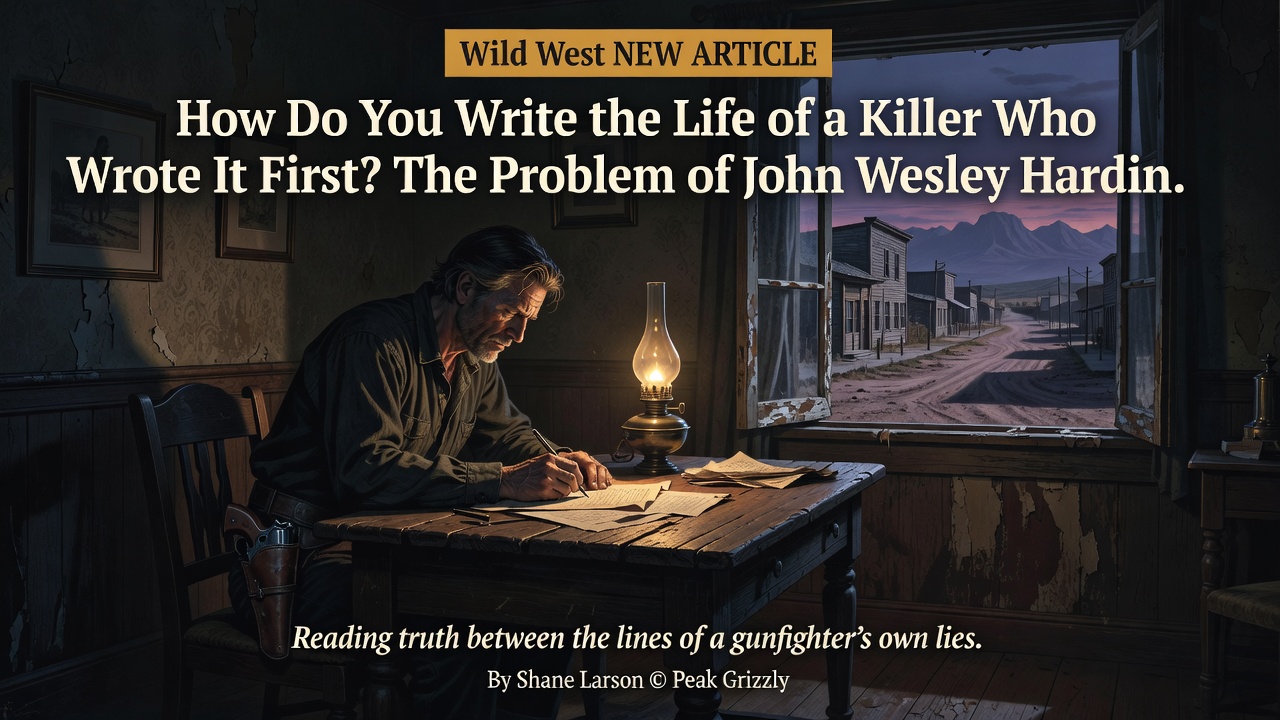
Most Old West outlaws come down to us through other people's words — newspaper men, lawmen, dime novelists, and the occasional eyewitness who lived to talk. John Wesley Hardin is different, and the difference is exactly what makes him so hard to write about. Hardin wrote his own life. In the months before he died, in a hotel room in El Paso, he filled page after page with The Life of John Wesley Hardin, As Written by Himself. It was published after his death, and it has anchored every account of him ever since.
That sounds like a gift. A primary source, in the subject's own hand, covering the whole arc of his career. In practice it is a trap. Because the most important fact about Hardin's autobiography is that it is a confession that never once confesses.
A ledger that never balances against him
By his own running count, Hardin killed around forty men. He does not hide the number. He tallies his victims with something close to a bookkeeper's care — names, dates, towns, the circumstances of each shooting. And in every single case, by his telling, he is the wronged party. The other man drew first. The other man insulted him, cheated him, threatened his life, came at him in the dark. Self-defense. Provocation. Bad luck. Never, in forty deaths, murder.
No one's life works that way. Read forty fatal encounters in which the shooter is blameless every time and you are no longer reading history — you are reading a defense brief. Hardin was, by the end, a trained lawyer. The autobiography reads like a closing argument delivered to a jury that will never convene.
So how do you use a source like that? You do what a good attorney does with a hostile witness. You let him talk, you write down everything he says, and then you check it against everything else.
Reading against the grain
The "everything else" for Hardin is richer than you might expect. Comanche County kept court records of the killing that finally ruined him — the 1874 shooting of Deputy Sheriff Charles Webb. The reorganized Texas Rangers, hunting him for years, left reports. Period Texas newspapers covered the feuds, the manhunts, and the capture. The Sutton-Taylor feud, the bloodiest blood feud in Texas history and the one Hardin threw himself into, generated its own paper trail of inquests, indictments, and partisan reporting.
Hold the autobiography up against that record and the seams show. Sometimes Hardin's version is broadly confirmed. Sometimes the documents flatly contradict him. And sometimes — this is the interesting case — there is simply nothing to confirm or deny, and you are left with his word alone and a duty to say so plainly.
The most famous Hardin anecdote falls into that last category. The story goes that in Abilene, in 1871, he shot a man through the wall of his hotel room because the fellow's snoring kept him awake. It is the perfect Hardin story: casual, lethal, almost funny in its cruelty. It is also almost certainly inflated, the kind of tale that grows every time it is told in a saloon. What matters is that Hardin never bothered to correct it. He understood, better than anyone, that a reputation for killing on a whim was a kind of armor. As long as men believed he might shoot you for snoring, they kept their hands well clear of their own guns.
The context the legend leaves out
There is a second reason the autobiography misleads, and it is bigger than any single anecdote. Hardin presents his early killings as personal — quarrels, fights, matters of honor. Strip away the self-justification and they look political.
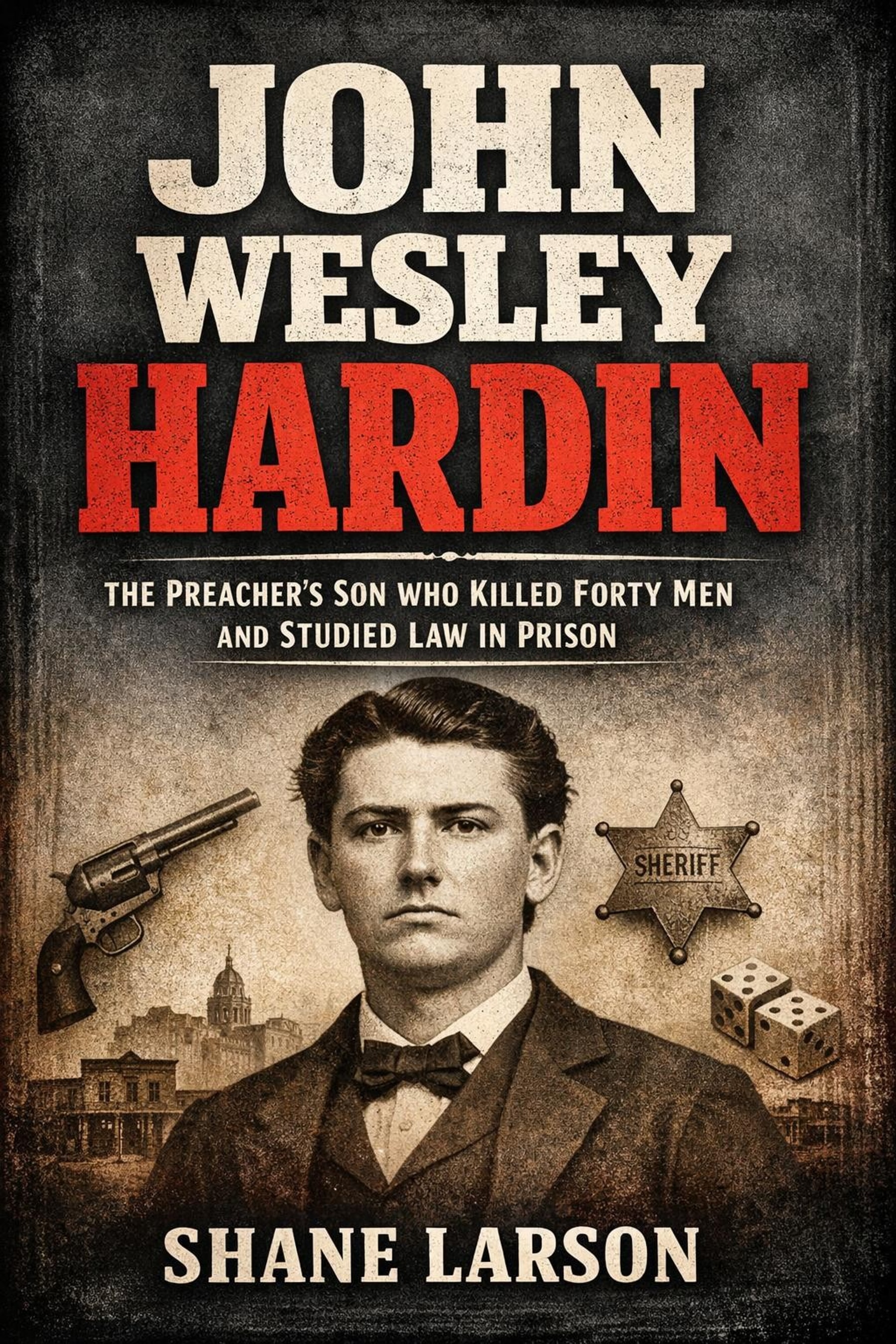
John Wesley Hardin
Hardin came of age in the wreckage of Reconstruction Texas: a defeated Confederate society under Union occupation, seething against the federal soldiers, the newly freed Black population, and the state police created to keep order across the South. His first killing, at fifteen, was of a freedman named Mage, after a wrestling match. The men he gunned down next were the soldiers and officers who came to arrest him for it.
To a modern reader that is racial and political violence, plain and ugly. To Hardin's unreconstructed neighbors in the 1860s and 1870s, it was something else entirely: resistance. It made him not a criminal but a folk hero, a young man striking back at an occupation they despised. You cannot understand why Hardin could move so freely, why families sheltered him, why juries hesitated, without understanding that the world around him largely approved of his early crimes. The body count has a context, and the context is Reconstruction. Leave it out and Hardin becomes a cartoon. Put it back and he becomes legible — which is not the same as forgivable.
The strangest chapter: a law school behind bars
The 1874 killing of Charles Webb changed everything. Shooting freedmen and Union men had made Hardin a hero to his own people; shooting a popular white local lawman, in front of witnesses, turned that same community against him. He ran for three years under the alias James W. Swain, through Florida and Alabama, until Texas Ranger John Armstrong took him alive in a violent scuffle aboard a train at Pensacola in 1877.
Then comes the second act almost no Western outlaw ever got. Sentenced to twenty-five years in the Huntsville penitentiary, Hardin began as a defiant prisoner — escape plots, the lash, punishment. Over the years, something shifted. He turned to the prison library. He read theology and ran the Sunday school. He read law, year after year, until he could pass the bar examination from inside the walls. Pardoned and released in 1894, he walked out a licensed attorney, hung a shingle in El Paso, and set out to become a respectable man.
It did not hold. Within a year he was drinking, gambling, threatening, and entangled with a married woman and a crooked lawman. On August 19, 1895, an old constable named John Selman walked up behind him at the bar of the Acme Saloon, where Hardin was rolling dice, and shot him in the back of the head. His last recorded words were about the game: another man had four sixes to beat.
The honest question the documents cannot fully answer is whether the prison transformation was real. Was the theology and the law degree a genuine attempt to become someone new, or one more performance by a man who had spent his life persuading juries he was innocent? The evidence points both ways, and a responsible account has to sit in that tension rather than resolve it cheaply.
Why it matters how we tell it
It would be easy to write Hardin as a romantic gentleman gunfighter, and easy to write him off as a simple psychopath. Both are lazy, and both flatten a man who was charming, intelligent, genuinely capable of self-improvement, and casually lethal all at once. The truth lives in the friction between those facts — and you only reach it by refusing to take the man's own word for anything.
That is the discipline this book tries to hold from the first page to the last: let Hardin talk, then check him against the record, and tell you clearly where the documents run out and the legend takes over.
John Wesley Hardin
New posts and releases, straight to your inbox. No spam, unsubscribe anytime.