The Hanging Judge Was Real. The Bloodthirsty Caricature Was Not.
July 4, 2026 · 6 min read
On a September morning in 1875, a crowd estimated in the thousands gathered outside the federal courthouse at Fort Smith, Arkansas. They had come to watch six men die at once. The condemned stood on a single long scaffold built for the purpose. The executioner walked the line, checking six nooses. And a new federal judge — thirty-six years old, only weeks into the job — let the law take its course.
The newspapers had a name for him before the trapdoor even dropped. They called him the Hanging Judge. It stuck for the rest of his life and well past his death.
That nickname has done a century and a half of damage to the truth. Because the Hanging Judge of folklore — the black-robed sadist who relished the scaffold — is a caricature. The documented Isaac Parker is a far stranger and far more interesting man. To understand why, you have to start not with the gallows but with the map.
A Court the Size of a Small Nation
When Parker took the bench of the U.S. District Court for the Western District of Arkansas, he inherited one of the hardest assignments in the federal system. His jurisdiction did not stop at the Arkansas line. It ran west across roughly 74,000 square miles of Indian Territory — the lands of the Five Tribes and the open country beyond.
This was not empty bureaucratic geography. It was the single most consequential fact of his career. The tribal courts had jurisdiction over their own citizens, but they had no authority over the flood of non-Native outlaws, whiskey peddlers, horse thieves, and killers who poured into the territory precisely because federal law was the only law that reached them — and federal law was hundreds of miles away, in Parker's courtroom.
The Indian Territory became a haven for fugitives for a simple, structural reason: there was a hole in the law, and bad men fell into it on purpose. Parker's court was the federal answer to a borderless frontier. His job was to make the law reach people who had crossed into the territory specifically so it couldn't.
If that problem sounds oddly modern, it should. Every borderless jurisdiction — including the digital one we live in now — faces the same puzzle: how do you reach an offender who operates precisely in the space your authority can't easily touch? Parker's answer in 1875 was not elegant. It was a machine.
The Machinery of Justice
We remember the judge. We forget the apparatus, and the apparatus is the real story.
To serve warrants across an area the size of a small nation, Parker presided over a force of deputy U.S. marshals that grew to some two hundred men. They rode out for weeks at a time, alone or in small posses, into country where the people they hunted had every advantage. They were paid by fees and mileage — a brutal, grinding economics that put them on the road constantly and rewarded volume over caution. Sixty-five of them were killed doing the job. Among the standouts was Bass Reeves, the formerly enslaved deputy who became one of the most effective lawmen the West ever produced, and whose own story is a companion to this one.
Back at Fort Smith waited the rest of the machine. A notorious basement jail that prisoners called "Hell on the Border," where men awaited trial in conditions that horrified visitors. A relentless docket, trial after trial after trial. And a quiet German immigrant named George Maledon, the executioner the press called the Prince of Hangmen. Maledon was no ghoul. He was a craftsman. He built his own ropes, stretched and tested them with sandbags, and approached the grim work with the methodical care of a man who took pride in doing a hard job correctly.
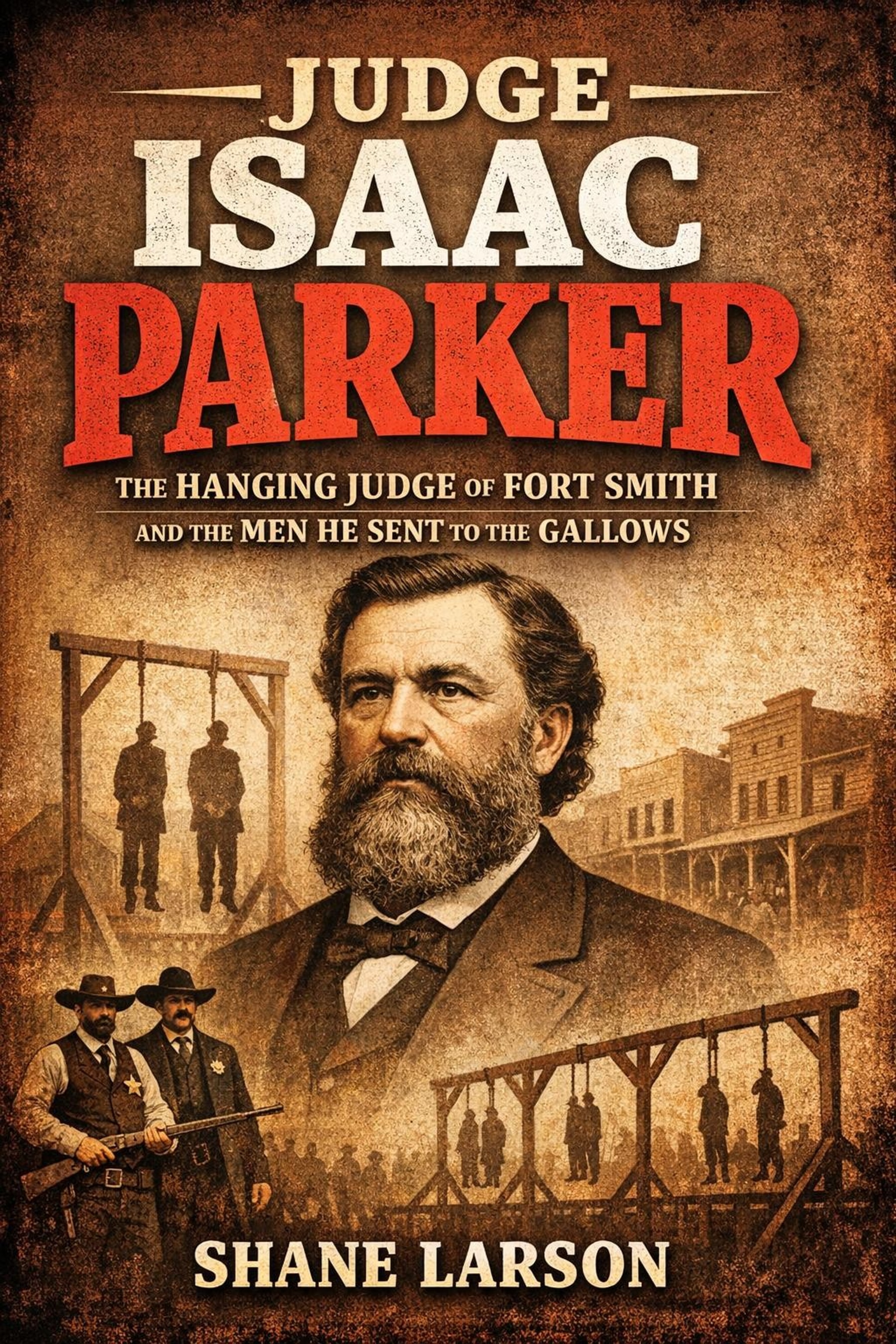
Judge Isaac Parker
A court is more than a judge. Parker's was a working system of warrants, posses, juries, dockets, and rope — and the human beings who made it run, and who died running it.
The Conscience Behind the Caricature
Here is where the legend collapses.
The folklore Parker hangs men because he likes it. The documented Parker is a man of real and visible conscience. He was, by the record, a defender of Native sovereignty who fought federal encroachment on tribal jurisdiction — at a time when the broader current of American policy was running hard the other way. He advocated for the rights and welfare of the territory's people. He worried aloud, publicly, about the social conditions that bred the crime his court was drowning in.
And — this is the part that should stop you — he came to oppose the very capital punishment his reputation rested on. The man whose name became a synonym for the gallows privately doubted the gallows. He believed that certain, swift punishment was the only force that could hold the territory together, and he carried that belief to its lethal conclusion. But he did not relish it, and toward the end he questioned it.
That is not a monster. That is a man trapped inside a contradiction he could see clearly and could not resolve.
The Reckoning
For the first fourteen years, there was no appeal from Parker's court to anywhere. His judgment was final — a concentration of power almost unimaginable in the modern federal system. Whatever Parker decided was simply the end of the matter.
Then, in 1889, Congress granted defendants the right to appeal his verdicts to the U.S. Supreme Court. And the high court began reversing him. Sometimes scathingly. The justices faulted his jury instructions and his handling of self-defense, overturning case after case.
Parker did not take it quietly. He fought back from the bench and in the press, defending his methods against justices he believed had never seen the territory he policed and did not understand what it took to hold it. The final years of his court became a running argument between frontier necessity and constitutional due process — and due process was winning. When the territory's jurisdiction was finally carved away from Fort Smith in 1896, Parker was already dying. He passed within weeks of losing the court that had defined his life.
There is something almost tragic in the timing. The most powerful judge on the frontier outlived his own authority by a matter of weeks.
Why the Real Story Matters More
It is easy to flatten Isaac Parker into a villain or to rescue him as a misunderstood hero. Both moves are lazy, and both miss what makes him worth a book.
The honest Parker is harder to hold: a man who believed deeply in the law and used it to send seventy-nine human beings to their deaths; who defended the dispossessed and was an instrument of a federal system busy dispossessing them; who wielded power without appeal and then watched the Constitution take it back, piece by piece. He was neither the bloodthirsty caricature of the dime novels nor a saint. He was a complicated, conscientious, contradictory man at the center of the West's most consequential courtroom.
That's the man the record reveals when you stop letting the nickname do the thinking for you.
Judge Isaac Parker
New posts and releases, straight to your inbox. No spam, unsubscribe anytime.