The Sequel to the Fall of Rome That Nobody Reads
July 29, 2026 · 8 min read
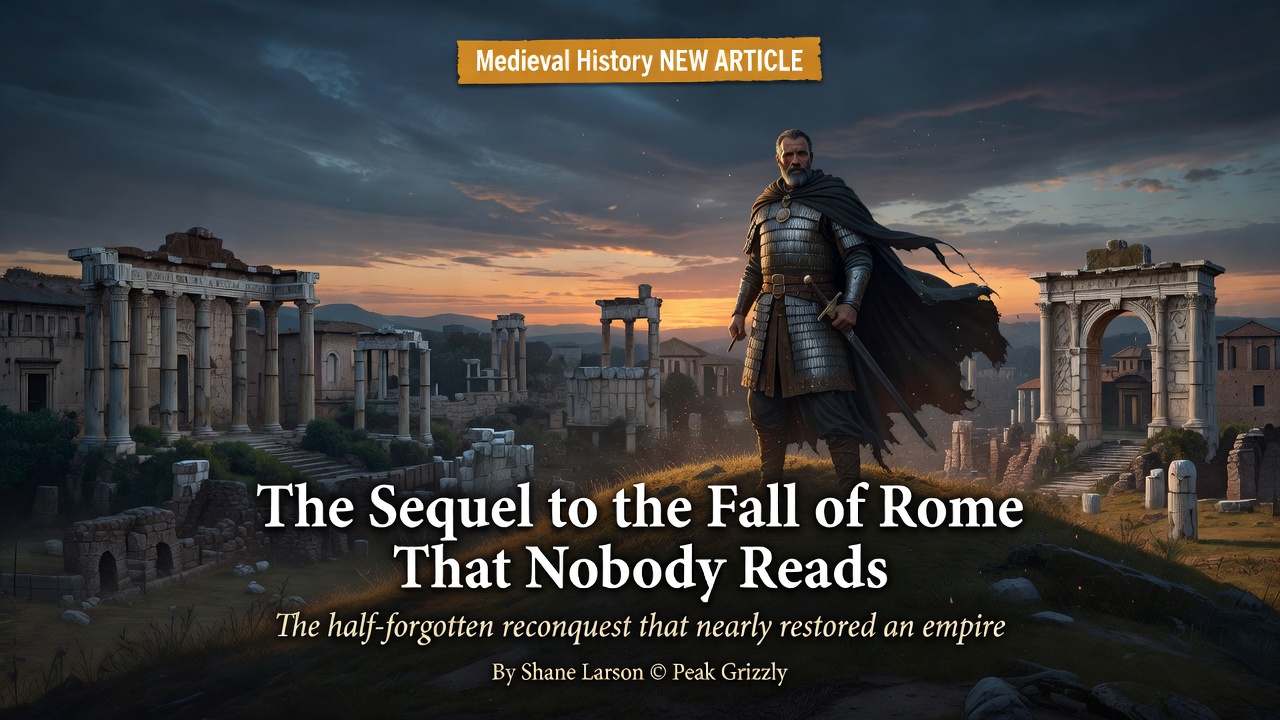
Ask most people how the Roman Empire ended and you'll get some version of the same answer: barbarians, decline, the year 476, the lights going out. It's a tidy story, and it has the great advantage of being an ending, which is what we want from history — a place to stop. The narrative feels complete because it lines up with the images we inherit from schoolbooks and popular accounts: sacked cities, retreating legions, and a sudden plunge into the early Middle Ages. That neatness is precisely why the fuller picture gets trimmed away.
The problem is that it isn't true. Or rather, it's exactly half true, and the other half is one of the most dramatic stories in all of history, and almost nobody knows the first thing about it.
Here is the half we skip. In 476, the Western Roman Empire ended when a Germanic general deposed a boy-emperor in Italy and didn't bother replacing him. But the Roman Empire had been administratively split for generations, and the eastern half — richer, more populous, more urban, ruled from Constantinople — did not fall. It didn't even wobble much. It kept collecting taxes, holding court, and thinking of itself, without a trace of irony, as the Roman Empire, because that is precisely what it was. The East had inherited the more defensible frontiers, the busier trade routes across the Mediterranean and Black Sea, and the denser network of cities that still generated reliable revenue. And sixty years after the West went dark, the man on that eastern throne decided the whole thing had been a mistake he was going to fix.
The Emperor Who Never Slept
His name was Justinian, and almost nothing about him fit the mold of a world conqueror.
He was the nephew of a peasant. His uncle Justin had walked to Constantinople as a teenager with bread in his pack, enlisted in the army, and — through decades of competent soldiering and one well-timed succession crisis — improbably ended up emperor. Justin had no children, so he sent home for a bright nephew, gave him the finest education in the eastern empire, and groomed him to inherit. That nephew took the name Justinian, and when he came to power in 527 he arrived with a program so total it bordered on megalomania: one empire, one law, one church. The Roman world made whole again, the lost West reconquered, a thousand years of tangled law codified into a single system, and a fractured Christendom united on the emperor's terms. Each piece of the plan reinforced the others; military recovery would supply the resources needed to enforce religious uniformity, while the new legal code would give the restored empire a single, usable set of rules instead of contradictory provincial customs.
He was not a general; he never led an army in the field. He was not a sensualist; even his enemies admitted he ate and drank sparingly. He was an administrator and a theologian, a man who found deep satisfaction in the fine print of law and doctrine, and he pursued his impossible program with a stamina that unnerved the people around him. Contemporaries called him the emperor who never slept, and they seem to have meant it almost literally — a ruler who prowled the palace through the night, working, while the city rested. That habit showed up in the sheer volume of legislation he issued and in the detailed instructions he sent to distant governors and generals.
And for about a decade, the impossible program worked. His general Belisarius reconquered North Africa from the Vandals in a single campaign season, with a modest force, against the advice of the emperor's own ministers. He took back Rome itself after a siege that left the ancient capital battered but once more under imperial administration. His lawyers, under the brilliant jurist Tribonian, compressed the entire chaotic inheritance of Roman jurisprudence into the Corpus Juris Civilis — a code that would be lost in the West, rediscovered centuries later, and become the foundation of the civil-law tradition across most of continental Europe and Latin America. The project did more than organize old statutes; it resolved contradictions, eliminated obsolete rules, and created a coherent system that later Byzantine rulers and medieval European scholars could actually apply. And out of the ashes of a catastrophic riot, he built Hagia Sophia, a church with a dome so audacious that people struggled to describe how it stayed up, in barely five years. For one genuine, map-changing moment, the Mediterranean was nearly a Roman lake again.
The Woman Named in the Law
He did not do it alone, and his partner is the other half of why this reign refuses to stay forgotten.
Theodora had started about as far down the Roman social ladder as it was possible to start. Her father kept the bears for one of the chariot-racing factions at the Constantinople hippodrome. She grew up in the theater and worked as an actress — a profession that in Roman law sat barely above prostitution, disreputable enough that an actual law had to be changed before the heir to the empire could marry her. The old senatorial families never forgave the match and spent years trying to be rid of her. They never managed it, because Theodora turned out to be one of the shrewdest political operators of the age. She understood the factions and the street-level loyalties that could make or break an emperor in a city where chariot races still doubled as political rallies.
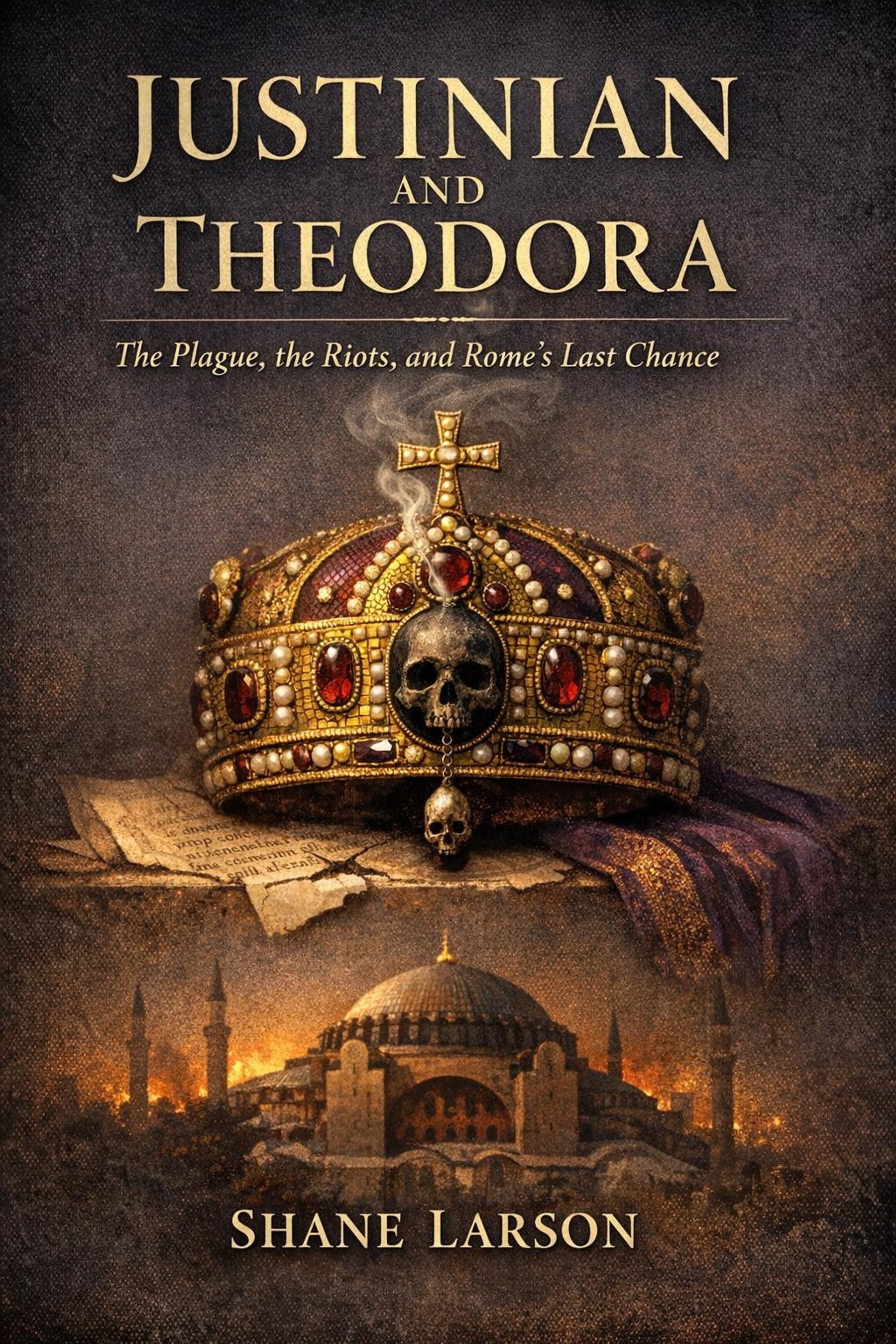
Justinian and Theodora
She was crowned Augusta and named in Justinian's own legislation as his partner in rule. She ran her own household, her own patronage networks, her own agents, and pursued her own agenda — most strikingly, she openly protected the Monophysite Christians whom her husband's official orthodoxy was suppressing, sheltering persecuted clergy in the capital. This wasn't a wife with influence. It was a second center of government. Historians increasingly read the marriage as a deliberate two-handed machine, a regime that could hold both sides of a bitterly divided empire at once — orthodox and Monophysite, hard line and accommodation — precisely because its two rulers could take different public positions. The arrangement let Justinian maintain doctrinal firmness while Theodora kept channels open to the large Monophysite populations in Syria and Egypt.
And on the single day the whole thing nearly died, it was Theodora who saved it. In January 532, the chariot factions — normally bitter rivals — united in a riot that burned half of Constantinople and acclaimed a rival emperor in the hippodrome. Justinian's ministers urged flight; ships were readied at the palace harbor. According to Procopius, who was in a position to know and who despised her, it was Theodora who refused to run, who told the council that she would not live to see herself stripped of the purple. The court stayed. Belisarius and Narses sealed the hippodrome, and perhaps thirty thousand people died on the sand so the reign could continue. Whatever the exact words, the reign was refounded that day on the empress's nerve.
The Hinge Nobody Could Fight
And then, in 541, at the very peak of the restoration, came the thing no code of law and no general could beat.
It arrived in Egypt and rode the grain ships north, and it was bubonic plague — the first securely recorded pandemic of the pathogen that would return eight centuries later as the Black Death. It reached Constantinople in 542 and killed on a scale the ancient world had no framework for. The sources describe the burial system collapsing entirely, corpses stacked in the towers of the sea walls, the markets empty, the great city grinding to a halt. Justinian himself caught it and was expected to die; his court quietly began plotting the succession, and the officers who plotted too openly would pay for it later. Contemporary accounts note that the disease moved with terrifying speed, often killing within days, and that entire households vanished while survivors struggled to maintain basic services.
Historians still argue about exactly how severe the pandemic was and how much it changed — that debate is itself part of the story, and I try to give it honestly. Some estimates suggest mortality rates in the capital approached 40 percent in the first wave, while others point to regional variation and partial recovery in later decades. But the strategic fact is hard to dodge: the plague gutted the tax base and the manpower of the empire at the precise moment the reconquest needed every soldier and every gold coin it could find. The armies in Italy were left to grind through two more decades of ruinous war. And the great project — Rome put back together — never fully recovered its footing.
Which leaves the question the whole reign poses, and which I spend the last part of the book weighing as honestly as I can: was Rome's last chance ever real? Was a durable restoration possible without the plague — or was it doomed regardless, by distance and money and the simple impossibility of holding two long frontiers with one overstretched army? The romantic answer is that a single catastrophe robbed Justinian of a reunified Roman world. The structural answer is that the West was always going to slip away, plague or no plague. I don't think the evidence lets us close the case cleanly, and I've tried to resist the temptation to pretend otherwise. The reconquest did briefly restore imperial presence in Italy, North Africa, and parts of Spain, yet the costs mounted faster than the returns, and the eastern provinces that paid the bills remained vulnerable to new threats from the north and east.
What isn't in doubt is what survived. The Lombards took much of Italy within three years of Justinian's death; the Arab conquests stripped away Egypt, Syria, and Africa within a lifetime. But the law code still sits beneath modern legal systems. Hagia Sophia is still standing, nearly fifteen centuries later. And the Eastern Roman state that Justinian ruled — reduced, transformed, but continuous — ran on for another nine hundred years, until 1453. If this reign is the sequel to the fall of Rome that nobody reads, it's also the doorway into a thousand years of history that mainstream books mostly skip. That's the door I wanted to open.
Justinian and Theodora
New posts and releases, straight to your inbox. No spam, unsubscribe anytime.