In 1191 the Monks of Glastonbury Dug Up King Arthur. Their Abbey Had Burned Down Seven Years Earlier.
November 25, 2026 · 6 min read
On 25 May 1184 a fire went through Glastonbury Abbey in Somerset. It took the great church, most of the monastic buildings, and with them the relics, vestments and books that made the house one of the richest in England. The monks were left with a chamber, a chapel and a bell tower.
Seven years later, digging in their own cemetery between two ancient standing crosses, the same monks found a grave. It held the bones of a very large man and a smaller skeleton beside him, and, they said, a lead cross with a Latin inscription naming the dead man as the renowned King Arthur, buried in the Isle of Avalon.
It is one of the best-timed discoveries in English history, and it is worth going through slowly.
What the monks said they found
The fullest early account is by Gerald of Wales, a royal clerk and a prolific writer, who visited the abbey and wrote about the discovery within a few years. By his description the monks dug down some way and came on a stone slab. Fixed to its underside was a cross of lead, with the inscribed face turned inward. A good deal deeper lay a coffin made from a hollowed oak trunk.
Inside were the bones of a man whose shin, set against the leg of the tallest monk present, came well above the knee. The skull bore the marks of several wounds, one of them unhealed. With him were the bones of a woman and a tress of yellow hair, which fell to dust when a monk snatched at it.
The cross has not survived. It was still at Glastonbury in the sixteenth century, when the antiquary John Leland handled it, and it is last heard of in the eighteenth. What remains is an engraving printed in the 1607 edition of William Camden's Britannia, which gives the inscription as a statement that here lies buried the famous King Arthur in the Isle of Avalon.
Why the timing matters
The abbey needed money. Rebuilding had been paid for at first by King Henry II, and it went quickly while he lived. He died in 1189. His son Richard I had a crusade to pay for, and the royal money stopped.
A medieval abbey that needed funds had one dependable way of raising them, which was pilgrims, and pilgrims came for relics. In the years after the fire Glastonbury announced the recovery of several sets of important bones. Arthur was the greatest of them.
The court had reasons of its own to welcome the find. Half a century earlier Geoffrey of Monmouth had made Arthur the most famous king in Europe, and had ended his story by sending him wounded to the Isle of Avalon. Among the Welsh and the Bretons there was a belief that he had not died and would come back. A king of England with restless Welsh neighbours had some use for a body. Gerald of Wales says that it was Henry II himself who told the monks where to dig, on the word of an old British singer.
The case that it was staged
The sceptical reading is straightforward. Before 1191 nobody connected Arthur's burial with Glastonbury. William of Malmesbury, a careful historian who knew the abbey well and wrote about its antiquities around 1130, says elsewhere in his work that the tomb of Arthur is nowhere to be seen. He would have mentioned it.
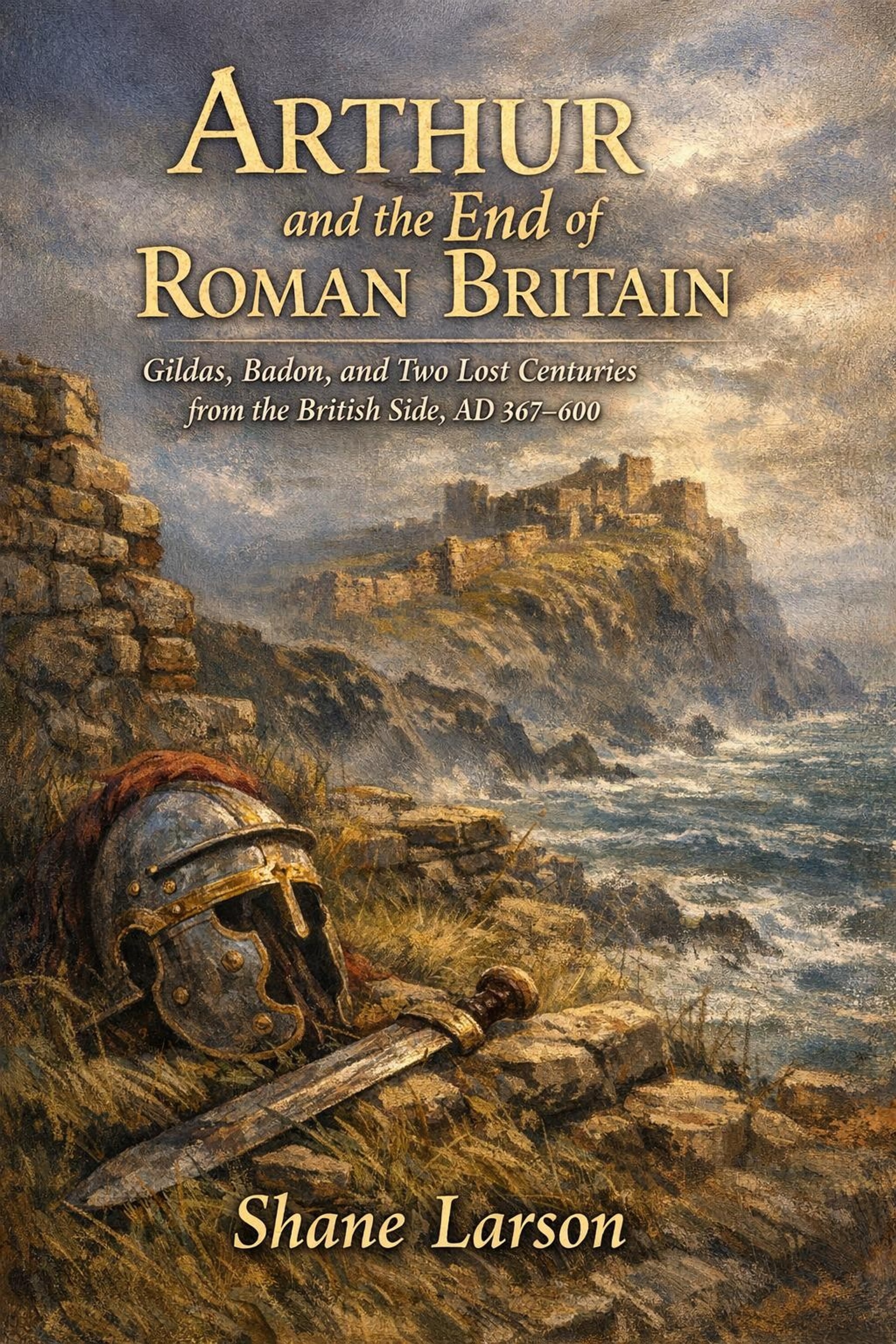
Arthur and the End of Roman Britain
The identification of Glastonbury with Avalon also appears only with the discovery. And the lettering of the cross, as Camden's engraving shows it, does not look like sixth-century writing. Scholars who have studied the forms have generally placed them much later, somewhere between the tenth century and the twelfth.
Then there is the wording. The earliest reports of the inscription do not agree with each other. Gerald's version includes Guinevere, described as Arthur's second wife. The cross in Camden's engraving does not mention her at all.
The case that they found something
The other reading does not require the monks to have been honest about everything. It only asks whether there was a real grave.
Glastonbury was an old place by 1191. Its cemetery had been in use for centuries, and burial in a hollowed tree trunk is a known early practice. The two standing crosses the monks dug between were genuine monuments of some age. It is quite possible that they opened a real, early, high-status burial and then supplied the name, either sincerely or with help from a newly made cross.
In the 1960s the archaeologist C. A. Ralegh Radford excavated in the old cemetery and reported a large pit, dug out and refilled in the right period, at about the right spot. For a generation that was taken as confirmation that the monks had at least dug where they said. A full reassessment of the abbey's excavation archive, published in 2015, was a good deal more cautious about how much Radford's records can support.
Most historians today think the grave of Arthur was a claim made by the abbey for the abbey's reasons. Whose bones were in it, if any were, cannot now be known.
What happened to the bones
They were treated as a royal relic. In 1278 King Edward I, who had just fought his first war in Wales, came to Glastonbury with his queen. The tomb was opened, the bones were shown, and they were reburied before the high altar in a black marble tomb with the king and queen carrying them.
The tomb stood until the abbey was dissolved in 1539. After that the bones are not heard of again. A sign in the grass of the ruined choir marks the place today.
What the story is evidence for
It is easy to treat the Glastonbury grave as a fraud and move on. It is more useful to ask what it is evidence of.
It tells us nothing about the fifth or sixth century. The only Briton who wrote about the wars of that time within living memory, a churchman named Gildas, never mentions Arthur at all. The name first appears in a compilation made in Wales in 829 or 830.
What the grave does record, with dates and names, is the moment in the twelfth century when a legend had become valuable enough that an abbey and a crown both wanted to own its ending. That is real history, and it is far better documented than the hero.
The same pattern runs through the whole subject. *Arthur and the End of Roman Britain* follows it from the collapse of the Roman frontier in 367, through the century in which Britain has one witness, to the excavations at Tintagel and Cadbury and the people who built the king everyone knows. It does not name a candidate. It puts a date on every source and says what each one can bear.
Arthur and the End of Roman Britain
New posts and releases, straight to your inbox. No spam, unsubscribe anytime.