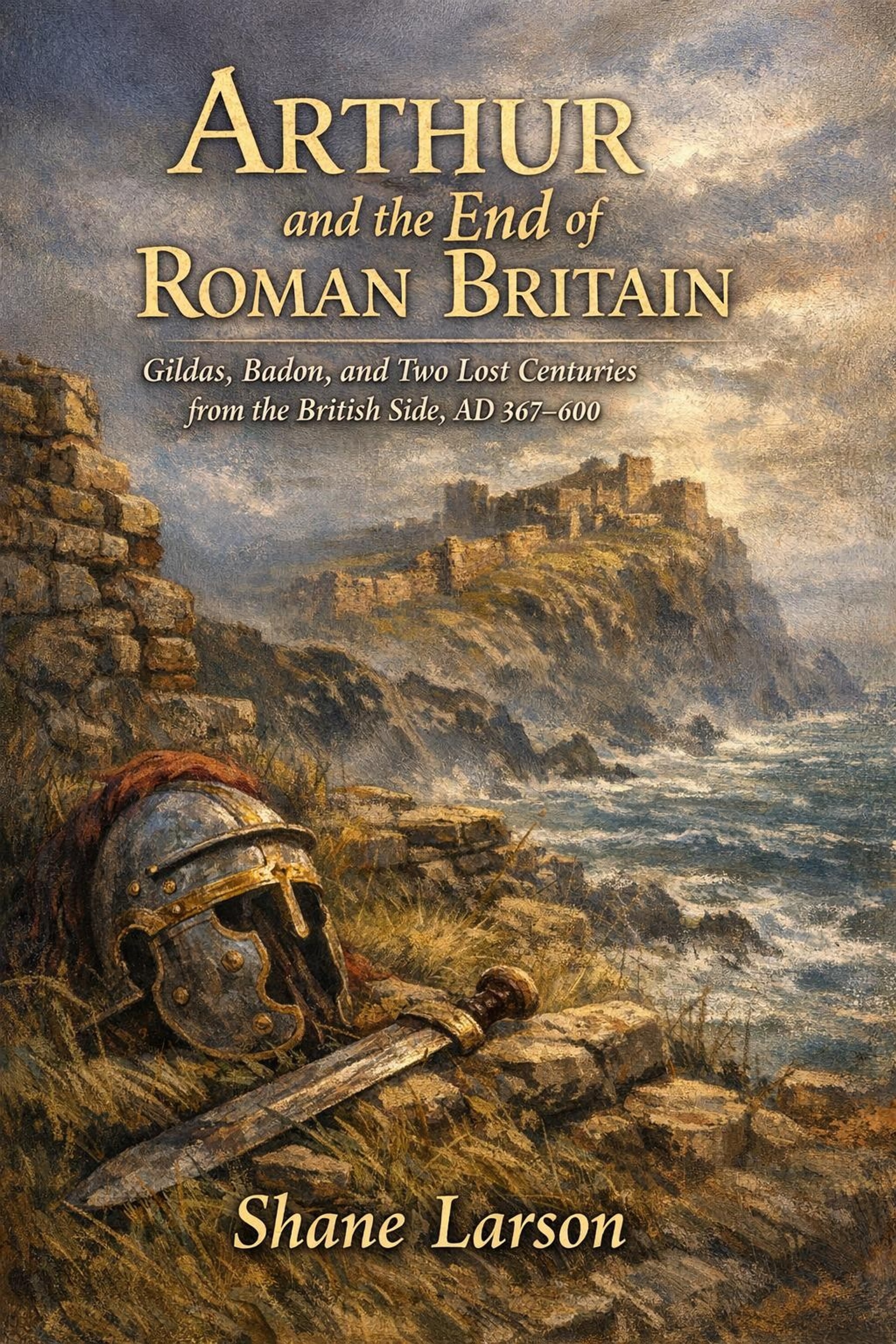
Arthur and the End of Roman Britain
Gildas, Badon, and Two Lost Centuries from the British Side, AD 367-600
By Shane Larson
About This Book
In the summer of 1998 archaeologists working on the headland at Tintagel, on the north coast of Cornwall, lifted a broken piece of slate that had been reused as the cover of a drain. Someone in the sixth century had scratched a few words of Latin on it. Among them was a name, Artognou.
For a few weeks the newspapers had found King Arthur. They had not. Artognou is a different name, sharing only its first syllable with the famous one, and the people who dug it up said so at once. What the slate does show is smaller and more solid: that at a windy stronghold on the Atlantic edge of Britain, a century after Roman government ended, somebody could still write Latin and thought it worth doing.
That gap, between a very large story and a very small piece of evidence, is the subject of this book.
The Two Centuries Behind the Name
Arthur and the End of Roman Britain is two histories in one binding. The first is the history of Britain from 367 to about 600, told from the side that lost the written record. It starts with the frontier collapsing under attack from the north and the sea, and follows the garrison as it is marched abroad three times in forty years by generals who wanted to be emperor. None of those armies came home. By about 410 the Britons had expelled the last Roman officials and were defending themselves, and within a generation the coins had stopped circulating, the potteries had closed and the towns were emptying.
What came next is known from very little. A British bishop's son named Patrick left two short documents. A churchman named Gildas left a furious sermon with a historical preface, written within living memory of the wars against the Saxons. He describes an appeal to Rome that went unanswered, a ruler who hired Saxon soldiers and lost control of them, a recovery led by a man called Ambrosius Aurelianus, and a great victory at a place called Mount Badon in the year of his own birth. He names five kings of his own day. He names no Arthur.
The second history is the Arthur question, asked the way it has to be. Arthur enters the record in a Latin compilation put together in north Wales in 829 or 830, three centuries after Badon, where he fights twelve battles and fells 960 men in one charge. A set of Welsh annals gives him two entries. One line of an old northern poem praises a warrior by admitting he was no Arthur. The book takes each of these apart: who wrote it, when, from what, and how far they stood from the events.
It ends with the people who made the king everyone knows, because their work can be dated and their motives can be read. It does not finish by announcing who Arthur really was.
Why I Wrote This
When I finished Roman Britain I stopped at 410, which is where the Roman story ends, and I knew I had left the reader on a cliff. What happened to the people? The usual answer is a paragraph about darkness and then, somehow, King Arthur.
What hooked me was a sentence in Gildas. He says, almost in passing, that he was born in the year of the siege of Badon. Here was a man who grew up in the peace that battle bought, who knew the grandchildren of the commander who started the recovery, and he gives us the name of that commander and not the name everyone wants. I could not decide whether that silence was damning or meant nothing, and I still cannot. I decided that was the book: the real history, the thin evidence, and an honest account of how far it goes.
Frequently Asked Questions
Was King Arthur a real person?
Nobody knows, and this book explains why nobody can. A British war-leader of that name could have lived around the year 500. The earliest text that mentions him was written about three hundred years later, and the one writer close to the events does not. The evidence can neither confirm him nor rule him out.
Does this book say who the real King Arthur was?
No. It weighs seven proposed candidates and shows that each identification rests on a late source taken on trust. If you want a book that names its man, this is not it.
Did the Romans really leave Britain in 410?
Not in the way the date suggests. The field army had already crossed to Gaul in 407 with a usurper, the money to pay soldiers had stopped arriving about 402, and in 409 the Britons themselves threw out the remaining officials. The famous letter of 410 telling the cities to look to their own defence may not even have been addressed to Britain.
Do I need to read Roman Britain first?
No. This book stands alone and gives the years 367 to 410 two chapters of its own, told from the point of view of the people left behind. Roman Britain covers the same years from the Roman side, and the four centuries before them.
Is there anything Arthurian to see at Tintagel?
There is a great deal to see from the fifth and sixth centuries, when the headland was one of the most important places in western Britain, and a medieval castle built there because of the legend. Nothing found on the site names Arthur. The gazetteer in Appendix B says what is there and how old it is.
If You Liked This, You Might Like
- Roman Britain — the story before this one: conquest, province and the long loosening that ends where this book begins.
- Hadrian's Wall — the northern frontier whose last garrisons stayed put when the pay stopped and turned into something new.
- Troy — another famous story tested against the ground and the documents, with the same refusal to claim more than the evidence gives.
- Richard III — a king whose legend can be watched being written, and a grave that settled less than people hoped.
A slate, a sermon, a list of battles and a line of verse: that is most of what the two centuries after Rome left behind. This book shows what can be built on them and where the building has to stop.
A standalone history on the early-Britain shelf, beside Roman Britain.
What You'll Learn
- Three departures, no evacuation. The troops left in 383, in 401 or 402, and in 407, each time for a continental war. The book follows what the Britons were left holding, and how a usurper Rome executed became the ancestor Welsh kings later claimed.
- Life after the coins stopped. A timber hall built over a ruined granary on Hadrian's Wall, a water main laid in a Roman town decades after Roman rule, and shiploads of Mediterranean wine jars arriving on the Cornish coast.
- Gildas read as an author. His date, his schooling, his errors about the Roman walls, and the reason a preacher with a grievance names almost nobody.
- How a story grows. The unnamed "proud tyrant" of the sixth century becomes Vortigern, then acquires Hengest, Horsa, a Saxon bride and a boy prophet, one century at a time.
- Badon without a general. The date, the arithmetic of Gildas's forty-four years, the candidate hills, and the generation of peace that followed.
- The twelve battles and the Welsh annals, set out with the date of each text and of the oldest manuscript that carries it.
- Seven candidates, each given a fair hearing: a Roman officer, a king who fought in Gaul, Ambrosius himself, two princes who really were named Arthur, and two rulers from the Welsh genealogies.
- Tintagel and South Cadbury. What two generations of excavation found, and the 1977 article that ended the scholarly case for a provable Arthur.
- The makers of the legend. Geoffrey of Monmouth and his "very ancient book", the Glastonbury grave of 1191, the Round Table hanging at Winchester, Malory in prison, and a Tudor prince named Arthur.
- Three appendices: every source dated and graded, a gazetteer of the places and the candidates, and a timeline from 367 to 1485 that marks each date as secure, approximate or traditional.
New Ancient History releases and free chapters — no spam, unsubscribe anytime.