Whatever Happened to the Ebla Tablets?
November 23, 2026 · 6 min read
If you read a newspaper or a church magazine in the late 1970s, you probably met the Ebla tablets. They were a huge archive of clay tablets from a buried city in Syria, more than four thousand years old, and they were said to contain the names of Abraham, Esau, Ishmael and David, a form of the name of Israel's God, and a list of the five Cities of the Plain, Sodom and Gomorrah among them, in the order in which Genesis gives them.
Then the story stopped. There was no announcement that it was over. The headlines moved on, and most people who had followed it were left with a vague sense that something important had been found and that somebody had probably hushed it up.
Nobody hushed it up. What happened is less dramatic and more interesting.
What was found
In 1964 a young Italian archaeologist, Paolo Matthiae of the University of Rome, began digging a large mound called Tell Mardikh, about thirty-five miles south-west of Aleppo. In 1968 his team found part of a basalt statue with an inscription naming its dedicator as a king of Ebla. That settled an old question. Ebla was a city that Mesopotamian kings such as Sargon of Akkad had boasted of conquering, and until then nobody had known where it was.
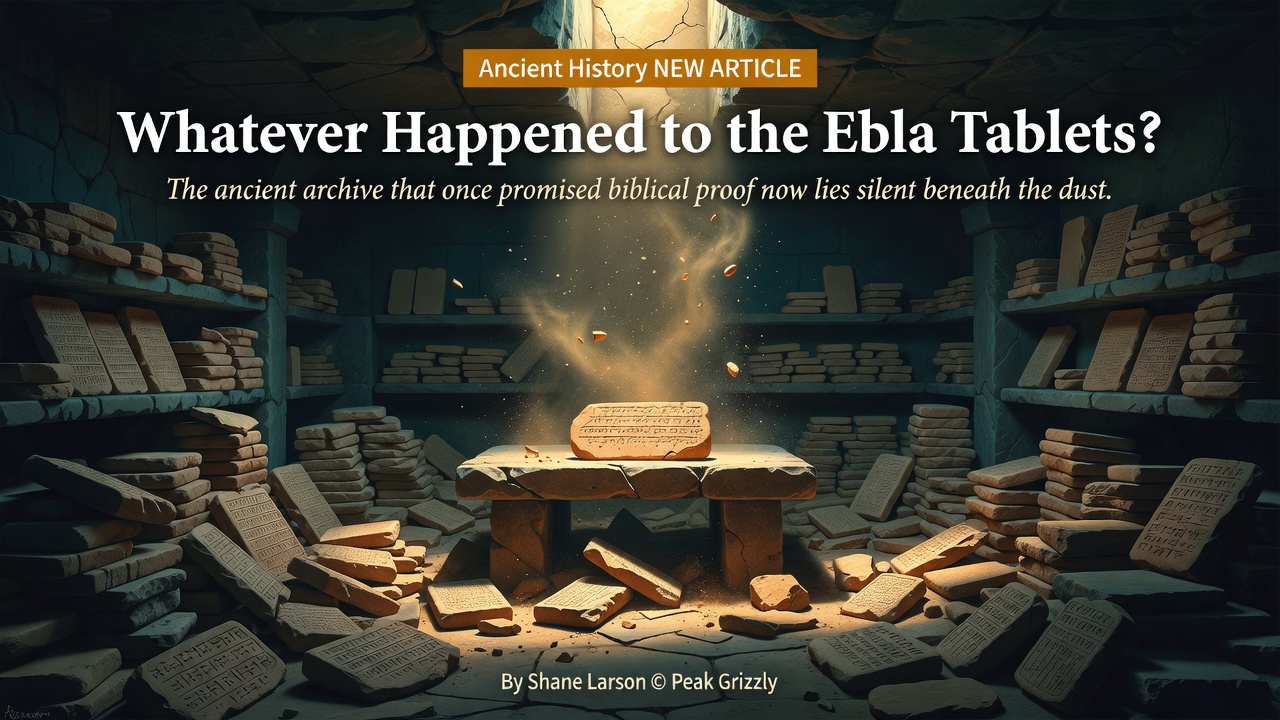
In 1974 the team found forty-two clay tablets in a burned palace far older than the statue. In 1975 they found the palace archive: a small room in which the tablets had been stored on wooden shelves. When the palace was sacked and burned, around 2300 BC, the shelves collapsed and the tablets slid to the floor in rows. The fire baked them hard. The count eventually passed 17,000 tablets and fragments.
The tablets were written in cuneiform, the wedge-shaped script of Mesopotamia, but the language behind them was new. It was Semitic, a relative of Akkadian and a more distant relative of Hebrew, and it had never been seen before. Scholars named it Eblaite.
What was claimed
The first person to read the tablets was the expedition's epigrapher, Giovanni Pettinato. In 1976 he began to report what he was finding, in lectures in the United States and in an article in the journal Biblical Archaeologist. Much of it concerned the kingdom's economy and politics. Some of it concerned the Bible.
He reported personal names that resembled biblical ones. He read a common ending on names, -ya, as a short form of the divine name. He reported place names that looked like Hazor, Megiddo, Gaza and Jerusalem. And it was reported that one tablet listed Sodom, Gomorrah, Admah, Zeboiim and Bela in the same order as Genesis 14.
In 1978 David Noel Freedman, a distinguished American biblical scholar and the journal's editor, published an article built on that last report. If the five cities appeared in a document of the third millennium BC, he argued, then the world of the patriarchs might belong a thousand years earlier than most scholars had placed it.
It is worth saying why serious people found this exciting. Fifty years earlier another Syrian archive, at Ugarit, had transformed the study of the Hebrew Bible by supplying Canaanite poems and myths in a language close to Hebrew. Ebla looked like the same thing happening again, on a larger scale and from a much earlier date.
What went wrong
Three things happened at once.
The first was political. The tablets belonged to Syria, and Syrian officials objected that an archive documenting an early Syrian civilization was being presented abroad as a chapter of somebody else's sacred history. This was within a few years of the wars of 1967 and 1973, and the American press drew the connection.
Ebla
The second was personal and professional. Pettinato and Matthiae disagreed about how old the archive was, about the biblical readings, and about how the tablets should be published. By 1979 Pettinato had left the expedition. A new epigrapher, Alfonso Archi, was appointed, and an international committee took over publication. Pettinato started a rival series of editions, so that for some years the same tablets appeared twice, with different readings.
The third was the slow, ordinary work of reading. Nearly all of the 1976 claims rested on tablets nobody else had seen. As the texts were published and other specialists worked through them, most of the biblical readings did not hold.
How the claims fared
The explanation lies in how the tablets are written. An Ebla scribe wrote mostly in Sumerian word-signs, the way we write "lb" and say "pound", and spelled out Semitic words only in between. Many signs can be read more than one way. A first reading of a text like that involves a great many choices, and in 1976 those choices were being made by one man, at speed, with the world watching.
The Cities of the Plain went first. Pettinato himself revised the reading of the later names almost at once, and no tablet listing the five cities in order has ever been published. The two sign groups once read as Sodom and Gomorrah occur in separate texts and are not now understood as those cities.
The -ya ending is generally taken to be an ordinary pet-name ending, or another way of reading a sign that can also be read differently. The thousands of offering records from Ebla, which list the gods who received sheep month by month, include no god of that name.
The personal names are real. But they are the names of ordinary people, and they are built from the same stock of words that Semitic-speaking peoples drew on for two thousand years. A man at Ebla with a name like Abram is evidence that the name is old. He is not Abram.
Pettinato kept some of his comparisons and dropped others. Freedman's article had rested on a reading that was withdrawn. No fraud was involved on anyone's part, and nobody suppressed anything. A set of first readings, made under unusual pressure, was corrected by second and third readings. That is how the field works. It usually happens without newspapers.
What the tablets turned out to be
What remained was the thing the controversy had buried: the kingdom.
The Ebla archive is the paperwork of a Syrian state that nobody had known existed. It records flocks of sheep in the tens of thousands and cloth issued by the thousand pieces. It records silver paid out by the hundred kilograms, princesses sent to marry into distant courts, and a treaty that is among the oldest known. It records a long war with the city of Mari on the Euphrates. It includes the oldest bilingual dictionary yet found, lists of Sumerian words with their Eblaite equivalents, made by scribes who needed them for the same reason anyone needs a dictionary.
It also holds a puzzle that is still open. Sargon of Akkad said the god Dagan gave him Ebla. His grandson Naram-Sin said he destroyed it. In 2003 two of the scholars who know the archive best argued from the tablets themselves that the palace was probably burned by neither, but by Mari, a few years after Ebla had beaten it in battle.
*Ebla: The Lost Archive That Rewrote Ancient Syria and Set Off a War Over the Bible* tells both stories: the kingdom the tablets describe, and the argument that broke out over them, claim by claim, with who said what and how each claim stands today. It also follows the city past the fire, through its rebuilding by the Amorites and its second destruction by the Hittites, to the present state of the site.
Ebla
New posts and releases, straight to your inbox. No spam, unsubscribe anytime.