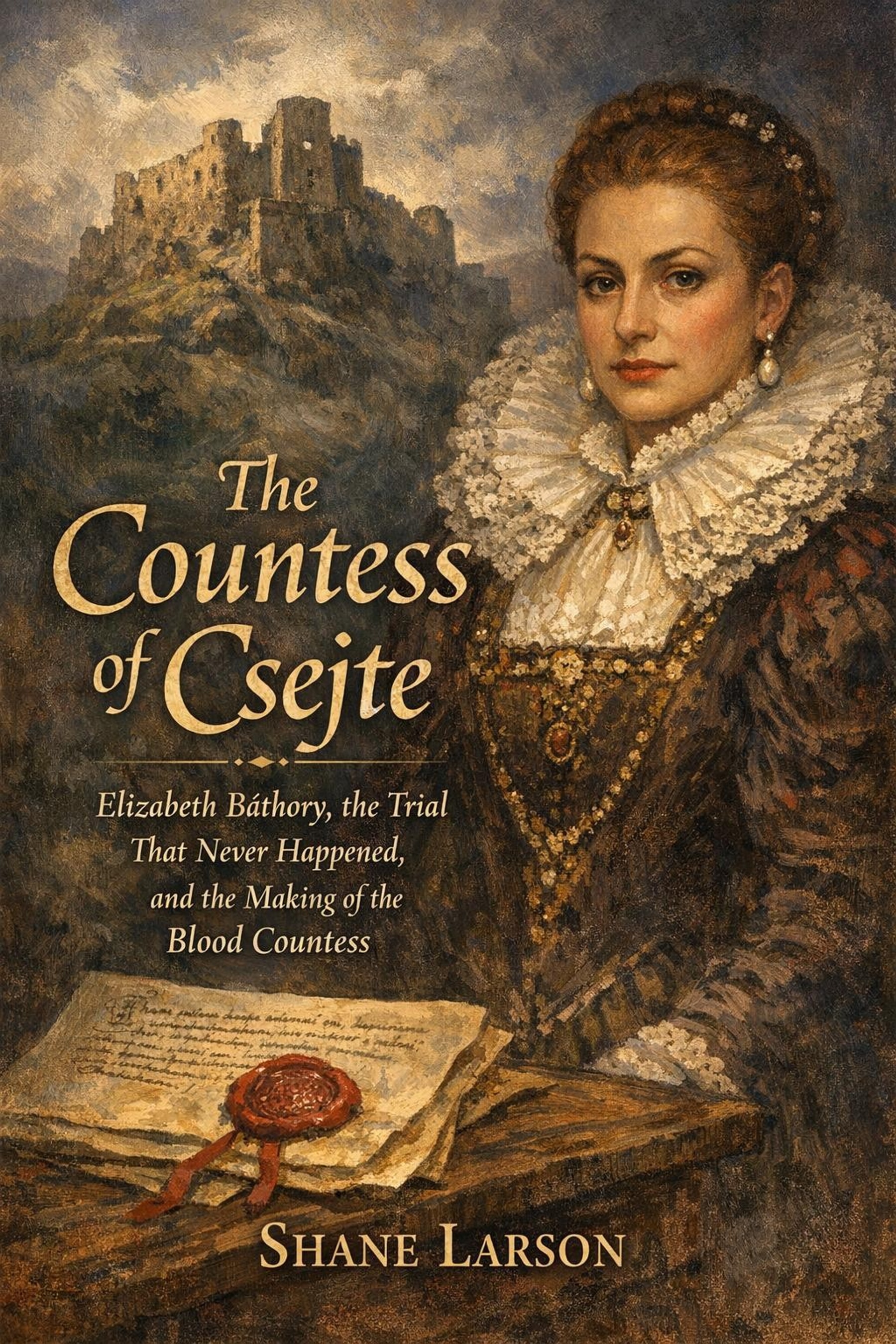
The Countess of Csejte
Elizabeth Báthory, the Trial That Never Happened, and the Making of the Blood Countess
By Shane Larson
About This Book
In June 1817 a German-language periodical in Prague called Hesperus printed a legal record that had gone unpublished for two centuries. It was a translation of the proceedings held at Bytča in January 1611: the confessions of four servants, the statements of thirteen witnesses, and the sentence passed on the accused. The copy it was made from had been certified by the chapter of Esztergom in 1705. For the first time, anyone with access to a library could read what had been sworn about Elizabeth Báthory by people who were alive when she was.
The record accuses the countess and her household of serious violence against the girls who served her. It does not contain the one thing every reader went looking for. Nobody at Bytča says she bathed in blood or used it to stay young: not the servants, who were questioned under torture, not the witnesses, and not the court.
By 1817 the bath had been in print for 88 years. Publishing the record did not dislodge it.
Elizabeth Báthory was never tried, and the most famous thing said about her appears in no document from her lifetime. The Countess of Csejte: Elizabeth Báthory, the Trial That Never Happened, and the Making of the Blood Countess starts from those two facts and works through the file that sits between them. It holds complaints running back to about 1602, an inquiry ordered by György Thurzó, the Palatine of Hungary, in March 1610, the two Bytča hearings, and a body of letters from the Palatine, the king, her sons-in-law and the countess herself. The witness statements come to about three hundred, most of them hearsay.
The outline is not disputed. At the end of December 1610 the Palatine's men seized her at Csejte, now Čachtice in Slovakia. The letter Thurzó wrote his wife the next day was sent from the nearby town of Vágújhely and reports what the men he sent into the house had found. Four servants were taken to Bytča, questioned, and sentenced within days. The countess was not there. She was never charged, never questioned on the record and never heard. The king, Matthias II, pressed for a trial. The Palatine and her family argued for confinement, and it was the Palatine in council with her relatives, not a court, who ordered her held at Csejte for life. She died there in August 1614.
For most of four centuries that silence was read as a favour done to a guilty aristocrat. Since the 1980s a group of historians has argued the opposite: that a rich Protestant widow, owed money by the crown and related to the prince of Transylvania, was removed by a procedure built to avoid a courtroom. The book gives each reading its strongest form and then its weak points. Its own position: she was probably guilty of serious and repeated violence, she was certainly never tried, the number of the dead cannot be known, and the bath is a legend with a date on it.
Why I Wrote This
I knew the bath story the way everybody knows it, and I assumed it came from the trial. Then I learned two things. There was no trial of the countess. And the bath is not in the testimony at all. It shows up in a Latin history 115 years after she died.
That gap is what hooked me. On one side there is a file: sworn statements, letters with dates on them, a court record. On the other there is a legend that never needed any of it. I wanted to know how the second came to replace the first, and I wanted to read the file the way a court should have and never did.
I also wanted to do it without the gore. The accusations are stated plainly here and not dwelt on. Most of the girls in the record have no names.
Frequently Asked Questions
Did Elizabeth Báthory really bathe in blood?
No document from her lifetime says so. The story first appears in print in 1729, in a history by the Jesuit László Turóczi, 115 years after her death in 1614. The Bytča record, printed in 1817, contains accusations of violence and no bath.
Was Elizabeth Báthory ever put on trial?
No. Four of her servants were tried at Bytča in January 1611, and three were put to death. The countess was not charged, not questioned on the record and not present. The Palatine, in council with her family, ordered her confined at Csejte, and the king's demand for a trial was allowed to drop.
How many people did Elizabeth Báthory kill?
Nobody knows, and the book says so. The servants gave counts of a few dozen each under torture. The figure of 650 comes from a register that one witness said another person had seen, and that was never produced. Most historians today think real and lethal violence is more likely than not, and treat the 650 as legend.
Was Elizabeth Báthory framed?
Some historians have argued it since 1984, pointing to the crown's debt to her estate, her lands and her Transylvanian kin. The theory explains why powerful men might have wanted her gone. It does not explain about three hundred witness statements or complaints that predate the politics by years. The book lays out both sides.
Did Elizabeth Báthory inspire Dracula?
It has been claimed and not shown. A book that retold her story is in Bram Stoker's list of sources, but his surviving working notes contain nothing about her.
If You Liked This, You Might Like
- The Bloody Benders: a Kansas case where, as at Csejte, the legend grew fastest exactly where the file was thinnest.
- Suleiman the Magnificent: the sultan whose victory at Mohács in 1526 split Hungary into the three parts the countess was born into.
- The Thirty Years' War: what became of the world of Matthias II, the king who wanted her tried and did not get his way.
A file with no verdict, a legend with no source, and a clear account of how one came to stand in for the other.
What You'll Learn
- Three grades of certainty. Every claim is marked in plain words as recorded, probable or legend, so the reader can see what a document of 1602 to 1614 says, what most historians accept, and what turned up after she was dead.
- A person before a defendant. Married at fourteen to Ferenc Nádasdy, a leading commander of the Long Turkish War, she ran a scattered network of castles and villages through his campaigns and then as his widow. Her own letters survive, and the book uses them.
- The inquiry as procedure. Two notaries, about three hundred statements, and the question an early modern lawyer would ask of each one: did this witness see it, or hear of it?
- The arrest, source by source. The claim that she was caught in the act comes from the preamble to the Bytča record of 7 January 1611. The Palatine's own letter, written the morning after, does not say it.
- Where the 650 comes from. One witness at Bytča said a household official had seen a list, signed in the countess's hand, with 650 names. The official did not confirm it and no list was ever produced. Appendix C sets out every victim count from 1611 to the present with its source and date.
- The frame-up theory, argued both ways. The crown's unpaid debt, the estates, and her kinsman in Transylvania are set against complaints older than the politics and a Palatine who took none of her land.
- Cruelty, discipline and medicine in 1600. What the law allowed a mistress to do to a servant, what counted as healing, and what witchcraft language in the testimony says about the witnesses.
- The legend's paper trail. A Jesuit history printed at Nagyszombat in 1729, a Lutheran scholar in 1742, a Viennese book on human nature in 1796, an English traveller in 1839 and a clergyman writing about werewolves in 1865. Each added something and none took anything out.
- Dracula and the record books. What Bram Stoker's working notes do and do not contain, and how a figure reported third-hand came to be printed as a score.
New Early Modern History releases and free chapters — no spam, unsubscribe anytime.
More in This Genre
View all →