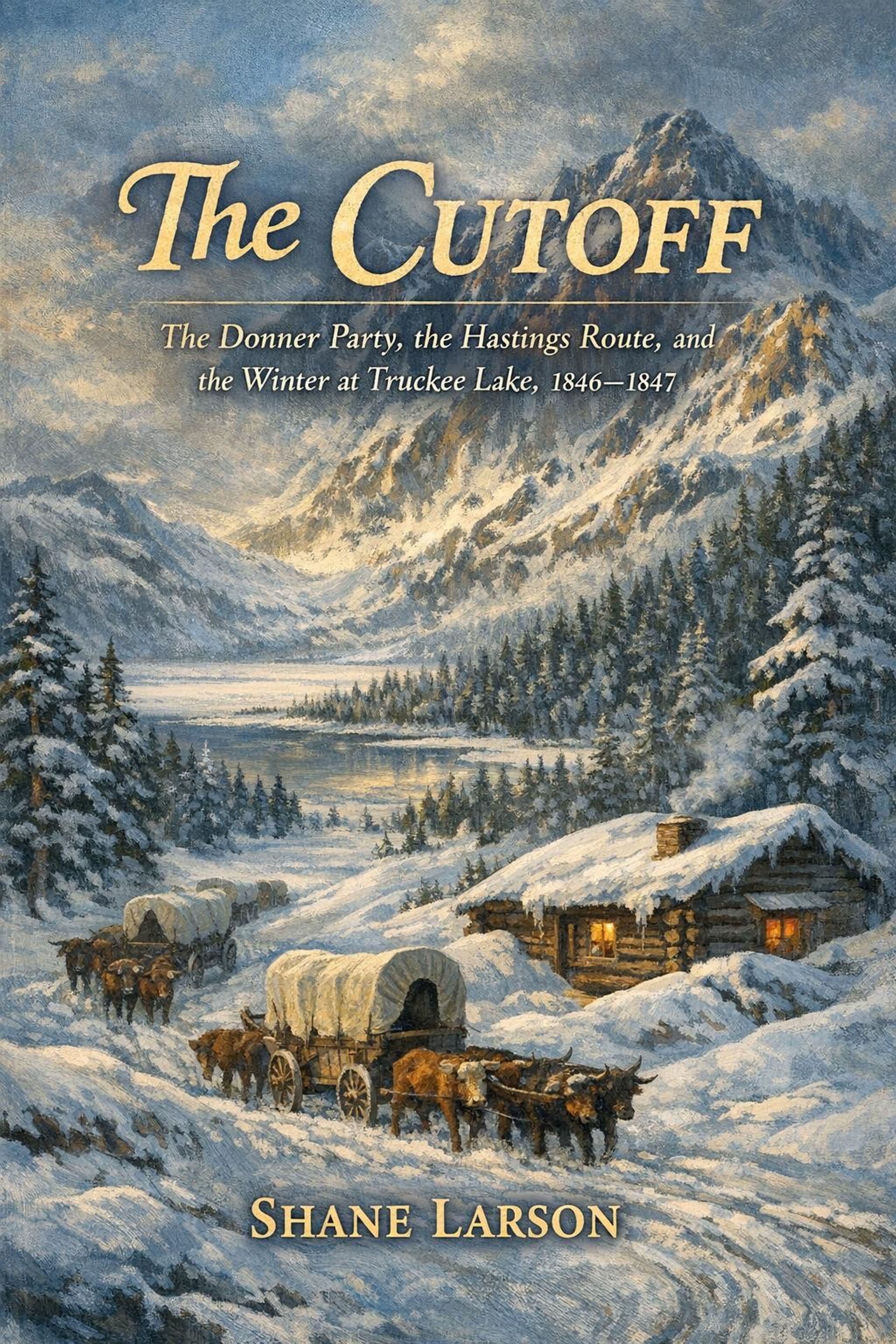
The Cutoff
The Donner Party, the Hastings Route, and the Winter at Truckee Lake, 1846-1847
By Shane Larson
About This Book
At Fort Laramie in the last days of June 1846, two men who had served in the same militia company fourteen years earlier met again. One was James Clyman, a mountain man riding east after crossing the Great Salt Lake Desert on horseback. The other was James Reed, a businessman from Springfield, Illinois, heading west with his wife, four children and three wagons. Clyman told him to take the regular wagon road to California and never leave it.
Reed had a book that said otherwise. Its author had never taken a wagon over the route he was recommending.
What happened to the people who followed that book has been reduced, over a hundred and eighty years, to a single word. This is an account of everything the word leaves out.
The Story
The company that history calls the Donner Party was never really a party. It was a collection of families who happened to be traveling at the same pace: prosperous Illinois farmers, an Irish family from Iowa, a widow from Tennessee with her married daughters, a German couple, a handful of hired teamsters. On or about 20 July 1846, at a creek called the Little Sandy, they turned left where almost everyone else turned right, and elected a farmer of about sixty named George Donner as their captain.
The left-hand road led to the Hastings Cutoff. On the map it was a straight line south of the Great Salt Lake. On the ground it was a mountain range with no road through it, which the men cut by hand at about two miles a day, followed by a salt desert that swallowed wagons to the axles. By the time the cutoff rejoined the main trail the company was about a month behind and coming apart. A man was killed in a fight over tangled ox teams. Another, too old to walk, was left beside the road. A third went back to hide his wagon and was never seen again.
They reached the foot of the last pass at the end of October. The snow reached it at about the same time. Eighty-one people spent the next four months in cabins by Truckee Lake and in brush shelters at Alder Creek, a few miles back.
The rest is a story of separate groups. Fifteen people who walked out in December on snowshoes made from ox yokes. The families who stayed, boiling hides. A father on the far side of the mountains, banished from the company in October, trying to raise a rescue in a province at war. And four relief parties of settlers and sailors who climbed the pass from the west, one after another, between February and April.
Why I Wrote This
I live in Alaska, and the part of this story I could not stop thinking about was the calendar. Nobody in that company did anything stupid in November. By November there was nothing left to decide. Everything that mattered had been settled in July and August, in good weather, by sensible people weighing a printed book against a stranger's warning and choosing the book.
I have built things with hand tools and I know how long a mile of road takes when you are cutting it yourself. Reading about the Wasatch, I kept doing the arithmetic they must have been doing, every evening, as the days went.
The other thing was the names. I had read about "the Donner Party" for years without being able to name six of them. Once you know who the Breens were, and the Graveses, and Charles Stanton, who got out and came back, the famous part stops being the point.
Frequently Asked Questions
Did the Donner Party really resort to cannibalism?
Yes. Survivors, rescuers and a diary kept in the camp all record it, at the lake cabins, on the snowshoe crossing and at the relief party's stranded camp west of the pass. Whether it happened at the Donner families' own camp at Alder Creek is less certain, and the book sets out the evidence on both sides. What the record also shows is that it came late, after months of eating hides and boiled bone.
What was the Hastings Cutoff and why did it fail?
It was a route south of the Great Salt Lake promoted by Lansford Hastings as a shorter way to California. Hastings had crossed it on horseback but never with wagons. It turned out to be longer than the established road, not shorter, with a mountain range that had to be cleared by hand and a waterless desert about eighty miles across. The delay put the company at the Sierra about a month late.
How many people were in the Donner Party and how many survived?
Counts differ depending on who is included. By this book's count, eighty-seven people made up the company, eighty-one were snowbound (including two Miwok men sent from Sutter's Fort), thirty-six of those died, and forty-five survived. A chapter explains why every published total is slightly different.
Is this book graphic?
No. It states what happened plainly and attributes it to the people who reported it, and it does not linger. Readers looking for a horror story will be disappointed. The book is about decisions, families and evidence.
Do I need to know anything about the Oregon and California trails first?
No. The book starts in Springfield, Illinois, in the spring of 1846 and explains the trail, the politics and the geography as the families meet them.
If You Liked This, You Might Like
- Kit Carson — Carson rode with Fremont across the same salt desert a year before the Donners, on the crossing Hastings used to sell his shortcut.
- Nine Hours Late — Another expedition undone by timing and a wrong turn, this time in the Australian interior, and another story in which the Indigenous people on the ground knew what the travelers did not.
- The Dime Novel West — How newspapers and showmen turned the frontier into a legend. The Donner story was one of the first to get the treatment.
Eighty-one people, four months, one bad piece of advice taken in good weather. This is the long version, with the names left in.
What You'll Learn
- The guidebook itself. What Lansford Hastings actually wrote, what he told people in person, and how one sentence in a book came to outweigh the advice of a man who had just ridden the route.
- The road through the Wasatch. Nearly three weeks to cover some thirty-six miles. Eleven months later the Mormon pioneers drove into the Salt Lake valley on the road these families built.
- Luis and Salvador. Two Miwok vaqueros from Sutter's Fort came over the pass with food for strangers. They were shot and eaten on the snowshoe crossing. Most tellings give them a clause. This one gives them their names every time.
- Patrick Breen's diary. The only record kept inside the camps as the winter happened, read closely: what he recorded, what he could not see, and the one entry everyone quotes.
- The Alder Creek excavations. What archaeologists found at the Donner family's hearth in 2003 and 2004, and why an absence of human bone neither proves nor disproves anything.
- Who lived. The demography of survival: why women outlasted men, why the young men who looked strongest died first, and why belonging to a large family mattered more than almost anything else.
- California in 1846. The war with Mexico, the politics of the relief, and why the men who might have gone up the mountain in November were three hundred miles south.
- Lewis Keseberg. The last man brought out, accused of everything. What was actually alleged, by whom, and how little of it was ever supported.
- Three reference appendices. Every member of the company by family, camp and fate; a dated timeline with the cutoff's real mileage; and a guide to the sources and how far each can be trusted.
New Wild West / American Frontier History releases and free chapters — no spam, unsubscribe anytime.
More in This Genre
View all →