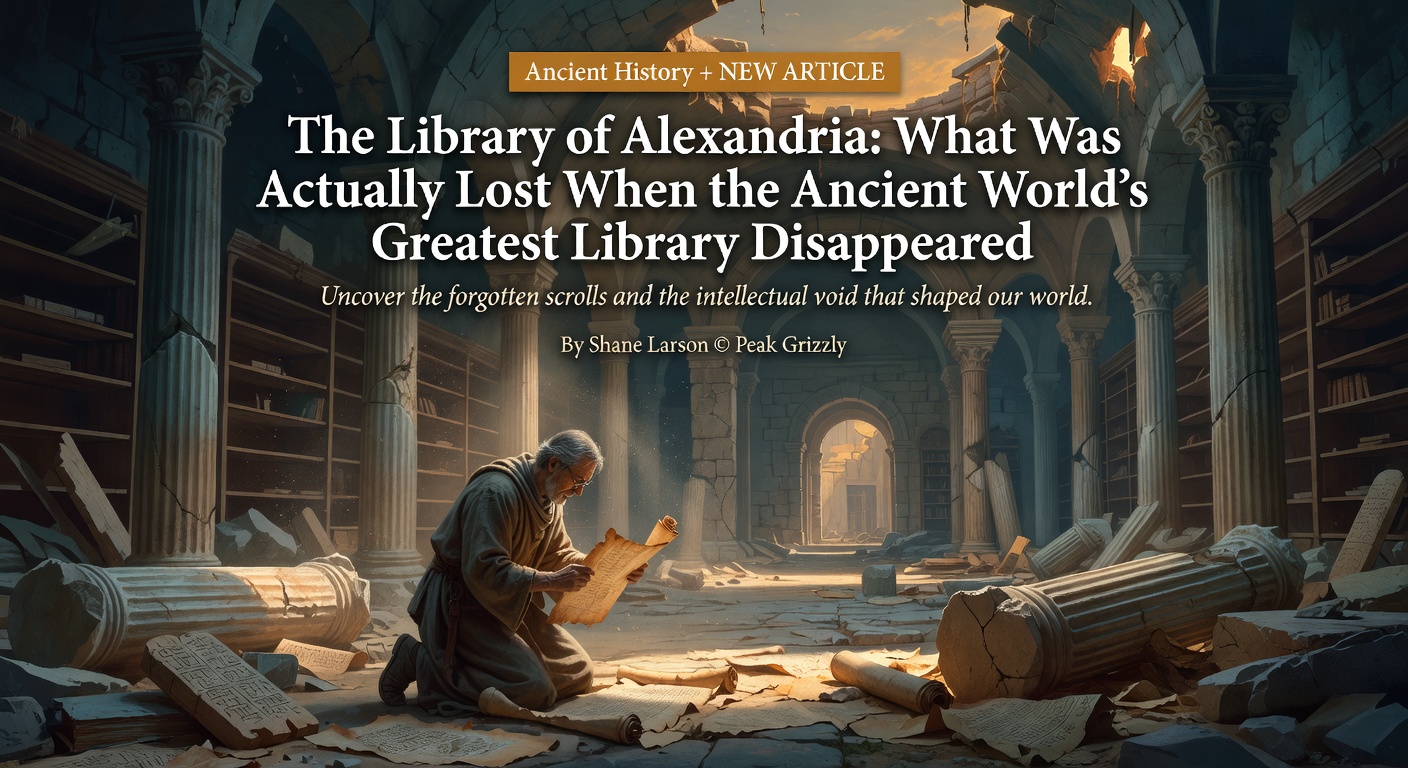
The Library of Alexandria: What Was Actually Lost When the Ancient World's Greatest Library Disappeared
April 9, 2026 · 12 min read
Most people know the Library of Alexandria was destroyed. Fewer people can tell you what was actually in it. The idea of a vast collection reduced to ashes captures the imagination, but the real tragedy lies in the specifics — the pages that fueled the minds of ancient scholars, the ideas that shaped philosophy and science, and the stories that might have altered our understanding of history. This isn't just about loss; it's about the intellectual void it created, a gap that echoes through time in the unanswered questions we still grapple with today.
That's the part that matters. Not the fire — fires happen, as they did in other great libraries like those in Rome or Antioch, where blazes were contained or rebuilt from. What matters is the inventory, the sheer breadth of human thought that was housed there, who curated it, and the profound implications of its disappearance for our collective knowledge. We'll never read those texts again, but we can piece together their shadows from fragments and references, reminding us how fragile the transmission of ideas truly is.
I just published a book on the full history of the Library of Alexandria, and the chapter that kept me up at night wasn't about the destruction. It was about the catalog of the vanished — a systematic accounting of works we know existed because other ancient authors quoted them, referenced them, or complained about them. For instance, Pliny the Elder and Strabo both drew from sources now lost, giving us tantalizing glimpses of what was there, while also highlighting how dependent we are on these secondary mentions. The scale of the loss is genuinely staggering, not just in volume but in the diversity of perspectives it represented, from everyday observations to revolutionary theories that could have accelerated human progress by centuries.
Let me give you the highlights. Or the lowlights, depending on your perspective, as they reveal both the pinnacle of ancient scholarship and the depths of what we've forfeited.
The Numbers
The Library of Alexandria at its peak held somewhere between 400,000 and 700,000 scrolls — the numbers come from ancient sources that don't always agree, such as the accounts of the librarian Galen or the historian Strabo, who based their estimates on inventory lists and eyewitness reports. These discrepancies arise partly because a single "scroll" doesn't map neatly to a modern "book"; it could be a single sheet for a short treatise or a series of connected rolls for epic works like Homer's Iliad, which might span multiple scrolls to accommodate its length. A long work might occupy twenty or thirty scrolls, requiring careful storage and organization in the library's vast halls, while a short poem might share a scroll with other texts, making the collection a dense tapestry of interwoven knowledge.
Still, even conservative estimates put the collection at something equivalent to 100,000 modern books, dwarfing any other library of the era, like the smaller collections in Pergamon or Athens. This was, without question, the largest concentration of written knowledge in the ancient world, and it remained so for centuries, serving as a beacon for scholars traveling from across the Mediterranean. The Ptolemaic rulers of Egypt built it deliberately, starting around 295 BCE, as part of their strategy to eclipse rivals like the Seleucids in intellectual prestige. They wanted Alexandria to be the intellectual capital of the Hellenistic world, and they were willing to spend extraordinary sums to make it happen — funding expeditions to buy, borrow, or even steal texts from far-flung places like Athens and Babylon. Scholars received salaries, housing, meals, and tax exemptions, which not only attracted talents like Euclid and Archimedes but also ensured a steady output of new ideas; in return, they were expected to do original research and help the library acquire every written work in existence, turning it into a living archive that evolved with each discovery.
What Was Actually There
The collection was comprehensive in a way that's hard to grasp from our modern vantage point, amassed through aggressive acquisition policies that included copying texts from visiting ships or commissioning translations from languages like Aramaic and Sanskrit. It wasn't a library in the sense we think of libraries — a curated collection of worthwhile books — but an attempt to gather everything, reflecting the Ptolemies' ambition to preserve the sum of human learning. Every Greek text, every Egyptian text, works translated from Persian, Babylonian, Hebrew; it included scientific treatises that blended empirical observation with philosophical speculation, philosophical dialogues that debated the nature of reality, epic poems that chronicled heroic deeds, plays that captured the human condition, medical texts that detailed herbal remedies and surgical techniques, astronomical observations that tracked celestial movements, engineering manuals that described aqueducts and siege engines, legal codes that governed ancient societies, religious texts that explored myth and morality, and travel accounts that mapped uncharted territories.
The catalog itself — the Pinakes, compiled by the poet and scholar Callimachus — ran to 120 scrolls, essentially a massive bibliography that organized works by author, genre, and subject, complete with biographical notes and critiques, which scholars used as a reference tool for centuries. Just the index underscores the library's scale and the effort invested in managing it. Here's a partial list of what was there and is now gone, drawing from cross-references in surviving texts to paint a fuller picture of the loss:
Literature. Sophocles wrote at least 123 plays, many of which explored themes of fate and human error in intricate detail; we have only seven, leaving behind fragments that tease at lost masterpieces like his satyr plays, which blended tragedy with comedy in ways that influenced later theater. Euripides wrote roughly 90 plays, often focusing on the psychological depths of his characters, and we have 18, but the missing ones might have included early explorations of social issues like gender and war that resonate today. Aeschylus wrote between 70 and 90 plays, pioneering the use of dramatic structure in works like his lost Prometheus Unbound, and we have seven; these aren't obscure writers — they're the three titans of Greek tragedy, and the Library of Alexandria almost certainly had complete collections of all three, potentially preserving performances that could have offered insights into ancient staging and audience reactions.
Beyond the famous names: Menander wrote over 100 comedies, celebrated for their witty dialogue and realistic portrayals of everyday life in Athens, and was considered the greatest comic playwright of the ancient world; until the 20th century, we had none of his complete plays, with only snippets surviving through quotations, though one was recovered from an Egyptian papyrus in 1958 — a reminder of how much is still buried in the sand, waiting for archaeological fortune to unearth it.
Philosophy. Aristotle's dialogues were considered by his contemporaries to be his finest work — elegant, literary, and accessible to general readers, much like Plato's own writings, which survived better due to wider copying; they're completely gone, leaving us with his lecture notes that are dense, technical, and sometimes barely coherent, such as the fragmented Physics that contrasts sharply with the polished rhetoric he was known for. The pre-Socratic philosophers — Heraclitus, with his cryptic ideas on constant change; Parmenides, who argued for the unity of being; Democritus, whose atomic theory foreshadowed modern physics; and Empedocles, who proposed the four elements — survive only in fragments quoted by later writers like Plato and Aristotle. Their complete works were in the library; for example, the full texts of Democritus alone, which likely included detailed explanations of matter and void, would transform our understanding of ancient science by providing context for how these ideas influenced later thinkers like Epicurus.
The Library of Alexandria
History. Manetho, an Egyptian priest writing in the third century BCE, produced a history of Egypt that organized pharaonic history into the dynasty system we still use, drawing on temple records and oral traditions; the complete work is lost, and we reconstruct it from summaries by later writers like Josephus, missing out on potentially vivid accounts of events like the Hyksos invasion. Berossus did the same for Babylonian history, compiling cuneiform tablets into a narrative that covered millennia, which is also lost, leaving gaps in our knowledge of Mesopotamian culture. Polybius wrote a 40-volume universal history, aiming to explain the rise of Rome through firsthand accounts of the Punic Wars; we have five complete books and fragments of the rest, but the missing volumes could have offered critical analyses of political strategies that shaped Mediterranean power dynamics.
Science. Aristarchus of Samos proposed a heliocentric model of the solar system — the sun at the center, Earth revolving around it — seventeen centuries before Copernicus, based on observations of planetary motions; his work On the Sizes and Distances of the Sun and Moon survives, but his heliocentric treatise does not, and we know about it because Archimedes mentioned it in his own writings, highlighting how one reference can preserve a revolutionary idea while the original vanishes. Eratosthenes calculated the circumference of the Earth to within roughly 2% of the correct value, using nothing but geometry, shadows measured at Syene and Alexandria, and a camel caravan's travel time to estimate distances; he also drew a map of the known world that was remarkably accurate, incorporating data from explorers like Pytheas. The map is lost, as is his geographical treatise, and we reconstruct his methods from references in other surviving works, underscoring the loss of practical techniques that could have advanced navigation earlier. Herophilus and Erasistratus performed the first systematic human dissections in Alexandria, identifying structures like nerves and the brain's ventricles, and made discoveries in anatomy that wouldn't be replicated for over a thousand years; their complete writings are gone, but echoes in Galen's texts show how their findings on circulation and the eye influenced medical practice.
The Works We Don't Know We Lost
This is the part that really gets you. Everything I've listed above, we know about because other ancient writers mentioned it, often in passing or as a counterpoint in their own arguments, like how Cicero referenced lost Stoic texts to build his philosophical cases. But the library's collection was vast, and the surviving ancient literature that references it is a tiny fraction of what once existed, perhaps because so many works were in non-Greek languages or covered niche topics that didn't align with the interests of later copyists. There were certainly works in the Library of Alexandria that no surviving source ever quotes — treatises on forgotten technologies, personal diaries of explorers, or even early mathematical puzzles that might have predated Euclid. We don't know their titles, their authors, or their subjects, but they existed, were read by scholars who debated them in the library's lecture halls, and contributed to the intellectual culture of the ancient world, influencing everything from art to governance before vanishing without leaving so much as a citation behind.
The unknown losses are, by definition, unknowable, but historians estimate that only about 1% of ancient Greek literature survives in full, based on comparisons with medieval catalogs, suggesting that the majority of the library's holdings fell into this category. Given the size of the collection and the fraction of ancient literature that survived to the medieval period — often through deliberate selections by monks or scholars who prioritized certain texts — the unknown losses almost certainly dwarf the known ones, much like how a single shipwreck might reveal a few artifacts while the ocean hides thousands more.
How Knowledge Actually Dies
Here's the thing most people get wrong about the Library of Alexandria: they focus on the destruction events, like Caesar's fire in 48 BCE, which accidentally spread to the docks and consumed part of the collection, or the later sack of the Serapeum in 391 CE, or the Arab conquest in 642 CE, each of which makes for dramatic stories and did real damage by interrupting the chain of transmission. But the primary mechanism of knowledge loss in the ancient world wasn't fire; it was the failure to copy, a process that required not just materials but a network of scribes, funding, and institutional support to prevent texts from crumbling under Egypt's harsh sun or the wear of constant handling.
Papyrus scrolls have a lifespan measured in decades to centuries, depending on conditions, with the library's location in arid Alexandria helping extend that, but even then, ink faded and edges frayed without regular renewal. The library maintained an active copying program — scribes producing fresh copies of aging texts, often cross-referencing for accuracy — which worked when the institution was well-funded and well-run, as it was under early Ptolemies who treated it as a national treasure. When the Ptolemaic dynasty declined, funding dried up amid political turmoil, and when Ptolemy VIII purged the intellectuals from Alexandria in 145 BCE, exiling figures like Aristarchus the grammarian, the scholars who knew what needed copying — who understood which texts were rare, which had multiple copies elsewhere, and which held critical insights — walked out the door. The institutional knowledge that kept the copying program effective was gone, leaving behind a collection that slowly decayed, with no one to prioritize or replace the most vulnerable works.
After that, the library was already dying, its contents gradually forgotten or overwritten by newer priorities, and the fires and destructions accelerated the process but weren't the root cause — it's the same thing that kills knowledge in every era, like the loss of Mayan codices during the Spanish conquest or the burning of Aztec libraries, where the quiet decision to stop maintaining it allowed entropy to take over.
Why This Matters Now
I wrote this book because the Library of Alexandria isn't just a historical curiosity; it's a case study in how civilizations lose knowledge, showing how even the most ambitious efforts can falter without sustained commitment, much like how the Mayan collapse led to the abandonment of their astronomical records. We tell ourselves that digital technology makes us safe — that because information is stored electronically, the kind of loss that happened in Alexandria can't happen again — but this is naive, as formats like floppy disks from the 1980s are now unreadable without specialized equipment, and vast digital archives require constant updates to avoid obsolescence. Server farms require maintenance and funding, companies go bankrupt and their data vanishes into inaccessible servers, and link rot destroys web content at a rate that would horrify ancient librarians, with studies showing that over 50% of URLs cited in academic papers from the early 2000s are now dead links.
The Internet Archive — the closest modern equivalent to the Library of Alexandria, housing petabytes of data from websites to historical texts — faces constant legal threats from copyright disputes and was literally hacked in 2024, losing portions of its collection and exposing vulnerabilities in digital preservation. The lesson of Alexandria isn't "fire is dangerous"; it's that preservation requires active, continuous, funded effort, from regular backups to legal protections, and the moment you stop maintaining knowledge, whether through papyrus copies or server updates, you start losing it.
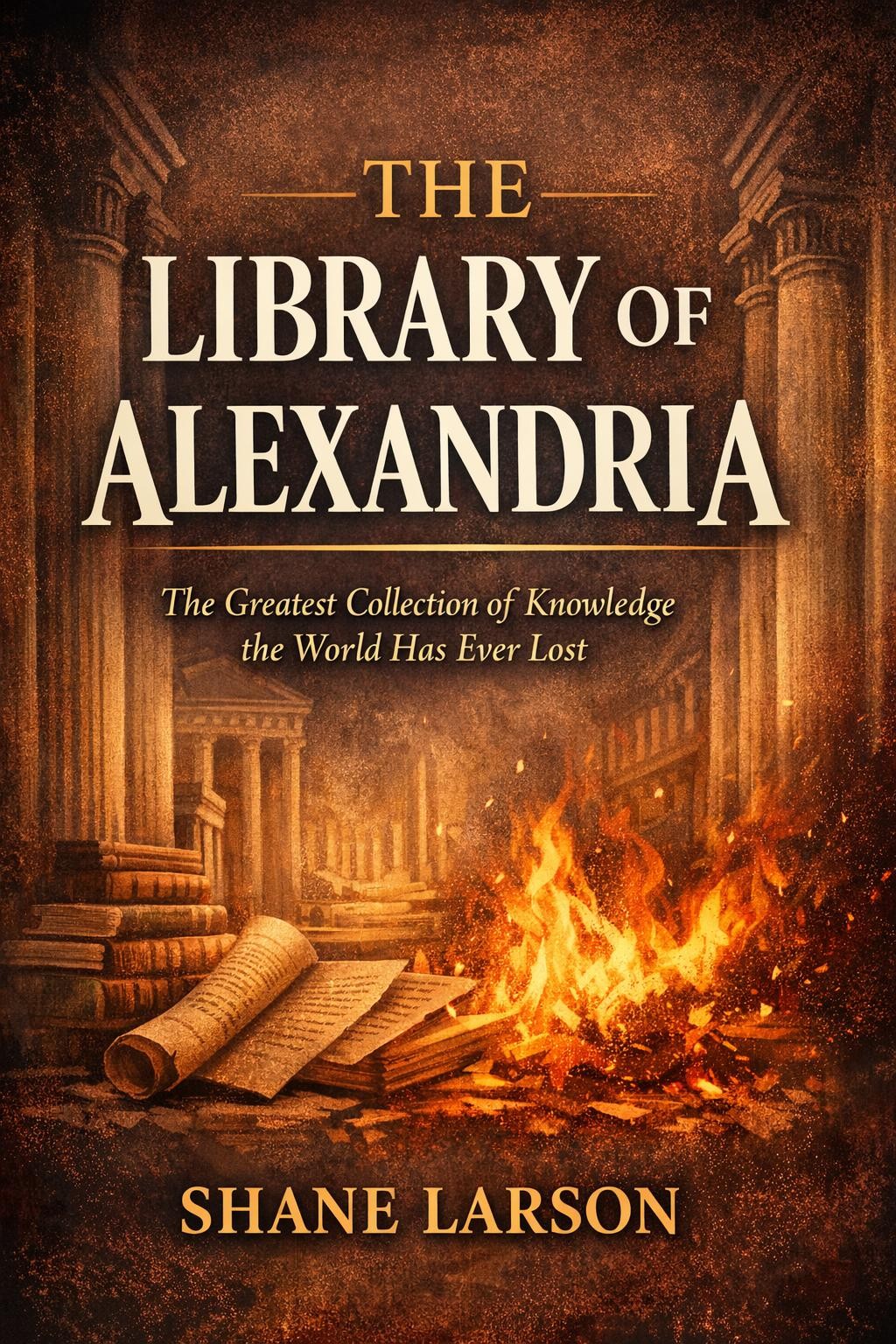
The full story — fourteen chapters, three appendices, and a detailed inventory of what was lost — is in my new book: The Library of Alexandria: The Greatest Collection of Knowledge the World Has Ever Lost.
It's part of my Ancient History series, alongside Cleopatra's Egypt, Alexander's Generals, The Persian Empire, The Fall of Rome, The Bronze Age World, Sparta: The Warrior State, Hannibal's War, and others. If you've read any of those, you'll find the same approach here: real history, clearly told, without the mythology.
Available now on Amazon Kindle. $3.99, or free with Kindle Unlimited.
The Library of Alexandria
New posts and releases, straight to your inbox. No spam, unsubscribe anytime.