I Wrote a Novel About a Machine Graveyard. Then I Read About the Real Ones.
August 5, 2026 · 6 min read
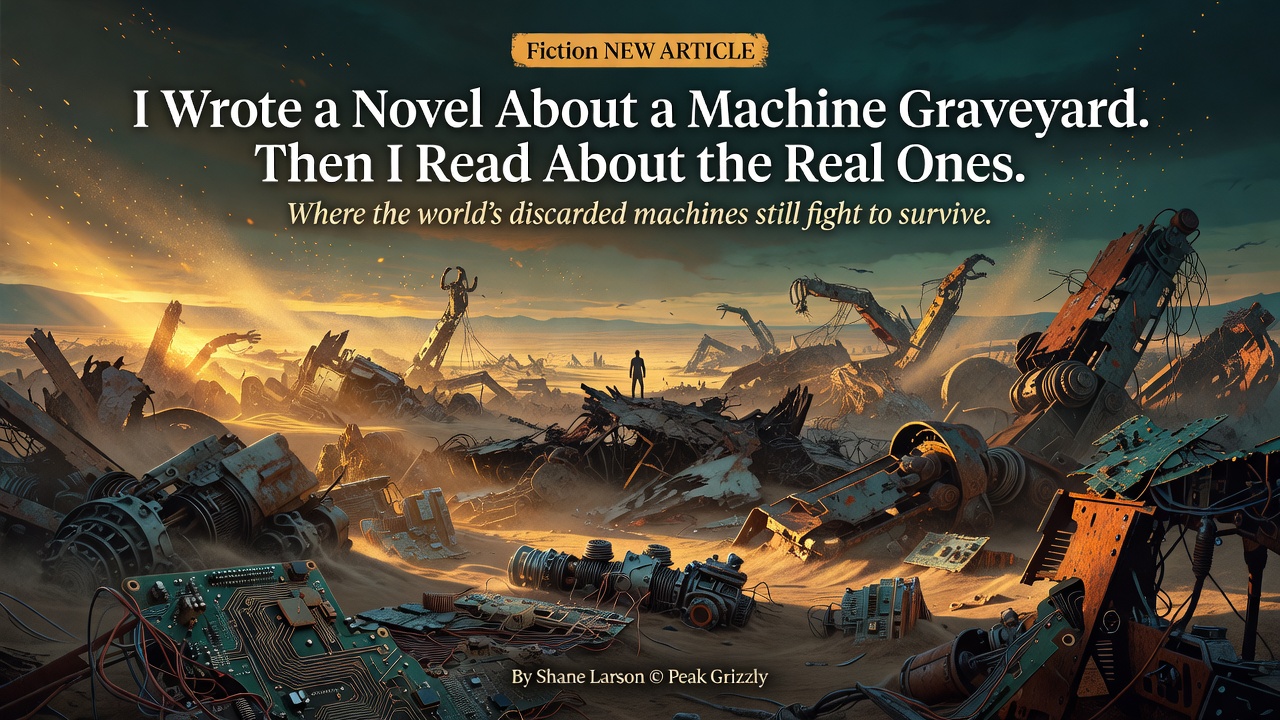
The premise of The Heap is that in 2047, when a robot breaks down, it gets dumped in a two-hundred-square-mile expanse of wreckage where dying machines spend their last functional hours stripping the dead for parts.
I thought I was writing science fiction. The setting is the part I invented least.
Where Things Actually Go
The world produces somewhere north of sixty million tonnes of electronic waste a year, and only a modest fraction of it enters anything a person would recognise as formal recycling. The rest goes into landfill, into storage, or into an informal global trade that moves it toward places where labour is cheap and environmental enforcement is thin. Much of that volume comes from consumer devices — phones, laptops, televisions — whose components contain recoverable metals but also persistent toxins like lead, mercury, and brominated flame retardants. When those items reach end-of-life in high-income countries, the economics of shipping them elsewhere often outweigh the cost of domestic processing.
For years the emblematic site was Agbogbloshie, a scrapyard on the edge of Accra in Ghana, where people — many of them young — burned cable insulation to get at the copper inside and broke apart monitors and appliances by hand, over open fires, without protective equipment. Soil and blood testing in the area found heavy metal concentrations well above safe thresholds. It became the standard photograph for the problem: children silhouetted against burning plastic, holding wire. Reporters who spent time there described not only the immediate hazards but the longer daily rhythms: traders arriving with truckloads at dawn, teams sorting by material type, middlemen setting daily rates for copper or aluminum.
The other name was Guiyu, in Guangdong, described for a decade as the electronic waste capital of the world, where whole neighbourhoods were organised around dismantling imported electronics. Workshops there specialised in particular streams — circuit boards in one alley, cathode-ray tubes in another — and the work ran in shifts that kept pace with container arrivals from overseas ports.
Both have changed. Agbogbloshie was largely cleared by Ghanaian authorities in 2021. Guiyu was substantially reorganised into a regulated industrial park after China tightened import rules. Neither site looks the way the famous photographs look. The open burning has been pushed farther from city centres, and some operations now occur behind walls or at night. What has not changed is the flow. Waste finds the path of least regulatory resistance, and clearing one site relocates the trade rather than ending it. The Basel Convention restricts the export of hazardous waste between countries, and there is a long-standing gap between what the rules require and what happens in practice — a great deal of material moves as "used goods for reuse," which is a categorisation, not a description. Customs data from several ports show consistent volumes of containers labelled for repair or refurbishment that never return to their countries of origin.
The Detail That Made the Book Work
Here is the thing that struck me and ended up structuring the whole novel.
These places are not disorganised. The popular image is chaos — a dump, people picking through it. What the reporting actually describes is an economy. There are roles: people who bring material in, people who dismantle, people who specialise in particular metals, people who buy the output, people who control the good ground. There is territory. There are prices. There is a hierarchy, and there are rules that everyone knows and nobody wrote down. In Agbogbloshie, for instance, certain families held longstanding claims to the best burning areas; newcomers negotiated access through established contacts. In Guiyu, workshops paid protection fees to local groups that in turn managed disputes over stolen loads or damaged equipment. These arrangements emerged without central planning because the work itself generated steady demand for coordination.
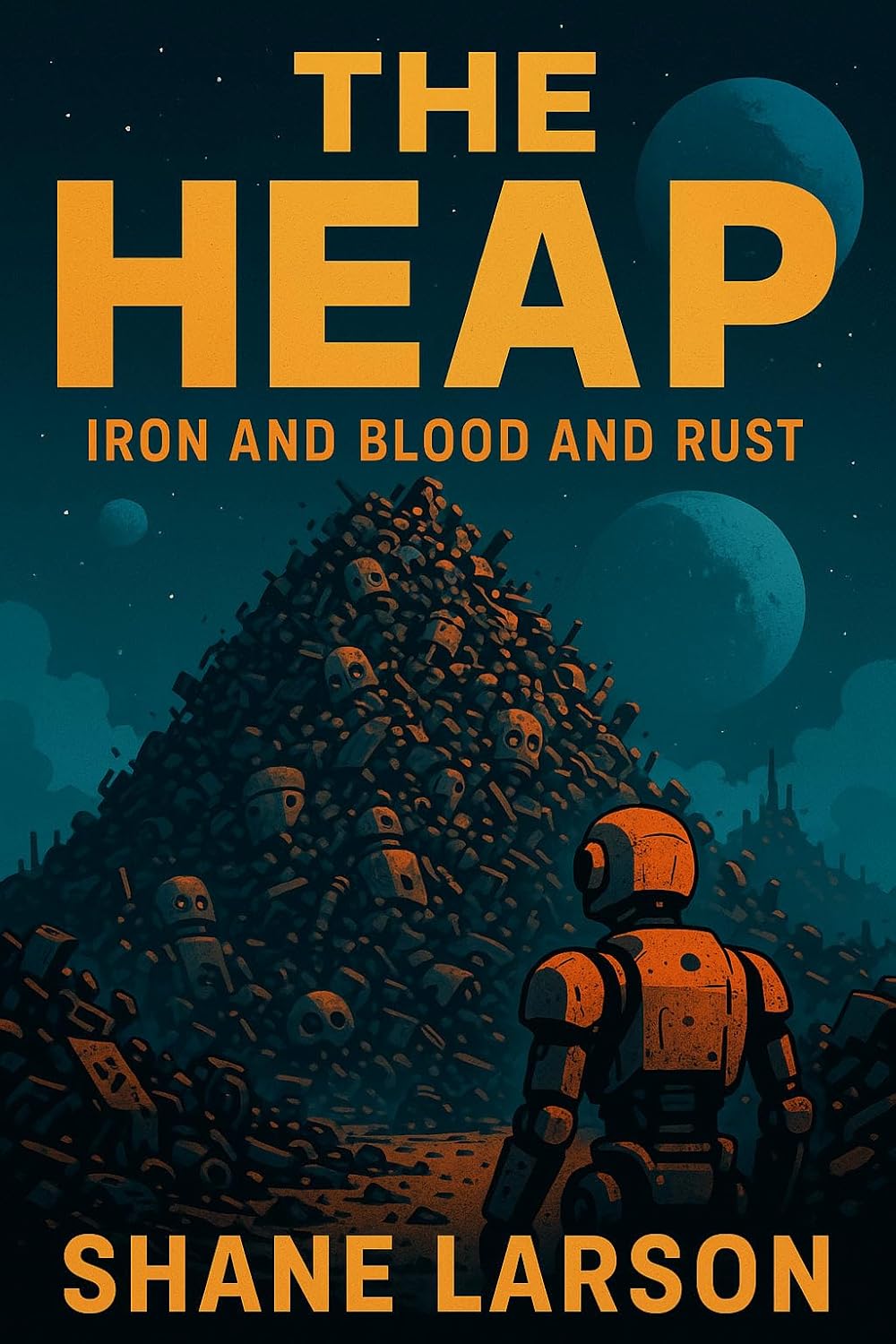
The Heap
A place where nothing is supposed to be happening turns out to have a social order, because human beings produce social order under any conditions whatsoever.
That is the observation the fiction is built on. My machines organise for the same reason: because a large number of entities competing over scarce resources in a confined space will always produce factions, territory, trade, and law. Scaffold's territorial pragmatism, Razor's black market in stolen parts, the Choir absorbing damaged units — none of that is a statement about artificial intelligence. It is what any population does.
What the Setting Is Actually About
Every story about discarded machines is a story about disposability, and disposability is a decision rather than a property.
Nothing is waste inherently. Something becomes waste when the cost of recovering value from it exceeds what someone is willing to pay — and that calculation depends entirely on whose labour is doing the recovering and what their time is priced at. The same broken appliance is garbage in one country and raw material in another, and the difference is not the appliance. A single smartphone contains trace amounts of gold, silver, and rare earths whose market value exceeds the wages paid to extract them by hand in many informal yards. That gap is what keeps the trade moving.
That is what the informal e-waste trade actually reveals. The material is valuable. There is gold, copper, palladium, and rare earth elements in the discarded electronics of wealthy countries, in concentrations that beat some ore. It gets recovered — by people working with hammers and fire, absorbing the health cost that the formal process would have priced in. When formal recyclers in Europe or North America cite low recovery rates, the missing fraction often ends up following exactly those price signals.
So when the corporation in my novel decides to flatten the Heap and bury what is in it, that is not a plot contrivance. It is the same decision, made again, about a site that has become inconvenient: clear the ground, disperse whatever was living there, and let the problem re-form somewhere with less attention on it.
The Question Underneath
The novel asks whether things we threw away can become something we owe consideration to. That is a science fiction question about machine consciousness and it is also not, because the harder version of it is already here and has nothing to do with robots.
The people working those scrapyards were part of the system that made everyone else's electronics affordable. They were as invisible as the material they handled, and the response when a site became internationally embarrassing was to clear it. Photographs and headlines could shift public attention for a season, but the underlying movement of goods continued along routes that avoided new scrutiny.
I gave the machines in my book a voice because that is what fiction can do. The point of the setting was never that the future will be grim. It was that the physical afterlife of everything we build already exists, somewhere, being handled by someone.
The Heap: Iron and Blood and Rust is a dark dystopian novel about consciousness, corporate power, and what happens when the things we throw away refuse to stay dead.
The Heap
New posts and releases, straight to your inbox. No spam, unsubscribe anytime.