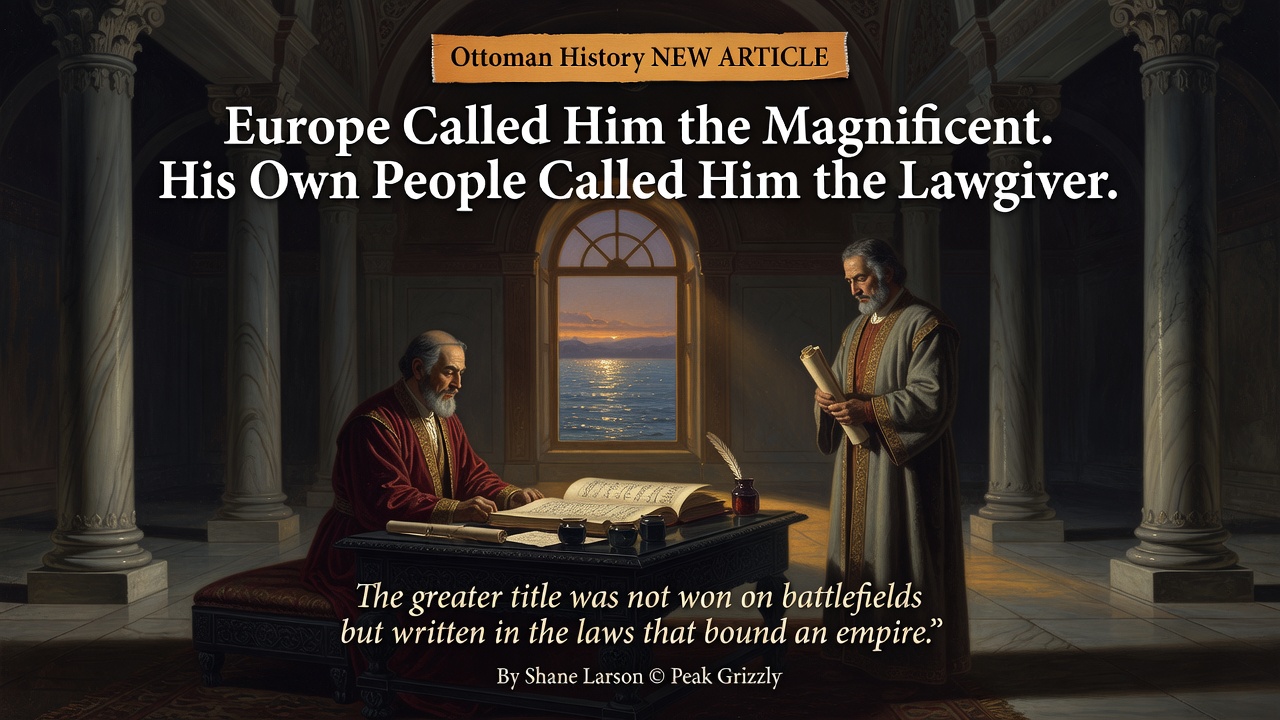
Europe Called Him the Magnificent. His Own People Called Him the Lawgiver.
August 5, 2026 · 6 min read
Europeans looking at the Ottoman Empire in the sixteenth century saw armies, wealth, and a fleet, and named its ruler Suleiman the Magnificent.
His own subjects called him Kanuni — the Lawgiver.
In Ottoman terms that was the higher compliment, and the reasoning behind it is worth understanding. Any sultan could conquer. Conquest was expected. What distinguished a genuinely great ruler was whether he delivered justice, and justice meant a legal order that actually functioned across an empire of extraordinary diversity.
The Problem He Was Solving
By Suleiman's reign the empire governed Muslims, Orthodox Christians, Armenian Christians, Jews, and others, spread across territories with incompatible traditions, economies, and customs, from the Balkans to Mesopotamia to North Africa.
One legal system could not serve all of that, and imposing one would have meant permanent revolt. In the Balkans, for instance, local customs around land use and village governance had grown up under Byzantine and then Serbian rule; in Anatolia and Syria, centuries of Islamic jurisprudence already shaped daily transactions and family disputes; in Egypt and the Maghrib, Mamluk and tribal practices still influenced taxation and market rules. A single code would have required erasing all of those layers at once.
The Ottoman answer was a dual structure. Sharia — sacred law, derived from scripture and centuries of jurisprudence, interpreted by the scholarly class — governed religion, family matters, inheritance, and much of daily life for Muslims. Alongside it ran kanun, secular law issued by the sultan, covering the areas where sacred law was silent or where practical administration needed specifics: taxation, land tenure, criminal penalties, military organisation, market regulation, and the relations between religious communities.
Suleiman's contribution was to take a kanun that had accumulated piecemeal over generations and systematise it — reconciling contradictions, standardising practice across provinces, and producing a coherent code that outlasted him by centuries. Earlier sultans had issued kanunnames for individual provinces; Suleiman gathered these into a single, revised corpus that provincial governors and kadis could consult uniformly. The result was not abstract theory but working administration: the same rules for collecting the çift tax on peasant holdings applied from Edirne to Damascus, and the same schedule of market fines governed butchers in both Bursa and Belgrade.
That is unglamorous work and it is the reason the empire held together. A state that spans several religions and dozens of ethnic groups does not survive on charisma; it survives on predictability. A merchant in Cairo and a farmer in Bosnia needed to know what the rules were and expect them to be applied.
The related arrangement — communities largely governing their own religious and personal affairs under their own leaders, within the imperial framework — meant that being a non-Muslim subject involved specific obligations, notably a tax, and also a substantial degree of autonomy. By the standards of sixteenth-century Europe, where religious difference was being settled by war, that was a materially different proposition, and it is a large part of why the empire could absorb so much territory and keep it.
The Conquests, Briefly
The military record is what earned the European name, and it was formidable. Belgrade in 1521. Rhodes in 1522, removing the Knights Hospitaller from the eastern Mediterranean. Mohács in 1526, which destroyed the Hungarian army in a couple of hours and killed the king, opening central Europe.
Then Vienna in 1529, which failed — beaten by distance, weather, and the logistics of moving siege artillery a thousand miles at the end of a campaign season. That failure marked roughly the practical limit of Ottoman power in Europe, and it is where the high-water line stayed.
Suleiman the Magnificent
At sea, under the admiral Barbarossa, the Ottoman fleet made the eastern Mediterranean effectively an Ottoman lake for a generation. North African corsair bases supplied ships and crews; the 1538 victory at Preveza confirmed Ottoman control of the sea lanes between the Adriatic and the Levant.
To the east, long and inconclusive wars with Safavid Persia — expensive, difficult, and never decisive, which is a recurring problem for empires with two fronts.
What Was Built
The reign produced the empire's cultural peak, and one name dominates it: Mimar Sinan, the chief imperial architect, who worked for Suleiman and his successors across a career of extraordinary length and output.
The Süleymaniye Mosque in Istanbul is the signature work — a vast domed complex that also housed a hospital, schools, a kitchen feeding the poor, and baths. It is worth noting the form: the great Ottoman religious buildings were social infrastructure as much as places of worship, funded by endowments designed to run in perpetuity. Sinan’s design drew on Byzantine precedent yet refined it for Ottoman needs, placing the main dome on four massive piers so that the interior remained open and the surrounding dependencies could be integrated into a single walled precinct.
Istanbul in this period was plausibly the most cosmopolitan city on earth, and it was deliberately made so — populations resettled into it, communities invited, trade privileges extended. Greek, Armenian, and Jewish quarters grew alongside Muslim ones; Venetian and Genoese merchants operated under capitulations that guaranteed their legal standing in exchange for customs revenue.
The Cost, Which Was Personal
The reign is also a study in what dynastic politics does to a family.
Suleiman broke with long precedent by marrying Hurrem Sultan, known in Europe as Roxelana, a woman who had entered the palace as a captive. Sultans did not marry. That she became his legal wife, remained at the palace rather than being sent to a province, and exercised real political influence was a genuine departure, and it reshaped court politics for generations afterward. Hurrem’s correspondence with the sultan survives, showing her involvement in diplomatic questions and in the placement of her own daughters’ marriages.
It also fed a succession crisis. In 1553 Suleiman ordered the execution of his own eldest son, Mustafa — a capable and popular heir — on suspicion of moving against him, amid factional manoeuvring at court. Another son died shortly after. Years earlier he had executed Ibrahim Pasha, his grand vizier and closest friend since youth.
Ottoman succession had no rule of primogeniture, which meant every transition was a contest and every capable son was a threat to his father and his brothers. The system produced strong rulers by ruthless selection, and it did so at a price that shows plainly in this reign.
The Death That Was Kept Secret
Suleiman died in 1566 in his tent, during a siege in Hungary, at seventy-one, still personally on campaign after forty-six years on the throne.
His grand vizier concealed the death. The body was kept in the tent, orders continued to be issued in the sultan's name, and the army was told nothing — because a sultan's death on campaign meant the army would break off and march home for the succession. The siege was completed. Only after the new sultan was secured did the news become official.
An empire whose greatest ruler had spent his life building a system of law and order ended his reign by pretending for weeks that he was still alive, because the succession had no such system at all.
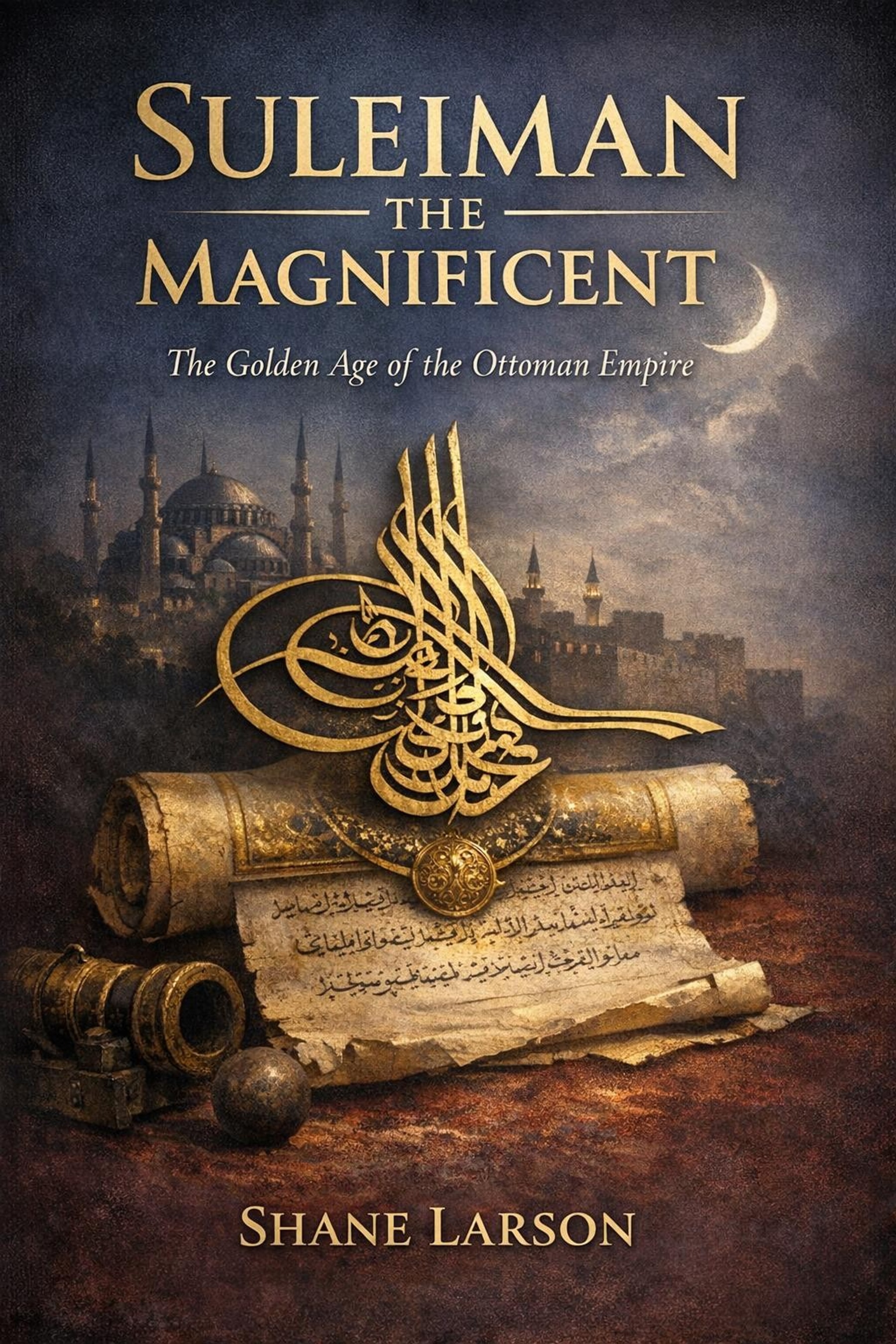
Suleiman the Magnificent: The Golden Age of the Ottoman Empire covers the full reign — the early wars, the legal reforms, Hungary and Vienna, the Mediterranean, the Persian campaigns, Hurrem Sultan, Sinan's architecture, the succession crisis, and what came after.
Suleiman the Magnificent
New posts and releases, straight to your inbox. No spam, unsubscribe anytime.