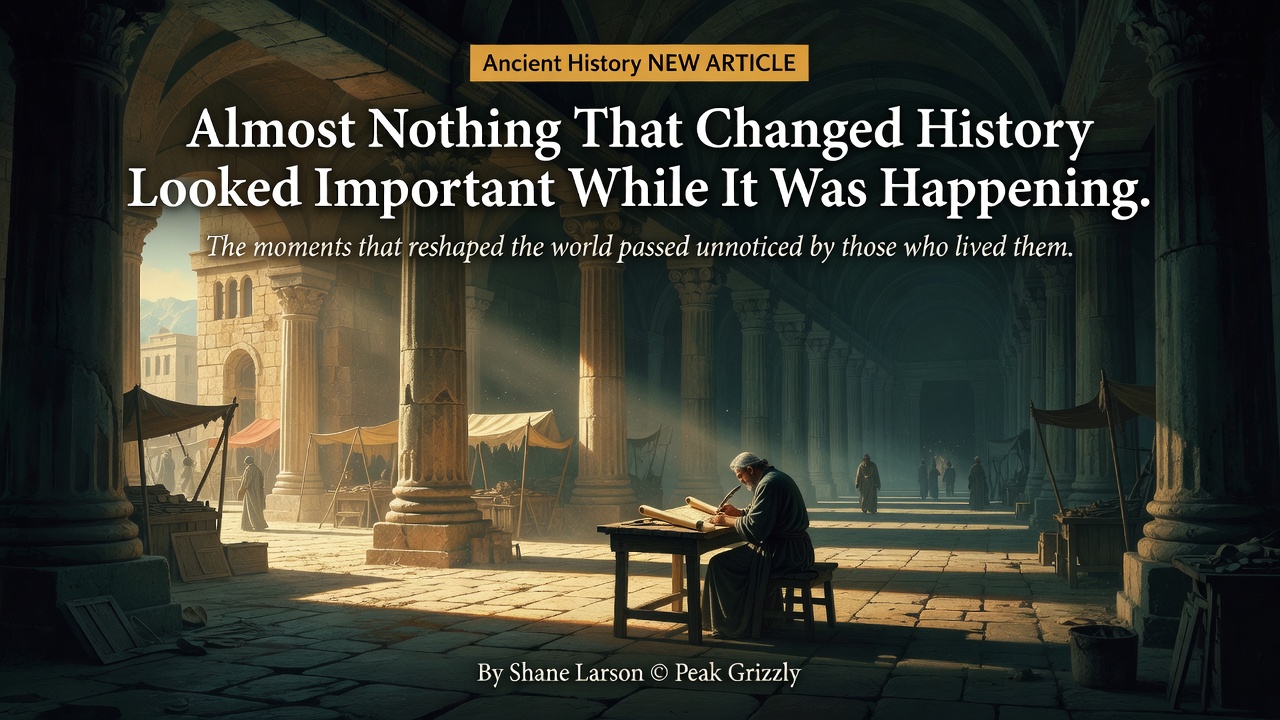
Almost Nothing That Changed History Looked Important While It Was Happening
August 5, 2026 · 5 min read
Try to name the most important thing that happened in your lifetime.
Whatever you picked, there is a decent chance the actual answer is something you did not notice at the time — a technical standard, a piece of legislation, a demographic shift, a research result published to no attention.
This is the recurring problem with pivotal events. They are identified backwards.
The Selection Is the Argument
Any list of the events that shaped the world is making a claim, and the claim is usually invisible because the list looks like a neutral recitation of facts.
Take a reasonable set: the invention of writing. The pyramids. The life of the Buddha. The founding of the Roman Republic. The birth of Christianity. The emergence of Islam. The Viking age. The Mongol conquests. The Black Death. The fall of Constantinople. The age of discovery. The Reformation. The scientific revolution. The American and French revolutions. The Industrial Revolution. Two world wars. The Russian Revolution. The moon landing.
Notice what a list like that is doing.
It is heavily weighted toward the last five hundred years, because recent events have better records and clearer consequences. It leans European and Mediterranean, because that is where the documentary tradition that produced most world-history writing came from. It favours things with dates — battles, revolutions, publications — over processes that unfolded across centuries. And it treats the arrival of a religion and the invention of a technology as commensurable, which is a philosophical position, not an obvious fact.
None of that makes the list wrong. It makes it an argument, and worth reading as one.
The Ones That Nobody Noticed
The most instructive entries are the ones that were invisible at the time.
Writing was invented for inventory control. The earliest tablets are records of grain and livestock, and for centuries after that the written record is overwhelmingly administrative. Nobody involved thought they were doing anything except solving a bookkeeping problem for a temple.
The Black Death was experienced as a catastrophe and understood as divine punishment. What it actually did — by killing a third or more of Europe's population — was invert the labour market. Survivors could demand wages. Serfdom weakened. Land became cheap and labour expensive, which pushed toward labour-saving technology. The pandemic that felt like the end of the world was, structurally, a reorganisation of European economics that nobody could have described in those terms while burying their families.
The Industrial Revolution had no start date and no announcement. It was a slow accumulation of improvements in textiles, iron, and steam that eventually compounded into the largest change in human material conditions since agriculture. Contemporaries argued about specific mills and specific machines. Nobody stood up in 1760 and said an era had begun.
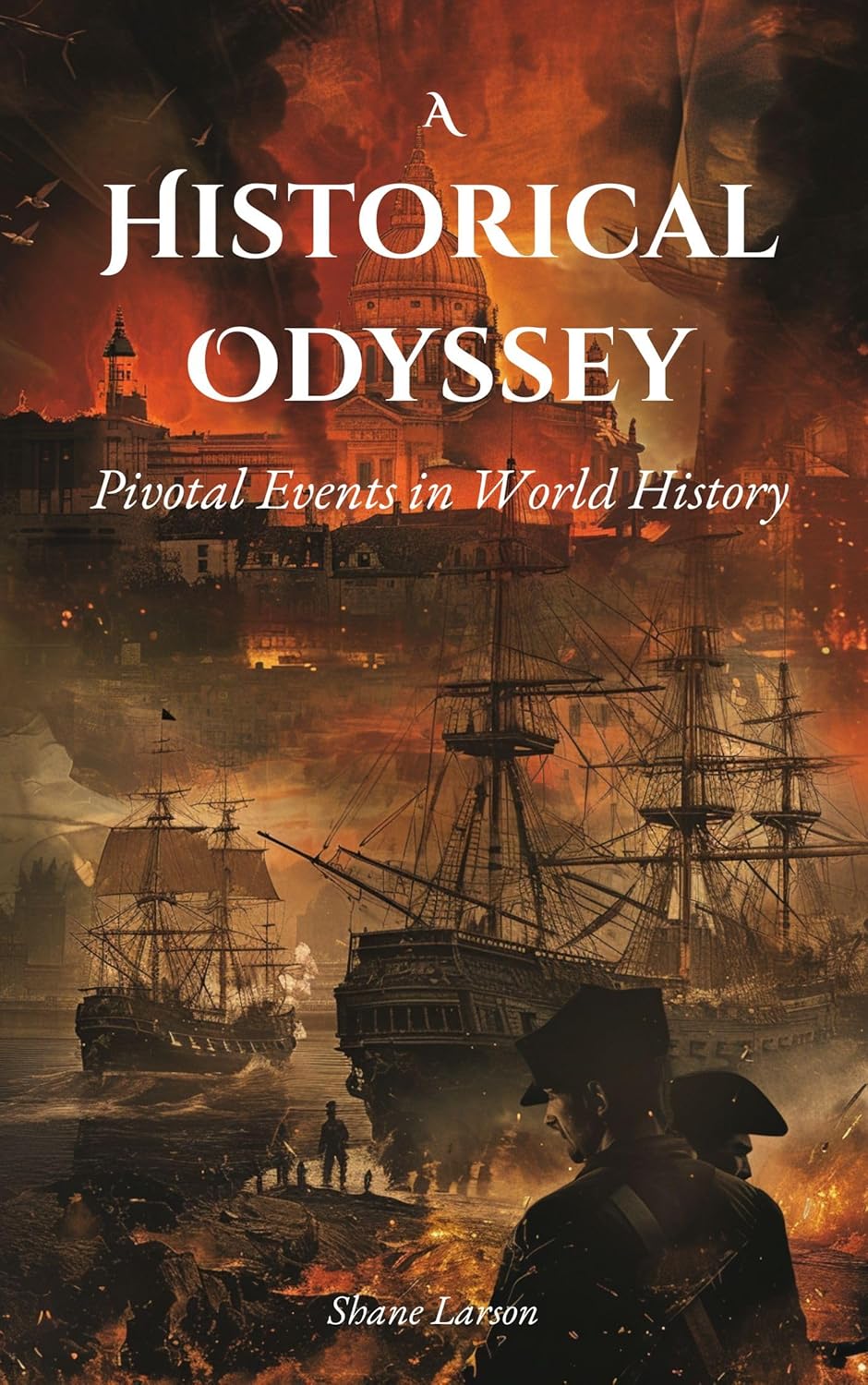
A Historical Odyssey
Now compare those to the things that felt enormous at the time. Dynastic marriages that were going to settle the fate of Europe. Wars of succession that consumed decades. Religious councils that seemed to determine the shape of civilization. Most of them are now specialist knowledge.
The pattern is reasonably consistent: events that change the rules are less visible than events that change the rulers, and contemporaries reliably overweight the second.
Why the Fall of Constantinople Is a Useful Test Case
1453 gets listed as a hinge of history — the end of the Roman Empire in its last form, the end of the medieval period, the trigger for European exploration.
Some of that holds up. The Ottoman capture of the city genuinely reorganised eastern Mediterranean power, and the migration of Greek scholars westward fed the Italian Renaissance.
But the standard story that Ottoman control of the city forced Europe to seek sea routes to Asia, thereby causing the age of discovery, is much shakier than its popularity suggests. Trade did not simply stop; the Ottomans wanted the revenue. Portuguese exploration down the African coast was already well underway before 1453, driven by its own logic.
The date survives partly because it is a date. A single day when a city falls is memorable in a way that a gradual reorientation of trade over eighty years is not, so the day inherits credit for the process.
That is worth watching for generally. When a long, complicated change gets attached to a specific year, the year is usually doing narrative work rather than causal work.
What a Survey Is Actually Good For
The case for reading history broadly rather than deeply is not that you will learn each subject properly. You won't — a chapter on the Mongol conquests is not a book on the Mongol conquests.
The case is that scale reveals shape. Reading twenty pivotal events in sequence, the recurrences become visible: how often collapse follows a peak rather than a decline; how often a technology's importance was invisible to its inventors; how often the winner's account is the only one that survives; how consistently the same institutional failures repeat in societies with nothing else in common.
You cannot see any of that from inside one subject. It only appears from a distance, and getting the distance requires covering more ground than you can cover carefully.
Which is the honest pitch for this kind of book. It is not the last thing you should read about any of these events. It is the thing that tells you which ones you want to read properly, and gives you the pattern to hang them on.
A Historical Odyssey: Pivotal Events in World History runs from the invention of writing to the moon landing — twenty turning points, what actually happened at each, and what followed.
A Historical Odyssey
New posts and releases, straight to your inbox. No spam, unsubscribe anytime.