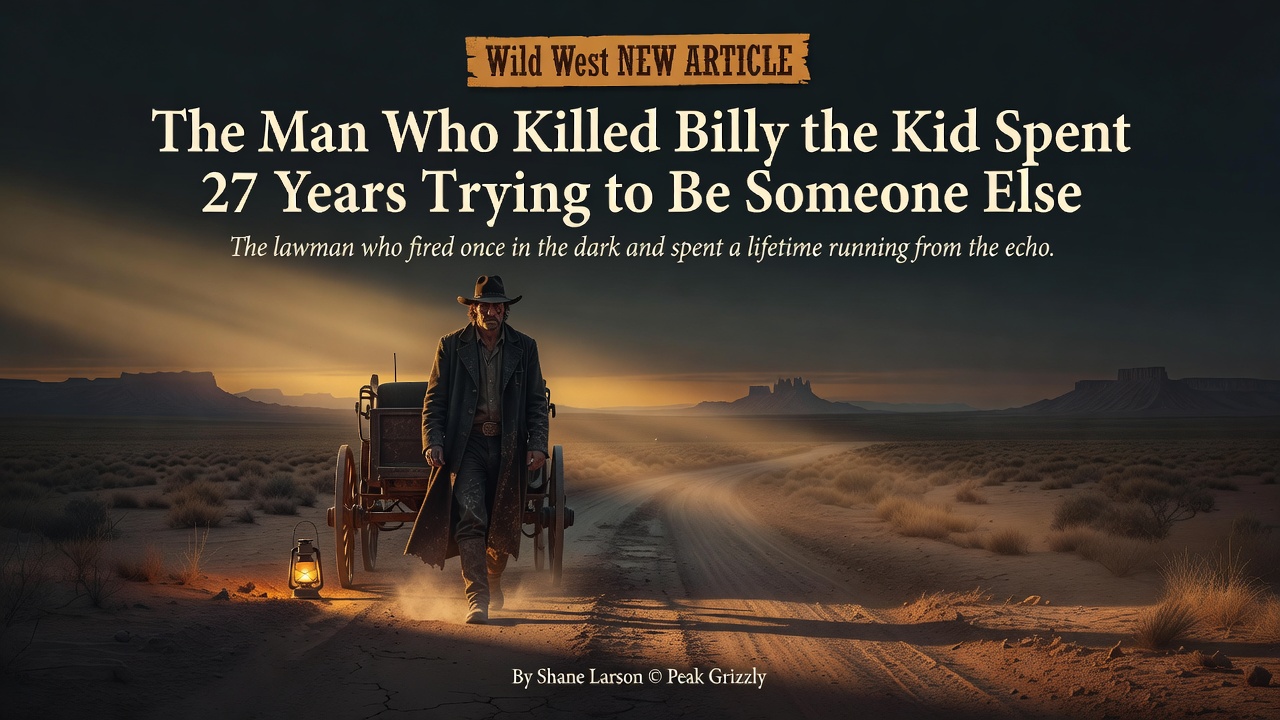
The Man Who Killed Billy the Kid Spent 27 Years Trying to Be Someone Else
July 5, 2026 · 7 min read
On the morning of February 29, 1908, a tall, gray man stepped down from a buggy on the road outside Las Cruces, New Mexico, walked a few paces to relieve himself, and was shot in the back of the head. He fell with his trousers unbuttoned. The man who confessed to the shooting was acquitted by a jury in a matter of minutes. More than a century later, no one can say with certainty who killed him or why.
The dead man was Pat Garrett — the most famous lawman in the American Southwest, the sheriff who had hunted down and killed Billy the Kid twenty-seven years earlier. And there is a terrible symmetry in how he died. Garrett had made his name by shooting a wanted man from the dark, without warning. He died exactly the same way: a single shot from behind, on a lonely road, the shooter never truly brought to account.
That symmetry is the reason his story is worth telling in full. We remember the night Garrett killed the Kid. We almost never ask what happened to the man afterward. The answer is one of the most quietly devastating arcs in the history of the American frontier.
A life built on a vanished world
Patrick Floyd Garrett was born in Alabama in 1850 and grew up on a Louisiana cotton plantation that the Civil War erased. The world he was raised to inherit simply ceased to exist while he was still a boy. Like a great many young Southern men with no future at home, he went west.
He became a buffalo hunter on the Texas plains in the 1870s, during the years when the great southern herd was being slaughtered down to nothing. It was brutal, filthy, dangerous work, and Garrett was good at it — until the buffalo were gone and the work disappeared with them. He drifted into New Mexico, tended bar, married, and might have vanished into the anonymous churn of frontier laborers and small-time strivers.
Instead, in 1880, Lincoln County needed a sheriff. The county had been torn apart by a vicious commercial feud — the Lincoln County War — and what remained was a landscape of rustlers, score-settlers, and men who had learned that the law could not touch them. The county needed someone hard enough and cool enough to end it. Garrett, tall and quiet and unafraid, got himself elected. His first and defining assignment was to hunt down a charismatic young rustler and Lincoln County War veteran he happened to know personally: William H. Bonney, better known as Billy the Kid.
The killing that made him
The hunt is genuinely gripping, and it shows Garrett at his absolute best. Through the winter of 1880 he ran the Kid's gang to ground across the Pecos country. He killed Tom O'Folliard in a confused gunfight at Fort Sumner. He cornered the rest of the gang at a rock house at Stinking Springs and froze and starved them into surrender. He was methodical, brave, and relentless — exactly the man the job demanded.
Then the Kid escaped from the Lincoln County jail, killing two of Garrett's deputies on the way out. And Garrett did the patient, unglamorous thing: he waited, gathered information, and eventually rode quietly to Fort Sumner, where he believed the Kid was hiding. On the night of July 14, 1881, he was sitting in a darkened bedroom in Pete Maxwell's house when the Kid walked in, sensed a stranger in the dark, and asked, in Spanish, who was there. Garrett fired twice. The Kid was dead before the legend even began.
Here is the fact that would haunt Garrett for the rest of his life: it was an ambush, not a duel. He shot a man who never saw it coming, in the dark, who may not have been holding a gun. By the cold logic of the job, it was the smart play — cornering Billy the Kid in the open had already killed plenty of braver, dumber men. But the frontier had a romance about the "fair fight," and that romance had no room for a sheriff who killed from the shadows. The whisper started almost immediately: he murdered an unarmed boy in the dark. Garrett heard it for the rest of his life.
The book that backfired
What Garrett did next is the part of the story that feels startlingly modern. He tried to control the narrative. In 1882, working with a hard-drinking journalist named Ash Upson, he produced The Authentic Life of Billy the Kid — a book meant to set the record straight, defend his own conduct, and cash in on his fame.
Pat Garrett
It is one of the great self-defeating projects in American publishing. The book sold poorly. Worse, its lurid, exaggerated prose — including the wildly inflated claim that the Kid had killed twenty-one men, one for each year of his life — helped build the very myth that would eventually dwarf its author. Garrett set out to author his own legend and instead handed immortality to the man he had killed. The Kid became a folk hero, the subject of dime novels and, eventually, more movies than almost any other figure of the West. Garrett became a supporting character in someone else's story. He had tried to write himself as the hero and accidentally cast himself as the villain.
There is a lesson in that for anyone living in an age when we are all, constantly, trying to manage how we're perceived. The harder Garrett tried to fix his image, the more firmly he welded himself to the one act he most wanted to escape.
The long fall
The remaining quarter-century of Garrett's life reads like a slow, grinding catalog of competence without luck. He ranched in Texas and New Mexico and lost money. He ran for office and lost. He took on the sensational, politically poisoned case of Colonel Albert Fountain and his young son, who vanished in 1896 and were presumed murdered — and after a violent standoff at a place called Wildy Well, he never secured a conviction, only fresh enemies.
His one real break came when President Theodore Roosevelt, charmed by the idea of having a genuine frontier legend on the federal payroll, appointed Garrett customs collector at El Paso. It should have been the dignified late-career landing he deserved. Instead Garrett embarrassed the administration — partly through the company he kept and a notorious photograph — and Roosevelt quietly declined to reappoint him. Garrett slid back into debt and lease disputes.
And it was a lease dispute, finally, that killed him. A petty, grinding argument over goats grazing on land Garrett wanted back put him in a buggy on the Las Cruces road on the wrong morning, with the wrong men. A man named Wayne Brazel confessed to the shooting and claimed self-defense. He was acquitted almost instantly. Many at the time, and many since, have suspected that Brazel took the fall for someone else — that a hired killer named Jim "Killer" Miller did the actual shooting, and that a web of land deals and grudges paid for it. The honest answer is that we do not know. The documented record runs out, and the theories begin.
Why his story still matters
It would be easy to file Pat Garrett under "Old West trivia" — the answer to the question who killed Billy the Kid? But his life is bigger and more human than that. It's a study of what happens when a person is permanently flattened into a single act. Garrett was brave, capable, prickly, loyal, and chronically unlucky with money and timing. He did one famous thing, and the fame of it took everything else — his fortunes, his second acts, and finally, in a strange echo, his life.
The temptation in telling this kind of story is to solve the mystery, to deliver a tidy verdict, to make Garrett either a hero or a villain. The more honest thing — and the harder thing — is to lay out exactly what the inquests, the trial transcript, the period newspapers, and Garrett's own self-serving book actually support, and then to stop where the evidence stops. The reader should finish knowing the difference between what is documented, what is argued, and what is invented. That last distinction is what separates history from legend, and Pat Garrett spent his whole life trapped on the wrong side of it.
If you've read about Billy the Kid, you already know the bright, doomed outlaw. This is the other half of that night — the man who pulled the trigger, and the twenty-seven years it cost him.
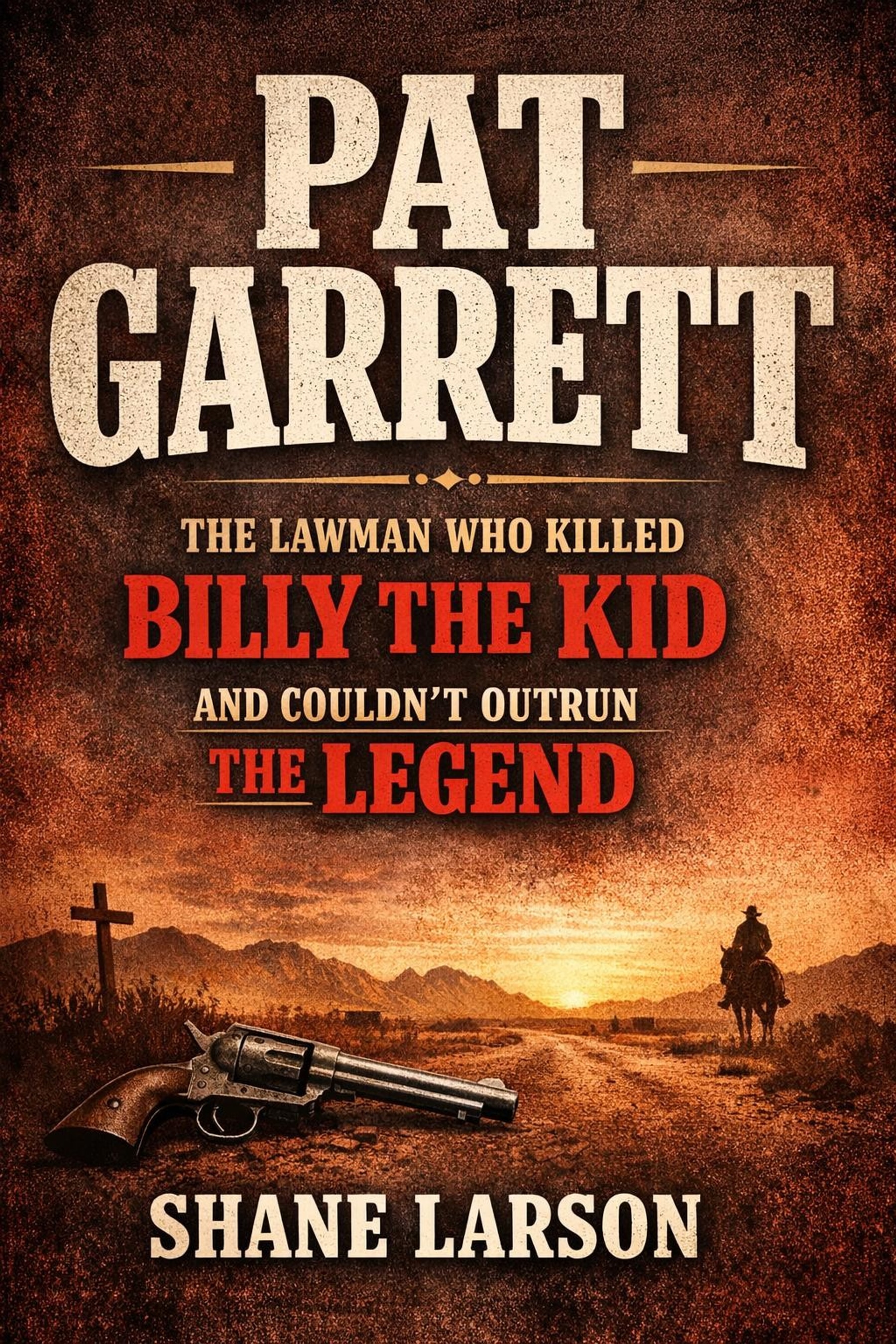
Want the whole story, told from the documented record and never faking a verdict the sources can't support? Read Pat Garrett: The Lawman Who Killed Billy the Kid and Couldn't Outrun the Legend — Book 2 of The Wild West series, available now on Kindle and free in Kindle Unlimited. Pair it with Billy the Kid and The Lincoln County War for the complete saga.
Pat Garrett
New posts and releases, straight to your inbox. No spam, unsubscribe anytime.