The Twenty-Two Signs That Changed Everything: How Phoenician Traders Democratized Literacy
March 24, 2026 · 5 min read
You are reading an alphabet right now. The letters on this screen — A, B, C, and the rest — descend in an unbroken line from a writing system standardized by Semitic-speaking traders on the eastern coast of the Mediterranean roughly three thousand years ago.
The Phoenicians did not invent writing. The Sumerians and Egyptians beat them to it by two millennia. But the Phoenicians did something arguably more important: they made writing usable by ordinary people. Before the Phoenician alphabet, literacy was a professional skill requiring years of specialized training. After it, a person of ordinary intelligence could learn to read and write in weeks.
That single innovation — reducing writing from hundreds of complex signs to twenty-two simple ones — was the most consequential development in information technology between the invention of writing itself and the invention of the printing press. And it happened because merchants needed to keep their own books.
The Literacy Bottleneck That Strangled the Ancient World
To appreciate what the Phoenicians accomplished, you need to understand the systems they replaced.
Sumerian cuneiform used roughly six hundred signs — a mix of logograms, syllabic signs, and determinatives. Egyptian hieroglyphics used several hundred more. Both systems worked. They recorded everything from temple inventories to epic poetry to diplomatic correspondence. But they shared a devastating limitation: they were brutally difficult to learn.
In Mesopotamia, scribes trained in dedicated schools called edubba — "tablet houses" — beginning as young boys and studying for years before they could write competently. In Egypt, the scribal profession was a prestigious and exclusive caste. In both civilizations, literacy was the property of a tiny professional class. Farmers, soldiers, merchants, artisans — the vast majority of the population — could not read or write.
The practical implications were enormous. Every transaction that needed recording required a trained scribe. Every message, every contract, every law. The scribal class held a monopoly on written information, and that monopoly gave them disproportionate power. Information flowed through them. Whoever controlled the scribes controlled the flow of information.
For a trading civilization like the Phoenicians, this was not an abstract problem. Maritime commerce generates staggering quantities of paperwork — invoices, contracts, inventories, shipping manifests, letters of credit, instructions to agents in distant ports. If every one of these transactions required a professionally trained scribe using a system that took years to master, the cost and friction of doing business was enormous. A merchant who could not read his own contracts was dependent on a scribe whose loyalties might lie elsewhere.
The Phoenicians needed a better system. And it turned out the raw material already existed.
From Ox Heads to the Letter A
The story begins in an unlikely place: the turquoise mines of Egypt's Sinai Peninsula, around 1800 BCE. Semitic-speaking laborers adapted a handful of Egyptian hieroglyphic signs to represent sounds in their own language using a brilliant trick called the acrophonic principle.
Each sign represented the first sound of the Semitic word for the thing it depicted. A sign shaped like an ox head represented the sound aleph — the first sound of the Semitic word for "ox." A house shape represented beth — the first sound of "house." Water represented mem. This was the conceptual breakthrough: instead of needing hundreds of signs, you could represent any word using a small set of signs for individual sounds.
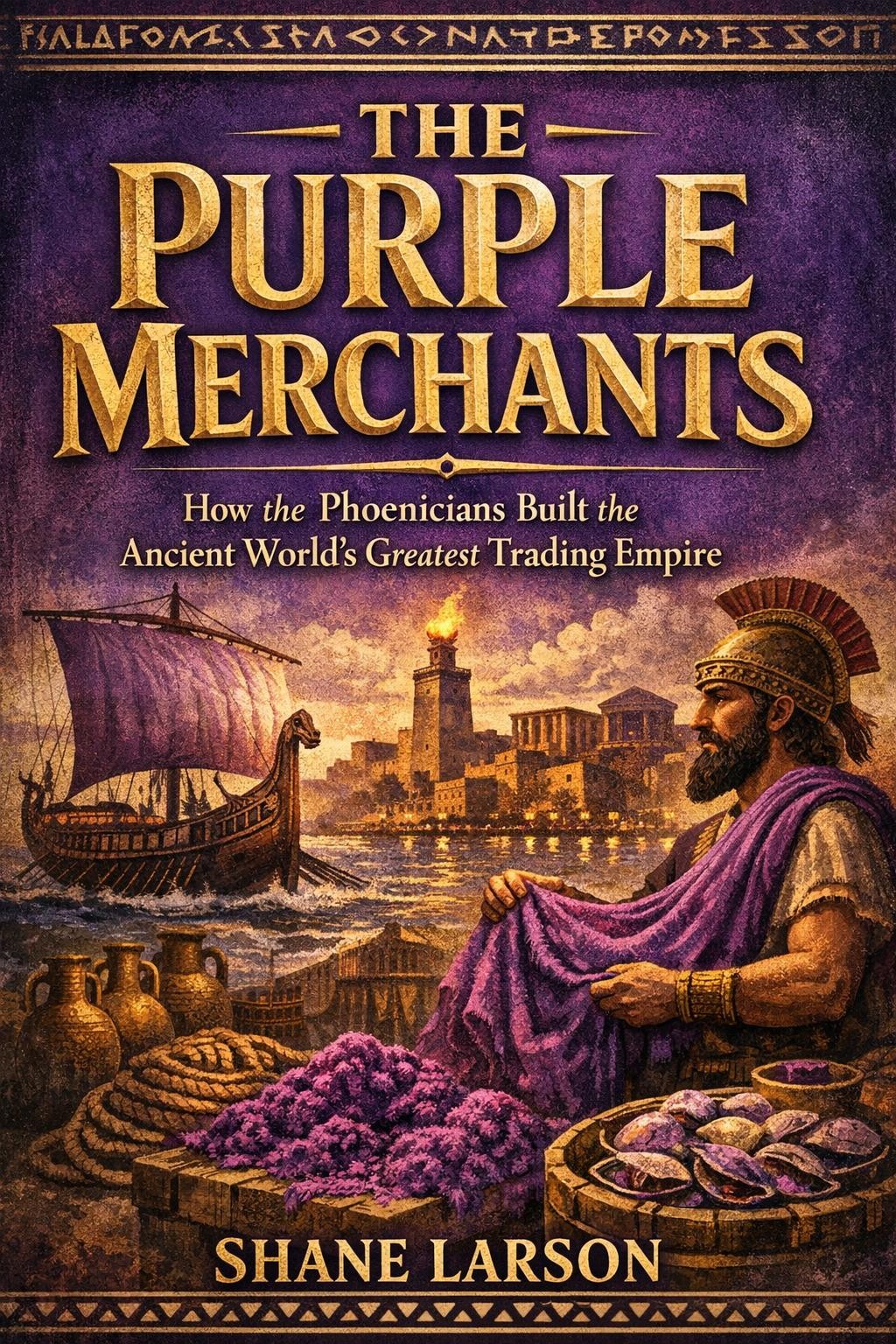
The Purple Merchants
This Proto-Sinaitic script was crude and limited — short inscriptions, unstandardized letter forms, nothing resembling a formal writing system. It remained local and informal for centuries. But the principle was established.
What the Phoenicians did was take this loose, variable, informal tradition and turn it into a standardized, systematic, widely distributed technology. By roughly 1050 BCE, they had a mature script of twenty-two consonant signs. The letter forms were consistent — a text from Byblos looked the same as one from Tyre or Sidon. The system was clean, efficient, and learnable.
Twenty-two signs. Compare that to cuneiform's six hundred. A Phoenician merchant could learn the entire system in weeks and keep his own records. Ship captains could write their own logs. Agents in distant ports could communicate directly with their principals. The alphabet democratized literacy by removing the single greatest barrier: the sheer difficulty of learning to write.
The Greeks borrowed it and called the letters phoinikeia grammata — "Phoenician letters." The names of the Greek letters — alpha, beta, gamma, delta — are transparently derived from Phoenician: aleph, beth, gimel, daleth. These Semitic words meant "ox," "house," "throwing stick," and "door." They were meaningless in Greek. The Greeks borrowed the names along with the letters, the way you might borrow a foreign tool and keep calling it by its foreign name.
The Greek innovation was to add vowels — repurposing Phoenician consonant letters that represented sounds Greek didn't use. The Phoenician aleph (a glottal stop) became alpha, the vowel "a." The Phoenician he became epsilon, the vowel "e." This completed the system: the first true alphabet capable of representing both consonants and vowels explicitly.
The Family Tree That Covers the Planet
Follow the descendants far enough and the scope becomes staggering.
From Greek came the Etruscan script, from which came the Latin alphabet — the one you are reading now, used today for English, Spanish, French, German, Portuguese, Indonesian, Turkish, Vietnamese, and hundreds of other languages. From Greek also came the Cyrillic script, via the Byzantine missionaries Cyril and Methodius, used today for Russian, Ukrainian, Bulgarian, and Serbian.
The Phoenician alphabet also spawned scripts moving east. Aramaic script descended directly from Phoenician and became the writing system of the entire Near East during the Persian period. From Aramaic came Hebrew and Arabic. From Aramaic-influenced scripts came writing systems used as far east as Mongolia.
Latin, Greek, Cyrillic, Hebrew, Arabic, Ethiopic, Armenian, Georgian — all descend from the Phoenician original. Even scripts that look radically different, like Devanagari or Thai, may trace their ultimate ancestry back to the Semitic writing tradition that Phoenician traders standardized and spread.
Twenty-two signs invented by traders on the Lebanese coast are the ancestor, directly or indirectly, of virtually every alphabetic writing system in use on Earth today. The Phoenicians didn't just build the ancient world's greatest trading empire. They built the infrastructure of human communication itself — and then history forgot them.
They invented the alphabet. They manufactured Tyrian purple, worth more than its weight in gold. They sailed to Britain for tin and possibly to West Africa for gold. They founded Carthage, which would become Rome's most dangerous rival. And almost nobody remembers their name.
The Purple Merchants
New posts and releases, straight to your inbox. No spam, unsubscribe anytime.