The People Who Gave the World the Alphabet Left Almost Nothing Written
August 5, 2026 · 6 min read
For roughly a thousand years, the Phoenicians were the most important commercial civilization in the Mediterranean. They ran the sea lanes, founded colonies from Cyprus to Spain, supplied timber and luxury goods to every major power in the Near East, and produced the writing system that nearly every alphabet in use today descends from. Their ships moved cedar logs to Egypt for temple construction, carried tin from Iberia to fuel bronze production across the region, and maintained regular routes that linked Levantine ports with North African and southern European shores. Yet nearly everything we know about their internal world comes second-hand.
And we know them mostly through what their competitors and conquerors wrote about them.
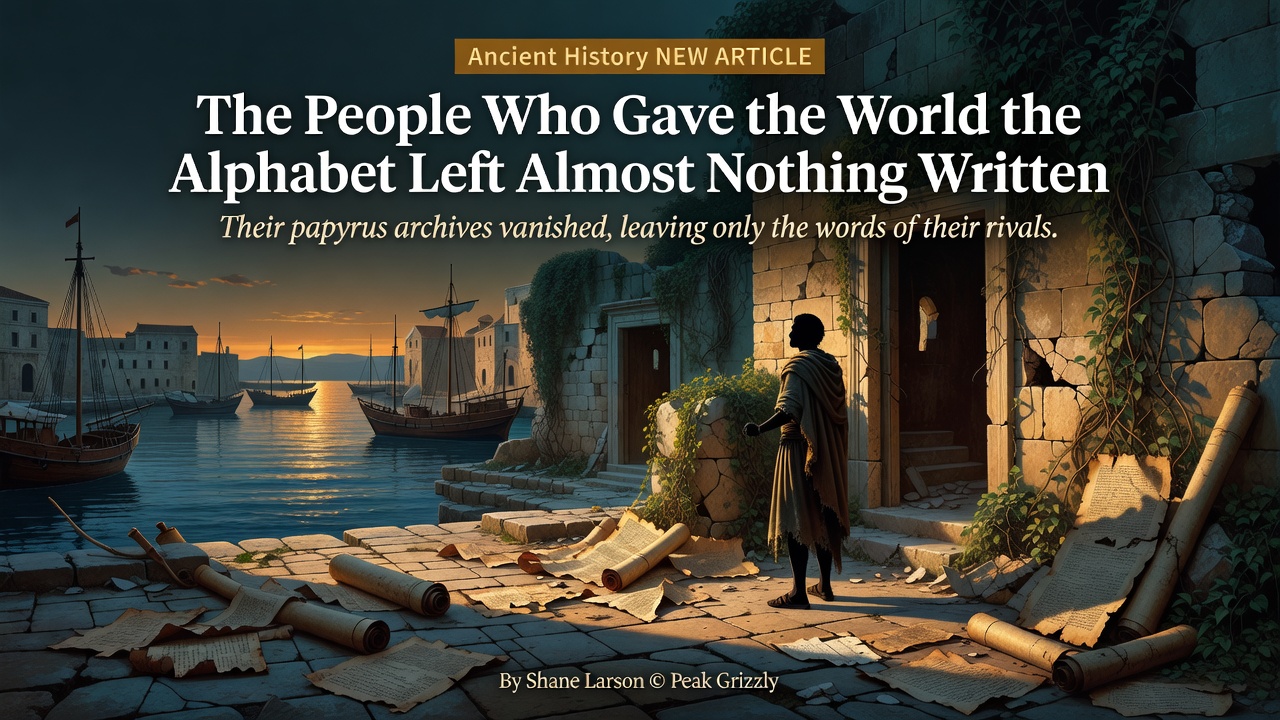
The reason is banal and total. The Phoenicians wrote on papyrus, and papyrus does not survive in the humid coastal climate of the Levant. The Egyptians got lucky with a desert. The Mesopotamians got lucky by writing on clay, which fires hard and lasts forever. The Phoenicians used the more convenient medium, and the entire archive of a civilization — its histories, its literature, its commercial records, its own account of itself — is gone. Only stray references in Egyptian administrative texts or Assyrian tribute lists hint at the scale of their bookkeeping. What remains is inscriptions on stone and metal, mostly short and formulaic, plus what Greeks, Romans, Assyrians, and Hebrews said about them. Which is roughly like reconstructing a company from its competitors' press releases.
A Civilization That Never Tried to Rule Anything
The second reason they are underweighted in popular history is that they do not fit the shape people expect a great civilization to have.
There was no Phoenician empire. There was no Phoenician king, no capital, no unified state. Tyre, Sidon, and Byblos were independent city-states that cooperated commercially, competed with each other, and were periodically dominated by whichever land power was strongest — Assyria, Babylon, Persia, and eventually Alexander. Each city maintained its own king and pantheon while sharing a common script and religious calendar that allowed merchants from one to operate smoothly in another. When Assyrian kings demanded tribute, the cities paid in timber, dyed textiles, and finished metalwork rather than risk their fleets in open rebellion. This pattern repeated under Babylonian and Persian overlords, with the Phoenician ports functioning as privileged but autonomous contributors to larger imperial economies.
They largely did not conquer. Their expansion across the Mediterranean was commercial: trading posts that became towns, towns that became colonies, colonies that stayed connected to the mother city by shared religion and trade rather than by administration or tribute. A settlement like Gadir in southern Spain, for instance, served first as a secure harbor for metal traders, then grew into a local production center without ever receiving governors from Tyre. The same pattern held at Motya in Sicily and Lixus on the Atlantic coast of Morocco. This is a genuinely different model of influence, and it is why they are hard to see. History as popularly told is organised around states — who ruled what, who beat whom, which dynasty succeeded which. A network of merchant cities that never unified has no throne to sit at the centre of the story, so it becomes background in everyone else's.
They were also, mostly by choice, subordinate. The Phoenician cities generally submitted to the dominant land power, paid tribute, and continued trading. It was not heroic and it worked for centuries — right up until Alexander decided that Tyre's refusal to admit him was intolerable, and spent seven months building a causeway out to the island city in order to take it. Even then, the decision reflected Tyre's calculation that its walls and fleet had always allowed it to outlast earlier sieges by Assyrian and Babylonian armies.
What They Actually Sold
The commercial base is worth being concrete about, because "traders" is vague enough to sound minor.
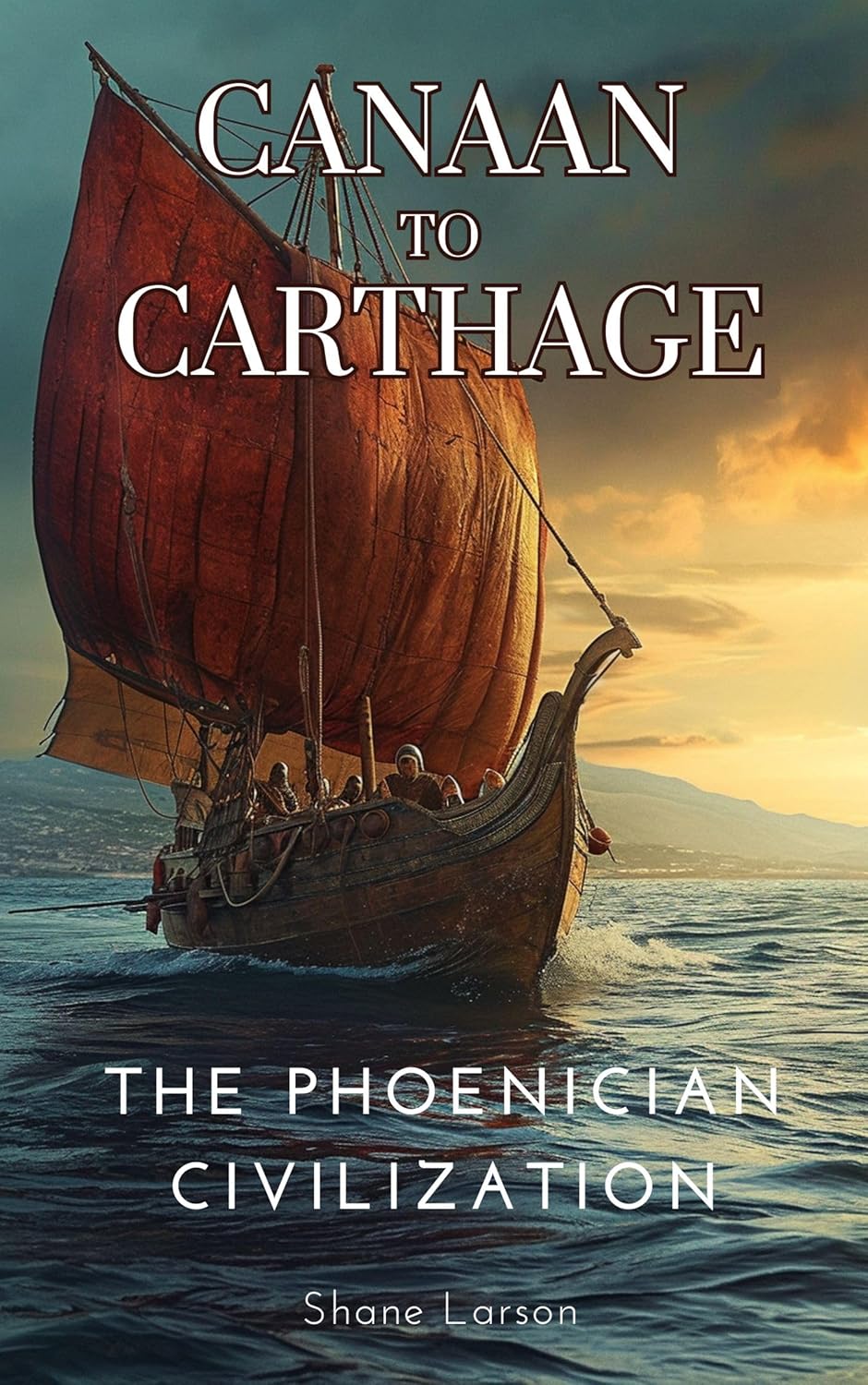
Canaan to Carthage: The Phoenician Civilization
Purple dye, extracted from murex sea snails in an appalling and labour-intensive process — thousands of molluscs for a small quantity of pigment. It was colourfast, which almost no ancient dye was, and it became the colour of royalty across the Mediterranean because it cost roughly what royalty could afford. The Greek name for the people, Phoinikes, is connected to the word for that colour. Workshops along the Levantine coast produced the dye in vats whose waste heaps still mark the shoreline today, and the finished cloth commanded prices high enough that a single bolt could equal several months' wages for a skilled laborer.
Cedar, from the mountains of Lebanon. Egypt and Mesopotamia had civilizations and no good timber, which made Phoenician cedar a strategic commodity for shipbuilding and monumental construction for millennia. Royal inscriptions from both regions record repeated expeditions or payments to secure Lebanese logs, and the wood's resistance to rot made it the preferred material for temple doors and warship keels alike.
Glass, metalwork, and manufactured luxury goods, and — crucially — transport. A great deal of Phoenician commerce was carrying other people's goods, which is a business that requires ships, navigation, and trust, and produces political neutrality as a competitive advantage. Their sailing was extraordinary by the standards of the time. They navigated at night by the stars, which most contemporaries would not do, and worked the Atlantic coast beyond Gibraltar. Herodotus records a Phoenician expedition, commissioned by an Egyptian pharaoh, that sailed around Africa — reporting, as evidence, a detail its crew found impossible: that at one point the sun was on their right hand. That is exactly what happens rounding the southern tip of Africa heading west, and it is a detail nobody in the Mediterranean could have invented.
Carthage
The most successful colony was founded from Tyre, traditionally in 814 BC, on the North African coast.
Carthage inherited the Phoenician model and then did something the homeland cities never had: it built a genuine territorial power, with a navy, an army, and possessions across the western Mediterranean. For a long stretch it was the wealthiest state in the region. Its agricultural hinterland in modern Tunisia produced grain surpluses that supported large-scale shipbuilding, while its control of Sardinian and Spanish mines supplied the silver that underpinned its coinage. Which brought it into collision with Rome, and produced the outcome that shapes everything written about Phoenicians since. Carthage lost three wars and was destroyed, and the accounts that survive were written by the winners — a people whose word for Carthaginian faithlessness, punica fides, entered the language as a synonym for treachery.
So the two most widely known things about Phoenician civilization are that they invented the alphabet and that they were untrustworthy. The first is true. The second is a slur produced by the state that levelled their greatest city, preserved because their own rebuttal was written on papyrus.
What Survives Anyway
The alphabet, obviously — a system with a small number of signs representing sounds, learnable by anyone rather than only by a professional scribal class, adapted by the Greeks and from there into Latin and most of the writing in use today. Its earliest clear examples appear in short inscriptions on arrowheads and pottery from the eleventh century BC, already showing the linear order that later scripts would retain with only minor additions.
But the more general legacy is the model. A commercial network held together by shared language, religion, and mutual interest rather than by conquest, operating profitably for a thousand years across an entire sea, without ever fielding an empire. Later trading leagues in the medieval Mediterranean and Indian Ocean would repeat versions of the same pattern, relying on port facilities, shared cults, and credit arrangements instead of garrisons. That is a form of power. It just does not photograph well, and it leaves fewer monuments than the alternative.
Canaan to Carthage: The Phoenician Civilization covers the whole span — the city-states of the Levantine coast, the religion, the maritime networks and colonies, the innovations, the long negotiation with Persia, the rise of Carthage, and what remains of a civilization that wrote on the wrong material.
Canaan to Carthage: The Phoenician Civilization
New posts and releases, straight to your inbox. No spam, unsubscribe anytime.