The Hanging Judge Who Never Hanged Anyone: The Real Roy Bean
July 4, 2026 · 6 min read
Ask most people what they know about Judge Roy Bean and you'll get some version of the same picture: a flinty hanging judge in a dusty Texas town, dispensing rough frontier justice from the end of a rope. It's a vivid image. It's also almost entirely wrong.
The real Roy Bean almost never sentenced anyone to death. His actual legal powers were modest — fines, minor cases, the small stuff a backcountry justice of the peace handles. The towering "hanging judge" of the dime novels and the movies is a costume the real man helped sew, then wore for the rest of his life. Pulling that costume off is one of the great pleasures of frontier history, because what's underneath is funnier, smaller, and far more interesting than the legend.
A long drift to nowhere in particular
Bean was born in Kentucky around 1825, and for the first fifty-odd years of his life he was a man perpetually one step ahead of consequences. He drifted into Mexico, where he reportedly fled after a shooting. He turned up in California, where more trouble found him — including, by his own telling, a brush with a noose he somehow survived. He passed through New Mexico. Eventually he washed up in San Antonio, scraping a hardscrabble living in a shabby district that took his name: Beanville.
None of it amounted to much. By any ordinary measure, Roy Bean was a small-time operator heading nowhere. Then the railroad changed everything.
The law arrives because the railroad does
In 1882, the rail lines pushed west across the Pecos River, and with them came tent camps full of teamsters, gamblers, and laborers — hundreds of restless men in a stretch of desert with no court, no jail, and no law within two hundred miles. The Texas Rangers, trying to keep order in this vacuum, needed someone on the spot to handle the disputes, the drunkenness, and the petty crime. They didn't need a great legal mind. They needed a body in a chair with a commission.
They got Roy Bean. Commissioned justice of the peace, the old drifter finally had a title — and he understood instantly that a title, in the right hands, was a business opportunity.
The bar was the bench
Bean set up shop in a clapboard saloon he named the Jersey Lilly. The spelling was wrong, which never bothered him. The name honored Lillie Langtry, the celebrated English actress he had become hopelessly, lifelong obsessed with, though the two never met. He named the town Langtry for her too, or claimed to.
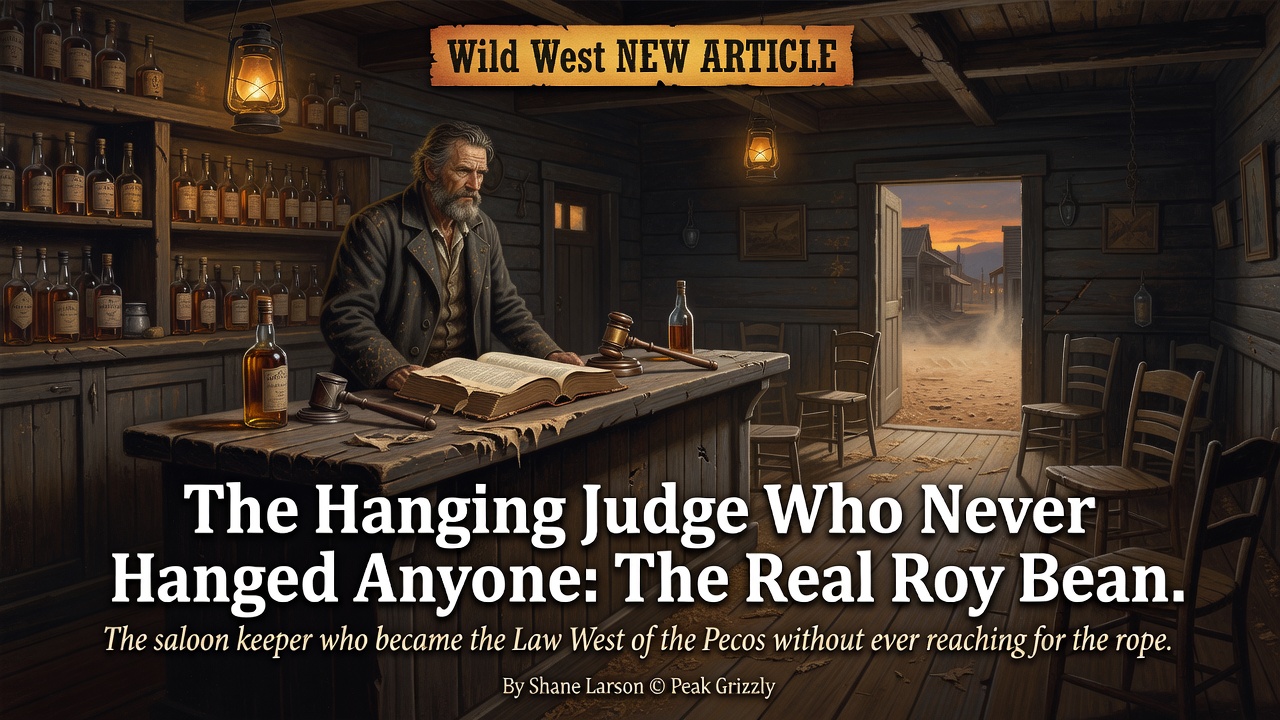
The Jersey Lilly was a saloon and a courtroom at the same time, and that was the entire point. The bar was the bench. Bean kept one law book — a battered copy of the Revised Statutes of Texas — and flatly refused to consult any newer edition, on the theory that more recent laws had no business interfering with his rulings. A pet bear was sometimes chained out front. Court was theater, and admission, more or less, was a drink.
Here's the part the legend gets right, even if it gets the tone wrong: Bean really did run a court that doubled as a saloon, and the saloon was the real enterprise. He performed marriages. He also granted divorces he had no legal authority to grant, reasoning cheerfully that since he had married the couples, it was only fair he should be able to unmarry them. He held inquests. He levied fines. The fines went into his pocket, and between every official act, he sold whiskey to the defendants, the witnesses, the jury, and the crowd that came to watch.
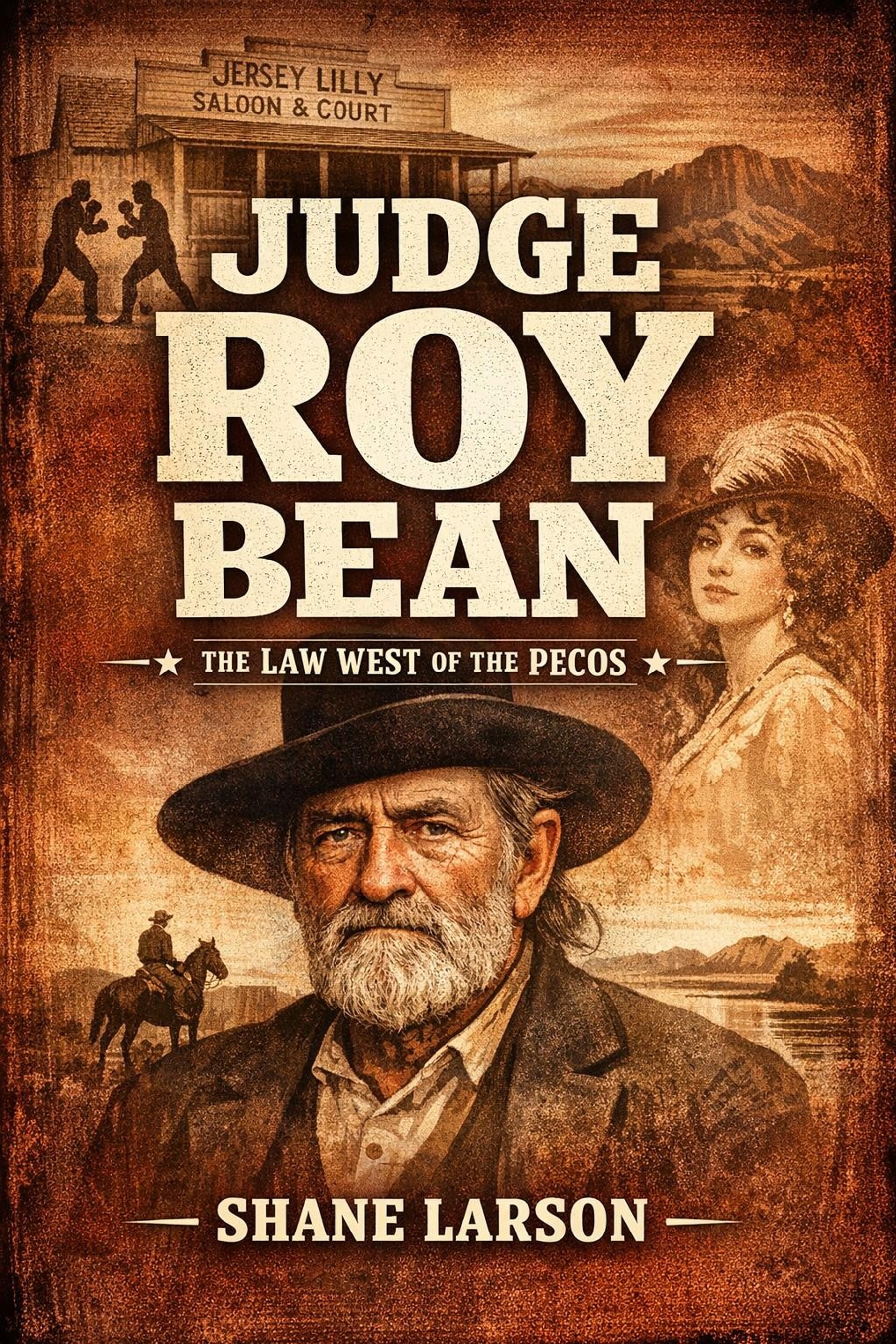
Judge Roy Bean
The corpse who paid a fine
The single most famous Bean anecdote captures the whole operation in miniature. As the story goes, a dead man was found near the tracks carrying about forty dollars and a pistol. Bean, holding an inquest over the body, fined the corpse forty dollars for carrying a concealed weapon — and kept the money.
Is it true exactly as told? Like most Bean stories, it's been polished and re-polished over the decades, and the careful historian flags it as the kind of tale that grew in the telling. But it's true to the man in a way that matters. Bean's justice was improvised, profit-minded, and delivered with a showman's wink. He understood that a good story sold whiskey and built a reputation, and a reputation built a career. He fed the legend on purpose.
The one true spectacle
If you want the real Roy Bean — not the invented hanging judge, but the actual article — look at February 1896.
The heavyweight championship of the world was, that winter, a fight nobody could legally hold. Prizefighting was banned in Texas. Banned in Mexico. Banned across the surrounding territories. The promoter had a title bout between Bob Fitzsimmons and Peter Maher and nowhere on earth to stage it.
Bean smelled the opportunity of a lifetime. He arranged for the fight to take place on a sandbar in the middle of the Rio Grande, below Langtry — technically in no man's land, beyond the reach of the Texas Rangers on one bank and Mexican authorities on the other. Spectators crossed to the island on a pontoon footbridge. The fight itself lasted about ninety seconds. And Roy Bean, naturally, sold whiskey to every soul who made the crossing.
No hanging. No gunfight. Just an old saloon-keeper finding the one gap in the law big enough to drive a world championship through, and charging admission in shots of whiskey. It's the purest distillation of who he actually was: a man who made his living in the seams between jurisdictions, and turned every one of them into a paying show.
The melancholy underneath
There's a sadder thread running under the comedy, and it's worth naming because most accounts play Bean purely for laughs. The obsession with Lillie Langtry was real and lifelong. He wrote to her. He named his saloon and his town for her. He worshipped a woman he had never so much as met, from a desert outpost a world away from the London stage.
She did, eventually, come to Langtry, Texas — drawn by the strange story of the man who had made her his patron saint. She arrived a few months after he died in 1903. The judge who built a town around his devotion never got to show her a single board of it. The comedy and the loneliness were the same man.
Why the real Bean is the better story
Set Roy Bean beside Judge Isaac Parker — the grim federal judge whose Fort Smith court sent dozens of men to the gallows — and you get the full range of justice on the American frontier. Parker was the lethal, procedural machinery of federal law. Bean was its opposite: law as performance, profit, and personality, invented on the spot by a man with a bar, a bear, and an out-of-date statute book.
The legend wants Bean to be a smaller, comic Parker, handing down death sentences with a quip. The record gives us something better — a shrewd, funny, limited, genuinely original operator who understood that on the frontier, a reputation was the most valuable thing a man could manufacture, and who manufactured one so durable that we're still repeating it more than a century later.
The honest measure of the man is more entertaining than the myth ever was. That's the whole reason to tell it straight.
Judge Roy Bean
New posts and releases, straight to your inbox. No spam, unsubscribe anytime.