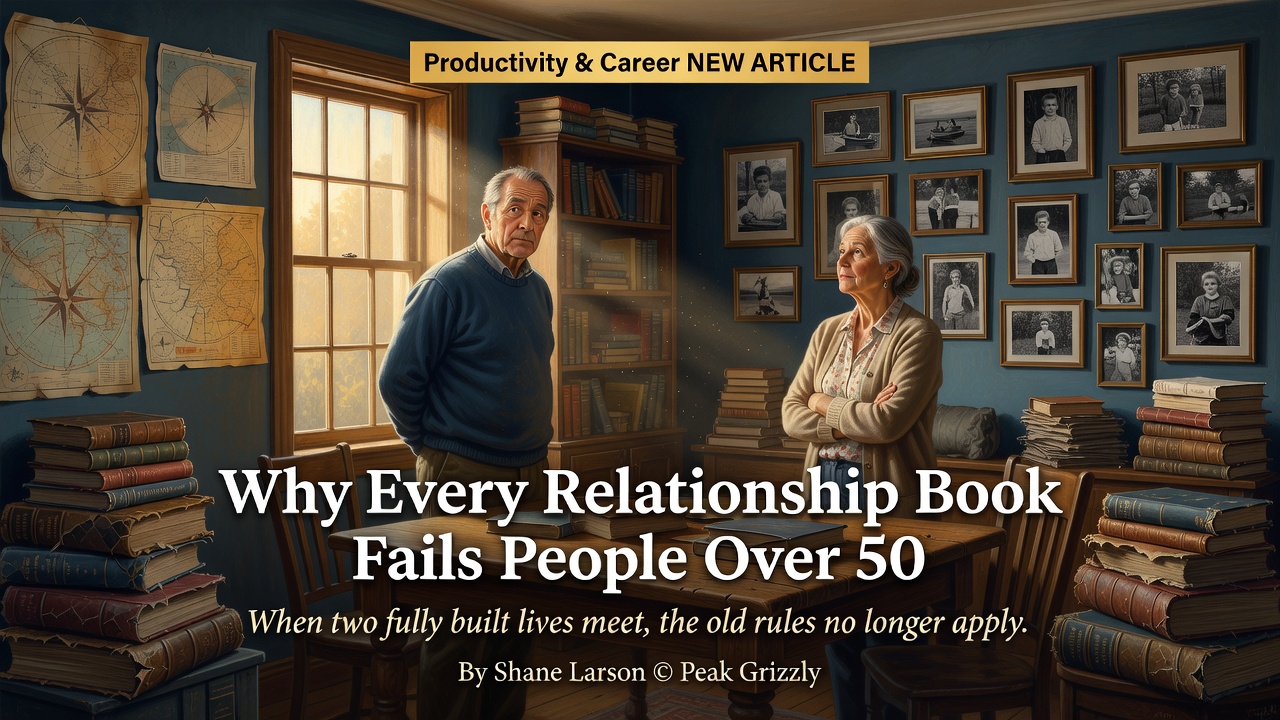
Why Every Relationship Book Fails People Over 50
June 27, 2026 · 7 min read
There is a woman who stood up at a relationship workshop and said something that stuck with me: "I read all the books when I was getting remarried at fifty-three. Every single one made me feel like I was doing it wrong because I couldn't just be open and trusting and flexible. It took me two years to realize I wasn't doing it wrong -- the books just weren't written for someone who'd already had her heart broken by someone she trusted completely."
She was right. The entire relationship advice industry has a blind spot, and it is enormous.
Walk into any bookstore and find the relationships section. You will see shelves of books about communication skills, attachment styles, love languages, and the art of lasting marriage. Some of them are excellent. Almost none of them are written for people who have already lived an entire life -- complete with divorce settlements, adult children with opinions, retirement accounts, and emotional scar tissue that took decades to form.
The advice is not wrong. It is incomplete. "Communicate openly about money" is great advice for a couple in their twenties deciding whether to open a joint checking account. It is woefully insufficient for two people in their fifties navigating retirement accounts, alimony obligations, estate plans, and fundamentally different relationships with money shaped by decades of independent experience.
Here is what nobody tells you: building a partnership after 50 is not building at all. It is a merger. And mergers are harder than startups.
You Are Not Building from Scratch -- You Are Renovating
At 25, two people build a life together from relatively raw materials. At 55, you are merging two fully constructed lives -- each with its own architecture, load-bearing walls, and rooms you don't let people into.
This is a renovation project, not new construction. And anyone who has ever renovated a house knows that is harder, not easier.
The differences are structural, not cosmetic. Your financial landscape is complex in ways that a first marriage never is. You both have assets, debts, retirement accounts, insurance policies, and financial obligations that do not disappear because you fell in love. You may have alimony payments. Your partner may have a child they are still supporting financially. One of you may own a home that has been paid off for a decade. The other may still be carrying debt from a divorce settlement.
Family dynamics are not about integration -- they are about diplomacy. Your adult children have opinions. Their adult children have opinions. There may be ex-spouses who are not going away. There are grandchildren, holiday traditions, family loyalties that run deep, and the very real possibility that the people you love most will not be enthusiastic about this new chapter in your life.
And time is finite in a way it was not before. At 25, you are planning for sixty years together. At 55, you are planning for twenty or thirty -- years that will include health decline, retirement transitions, potential caregiving, and death. This is not morbid. It is honest. The couples who can talk about it openly build stronger partnerships than those who pretend they have unlimited time.
The Money Conversation Nobody Wants to Have
Money is the thing couples fight about most, and it is the thing late-life couples are least prepared to discuss honestly. Not because they lack financial literacy -- most people over 50 have more financial experience than they did at 25. But because by 50, money has become deeply entangled with identity, security, independence, and decades of emotional history that has very little to do with dollars and cents.
Here is what actually works, based on the patterns I have seen in couples who navigate this well:
Share your financial histories before you share your financial numbers. Not "let me see your credit score," but "help me understand your relationship with money." One couple I know called it "financial story time." Each shared their complete financial narrative -- the business that failed, the ex-husband's secret credit card debt, the year they could not make rent. By the end of the conversation, they did not have a budget. But they understood each other's financial fears and non-negotiables in a way that made every subsequent money conversation easier.
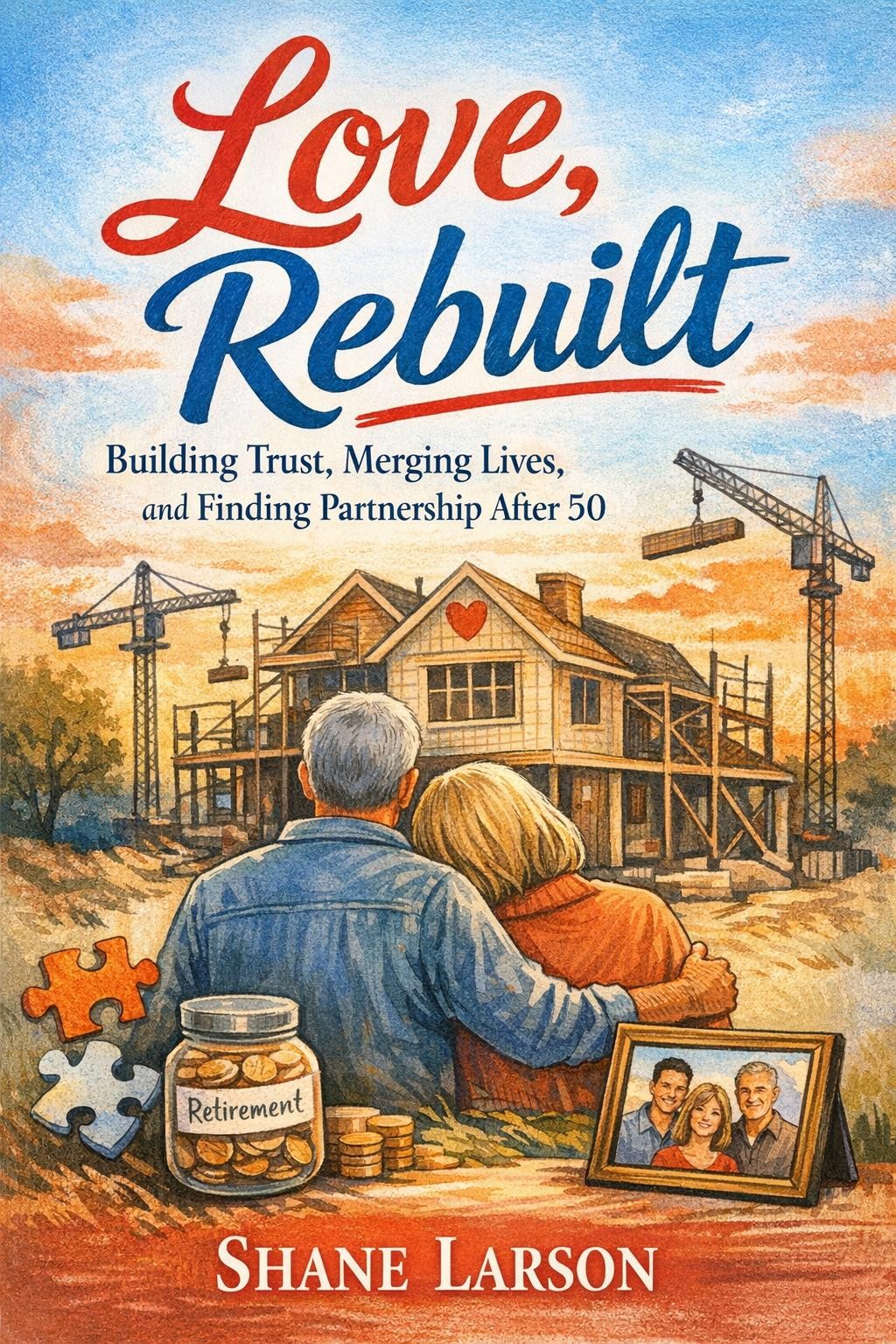
Love, Rebuilt
Name your non-negotiables before you start negotiating. Everyone has financial lines they cannot or will not cross. Some are practical -- alimony obligations, existing legal commitments. Some are emotional -- the need for a certain amount of personal savings, the importance of maintaining financial independence. Put them on the table as information, not demands: "I need to maintain a separate savings account. That is not about you -- it is about what I need to feel safe."
Choose a financial structure deliberately, not by default. Most late-life couples land on partially merged finances -- individual accounts for personal expenses, a joint account for shared costs, contributions proportional to income. This works because it acknowledges that both people have financial histories that preceded the relationship and that deserve continued respect. Fully merged finances require the highest trust. Fully separate finances require the most ongoing negotiation. Neither is wrong, but drifting into one without deciding is how resentment builds.
And the prenup conversation: a prenup is not a prediction of failure. It is a recognition of reality. You both have assets, obligations, and people depending on you. A prenup clarifies what happens to those things if the marriage ends through divorce or death. It protects both of you. The couples who resist this conversation are usually the ones who need it most.
Ready Does Not Feel Like Confidence -- It Feels Like Informed Courage
The most damaging piece of advice in self-help culture is that you need to be "healed" before you can be in a relationship. It sounds wise. It is subtly wrong.
"Healed" implies a destination -- a state you reach where the past no longer affects you. That is not how human psychology works. You do not heal from a devastating divorce the way you heal from a broken bone. The experience is integrated into who you are. You carry it. You learn from it. You develop around it. But you do not leave it behind.
If "healed" were the prerequisite for a new relationship, nobody would ever be in one.
"Ready" is a more useful concept. You are ready when you can distinguish between your new partner and your old one -- not perfectly, not every time, but most of the time. You are ready when you can tolerate discomfort without bolting. When you can take responsibility for your own reactions. When you can hold two truths simultaneously: that your past was painful and that your future can be different. That trust is scary and that it is worth pursuing. That this might not work and that it is worth trying.
One woman spent three years after her divorce in therapy. She did the work. She understood her patterns. She knew her triggers. When she started dating again, she expected to feel ready -- confident, calm, open. Instead, she felt terrified. Her therapist told her something she has never forgotten: "You are not going to feel ready. You are going to feel scared and do it anyway. That is what ready looks like for someone who has been through what you have been through."
That is the truth that sits underneath all of this. Building a partnership after 50 is harder in some ways because you are less flexible, more financially complex, more emotionally guarded, and more aware of how badly things can go wrong. It is easier in others because you know yourself. You know what you need, what you cannot tolerate, what matters and what does not. You are choosing this with open eyes, not falling into it on a wave of hormones and hope.
The people who build the strongest late-life partnerships are the ones who embrace both sides of that equation. They acknowledge the difficulty without being paralyzed by it. They are honest about their fears, practical about their logistics, and brave enough to be genuinely vulnerable with another human being despite knowing exactly what that vulnerability can cost.
That is not less romantic than a fairy tale. It is more.
Love, Rebuilt
New posts and releases, straight to your inbox. No spam, unsubscribe anytime.