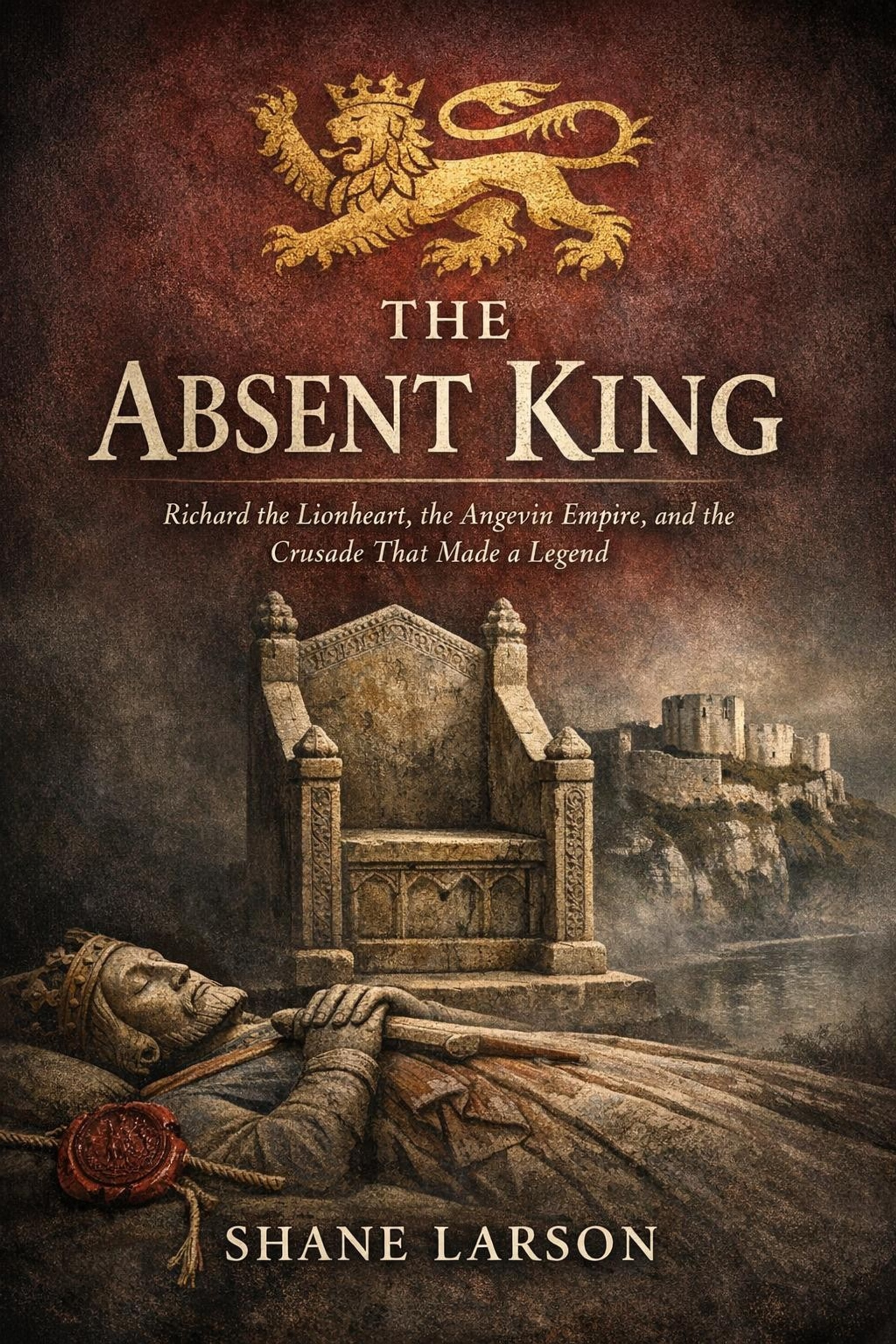
The Absent King
Richard the Lionheart, the Angevin Empire, and the Crusade That Made a Legend
By Shane Larson
About This Book
At Michaelmas 1199 the exchequer sat at Westminster, and the sheriffs of England came in to render their accounts to a king who had been dead since April. The roll records his government as every roll of the reign had: county farms, castle fines, instalments of a ransom still trickling in from men slow to pay six years before. Nothing in it notes that the king lay at Fontevraud at his father's feet. The clerks who kept it had met him, if at all, for a few weeks in 1189 and a few weeks in 1194, and the machine they ran had never needed him in the room.
That is the fact at the centre of Richard the Lionheart's reign, and the one his statue outside Parliament hides. He ruled England for nine years and nine months and was in it for about six months of them. He was born at Oxford, but he was a prince of Aquitaine: he spoke French and Occitan, wrote songs in the troubadour manner, and is not recorded as having spoken English. When he was not on crusade or in a German prison he was fighting in France, and that is where he died, from a crossbow bolt fired off the wall of a castle that was hardly defended.
A French Prince Who Inherited England
The Absent King: Richard the Lionheart, the Angevin Empire, and the Crusade That Made a Legend follows the life as he lived it, which is to say mostly on the far side of the Channel. It opens with the duke: given Aquitaine at eleven, invested at fourteen, in revolt against his father at fifteen, then sent south to subdue the barons who had risen with him. The Limousin was his school of war, a decade of small sieges and lords who rebelled every second spring, and by thirty he had a method and a grievance. In Henry II's last two years the grievance became a war, and Richard, allied with Philip of France, won it.
Then the crusader. Jerusalem fell in October 1187 and Richard took the cross within weeks, before his father and before Philip. His four months in England after the coronation went on turning the kingdom into a fleet: offices sold, the Scottish king's homage sold back, more than a hundred ships loaded with biscuit and horseshoes. The crusade took him to Sicily, Cyprus, the siege of Acre, down the coast to Arsuf and Jaffa, and twice to within twelve miles of Jerusalem. He sailed in October 1192 with a treaty that gave the crusaders the coast and pilgrims the city, having decided not to take what he could not hold.
Then the prisoner, caught near Vienna and sold to the emperor for a price England paid with a quarter of everyone's movable goods. And last, the part almost nobody tells: five years on the Seine winning back from Philip nearly everything lost in his absence, the French royal archives captured at Fréteval, and Château Gaillard raised in two seasons for more than every castle he built in England. He was forty-one when he died, and the empire went to John.
None of this is a debunking. The six months are not a scandal but the explanation, and the book keeps the reader aware, chapter by chapter, of where the king is and where the silver is coming from.
Why I Wrote This
I came to Richard the way his mother did, from the wrong end. Twice a Queen ends with Eleanor of Aquitaine crossing to Germany in winter to collect a son from the emperor's custody, and I wanted to know what he had done to need collecting. What I found was a life the English remember backwards. The statue in Old Palace Yard shows a king arriving home with his sword up, and the man never arrived; he was always on his way somewhere else with England's silver in the baggage. Everyone has read the crusade, so I gave it its due and kept going, because the five years in Normandy are the longest campaign he fought and almost nobody tells them. And I wanted a book that could put Acre and Arsuf on the same page without flinching at either. Most lives pick one and apologise for the other; the sources, on both sides of the line, do not.
Frequently Asked Questions
Do I need to read Twice a Queen before this book?
No. The two books share a family and a dozen scenes, each told from its own subject's side. Eleanor's court, her part in the 1173 revolt and her management of the ransom are told in full in her book and given a paragraph and a pointer here.
Did Richard the Lionheart really spend only six months in England?
About that. He landed in August 1189 and sailed in December, roughly four months; he came back in March 1194 and left in May, roughly two. The chroniclers are not always exact about sailing days, so the figure is approximate, but no reading of the itinerary gets it past seven.
How does the book handle the massacre at Acre?
As a fact, with its sources named and both counts given. It sets the account from Richard's camp beside Saladin's, lays out the arguments about motive, and gives its own reading: that the decision was cold, calculated and military. That reading is not offered as a defence.
Was Richard the Lionheart gay?
Nobody knows, and the book says so. The claim rests on a mid-twentieth-century reading of a few chronicle passages, chiefly a report that Richard and Philip of France shared a bed as young men, which in the twelfth century was a political gesture, and two public penances whose sins are not named. The book presents the case and the reply as a debate and leaves it there.
Does the book cover Saladin's side of the war?
In every crusade chapter, wherever a Muslim writer saw what Richard's men also saw. Baha al-Din, a judge in Saladin's household present at Acre, Arsuf and Jaffa, is a witness alongside Howden and Ambroise, not a token.
Is this a military history or a biography, and how long is it?
A narrative biography in thirteen chapters and four parts, about 74,000 words, with three appendices. Six chapters, the crusade and the French war, are military history; the other seven are the duke, the son, the prisoner and the king.
If You Liked This, You Might Like
- Twice a Queen — Richard's mother governed England for him, raised his ransom and carried the first instalment to Germany herself; this is the same decade from her chair.
- The Crusades — the two-century war of which Richard's four chapters are one campaign, from Clermont in 1095 to the fall of Acre in 1291.
- The Norman Conquest — the cross-Channel dominion Richard inherited, and the habit of ruling England from Normandy, were both made at Hastings.
- The Hundred Years' War — Gascony, the one piece of Richard's Aquitaine that England kept after 1204, is what Edward III went to war over in 1337.
The lion is on the statue and the ledger is in the rolls, and this book keeps both open at once.
A standalone on the medieval shelf, following Twice a Queen.
What You'll Learn
- **London and York, 1189–90.** The attacks on England's Jews that followed the coronation, from William of Newburgh's account: what Richard ordered, what he profited by, and what he never said.
- **Acre, 20 August 1191.** About 2,700 prisoners by the Christian count, about 3,000 by the Muslim one, killed when a ransom ran late; both camps' accounts side by side, the arguments about motive laid out rather than settled.
- **Twelve miles from Jerusalem, twice.** What the council at Beit Nuba argued, what Saladin's biographer says his emirs feared, and whether turning back was judgement or failure.
- **The devil is loose.** The shipwreck, the inn near Vienna, the trial before the emperor, and how a kingdom found 150,000 marks while the king's brother bid for his lands.
- **Gaillard and Châlus.** The fortress on the Seine as an argument in stone, the five-year war most lives skip, and the bolt in the shoulder that ended it.
- **Three appendices.** The crusade in numbers; every chronicler on both sides and where each stood; an itinerary of the reign with the six months in England marked.
New Medieval History releases and free chapters — no spam, unsubscribe anytime.
More in This Genre
View all →