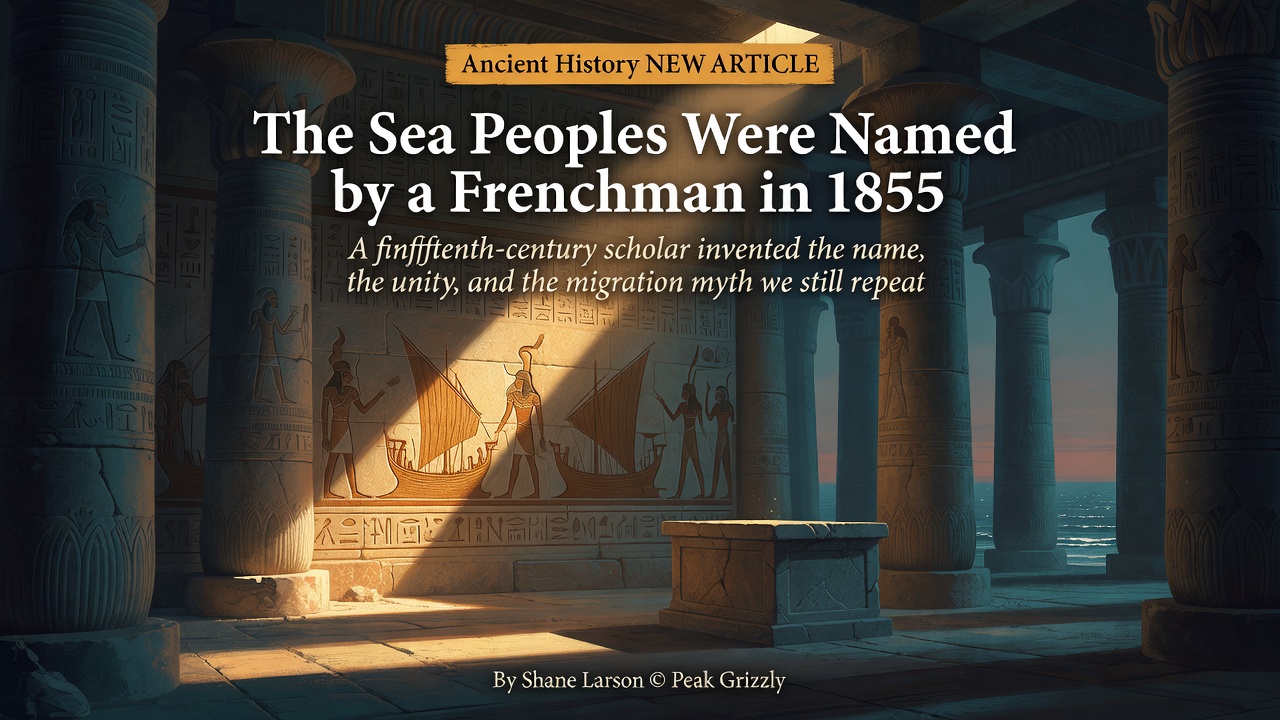
The Sea Peoples Were Named by a Frenchman in 1855
August 5, 2026 · 6 min read
Here is what we know for certain about the Sea Peoples: almost nothing.
We do not know what they called themselves. We do not know where most of them came from. We do not know what language they spoke, or more likely what languages. We do not know how they were organised, who led them, or whether anyone did. The Egyptian records that mention them do so in the context of specific campaigns, not as a comprehensive census of foreign peoples, which leaves the picture both vivid in places and almost entirely blank in others.
What we have is what the Egyptians said about them, and the Egyptians had specific reasons for saying it the way they did.
The Name Is Modern
The term "Sea Peoples" appears in no ancient text. The Egyptian inscriptions list particular group names — Peleset, Tjeker, Shekelesh, Denyen, Weshesh, Lukka, Sherden, Ekwesh — and describe some of them as coming from the sea or from islands in the midst of the sea. The inscriptions sometimes add the detail that certain groups arrived “in their isles” or “from the midst of the sea,” but these phrases function more as geographic markers than as proof of a unified seafaring identity.
The collective label was coined in 1855 by the French Egyptologist Emmanuel de Rougé, who gathered those scattered names under a single convenient heading. A generation later Gaston Maspero, one of the great popularisers of Egyptology, took the label and built a narrative around it: a vast coordinated migration of northern peoples sweeping down through Anatolia and across the Mediterranean, toppling civilizations as it went. Maspero drew on the Medinet Habu reliefs and earlier Merneptah inscriptions to sketch a single wave of destruction, and his account was quickly adopted in textbooks and museum displays.
Maspero's version was vivid, dramatic, and far more confident than the evidence permitted. It stuck anyway. A great deal of what the public knows about the Sea Peoples today is a nineteenth-century French story wearing a modern jacket.
Two Assumptions Smuggled In With the Label
The name is useful shorthand and it imports two things that the evidence does not support.
Unity. "The Sea Peoples" sounds like a nation, or at minimum an alliance with a headquarters and a plan. Nothing in the sources indicates that. What the texts describe is a coalition — different groups, probably from different homelands, appearing in overlapping periods, sometimes together and sometimes not. The Sherden, for instance, appear in Egyptian records as early as the reign of Ramesses II, sometimes serving as royal guards, while the Peleset surface later in the Levant. Treating them as a single actor with a single motive is a grammatical accident that became a historical claim.
The sea. The label implies a maritime phenomenon, a Bronze Age Viking fleet. But the Egyptian reliefs show these people arriving by land as well as by water, with ox-carts, families, and baggage. Some of the groups may never have been seafarers at all. The ox-carts are the detail worth stopping on. A raiding fleet does not bring wives, children, and household goods. What the Egyptians carved is not a picture of a raid. It is a picture of a migration — people moving somewhere because they could not stay where they were. The presence of livestock and wheeled transport suggests groups that had already lost or abandoned fixed settlements rather than mobile warriors traveling light.
The Sources Are Propaganda, and We Knew That
Nearly everything comes from Egyptian royal inscriptions, principally the reliefs and texts at Medinet Habu recording Ramesses III's campaigns, plus earlier material from Merneptah's reign. At Medinet Habu the scenes depict both land and sea battles, with careful attention to the different weapons and ships of the various groups, yet the accompanying texts follow the standard royal formula of total victory.
Sea Peoples: Raiders of the Bronze Age
These are not reports. They are monumental royal statements, carved on temple walls, whose genre requires the pharaoh to face overwhelming enemies and destroy them utterly. The numbers are unreliable by convention. The unity of the enemy is a rhetorical convenience — a single named coalition makes a better victory than a decades-long, incoherent crisis. And the outcome is guaranteed in advance, because no Egyptian temple relief ends with the pharaoh doing moderately well.
We are reconstructing one of the pivotal events in ancient history almost entirely from the victory announcements of one participant, and we are doing it because there is nothing else. The Hittite archives stop. Ugarit's last tablets are letters begging for help that never came. The Mycenaean palaces burn without leaving an account. The abrupt end of Linear B records at sites like Pylos and Knossos leaves the Greek side of the story almost entirely silent.
So the fullest surviving description of the crisis comes from the one major power that survived it and had every incentive to describe it as an external attack heroically repelled.
What They Actually Did, and What Happened Next
Strip away the framing and some things remain solid.
Cities across the eastern Mediterranean were destroyed in this period, and the destruction layers are real. Trade collapsed. Egypt fought at least two significant engagements against groups it identified this way, and after the second — the naval battle in the Delta — Egypt held, but it never recovered its former reach. The economic contraction that followed is visible in the reduced volume of Cypriot and Mycenaean pottery reaching Levantine ports after 1170 BCE.
And then the part that undermines the whole raider framing: some of these groups settled. The Peleset appear in the southern Levant, in a cluster of cities, with a distinctive material culture including pottery closely related to Mycenaean styles. Over the following centuries they become the Philistines of the biblical narrative — not a marauding fleet but a settled, urban, agricultural neighbour, with towns, temples, and politics. Their pentapolis of Gaza, Ashkelon, Ashdod, Ekron, and Gath shows continuity in architecture and cult practices that point to long-term residence rather than seasonal raiding.
That is not what invaders do. It is what displaced people do when they find somewhere to stop.
Why This Matters Beyond the Bronze Age
The Sea Peoples are the clearest case study in how a historical certainty gets manufactured.
A set of unrelated group names in a propagandistic source gets a collective label from a scholar who needed one. A popular writer builds a narrative around the label. The narrative is repeated for a century and a half until it becomes the thing everyone knows, and the underlying evidence — thin, one-sided, and largely incompatible with the story — stays exactly as thin as it was in 1855. Similar processes can be seen in the way nineteenth-century scholars grouped the various “barbarian” incursions into the Roman Empire under single dramatic headings that later archaeology has had to unpack.
The honest position is that something enormous happened, that people moved in large numbers under pressure, that cities burned, and that we do not know who most of them were or why they came.
That is less satisfying than an invasion. It is also what the evidence supports, and there is a particular pleasure in a subject where the most interesting thing is watching a certainty dissolve under examination.
Sea Peoples: Raiders of the Bronze Age works through the whole problem — the world before the collapse, the Uluburun shipwreck, the group-by-group evidence, Merneptah and Ramesses III, the trail of destruction, the Philistine settlement, and the detective work still going on.
Sea Peoples: Raiders of the Bronze Age
New posts and releases, straight to your inbox. No spam, unsubscribe anytime.