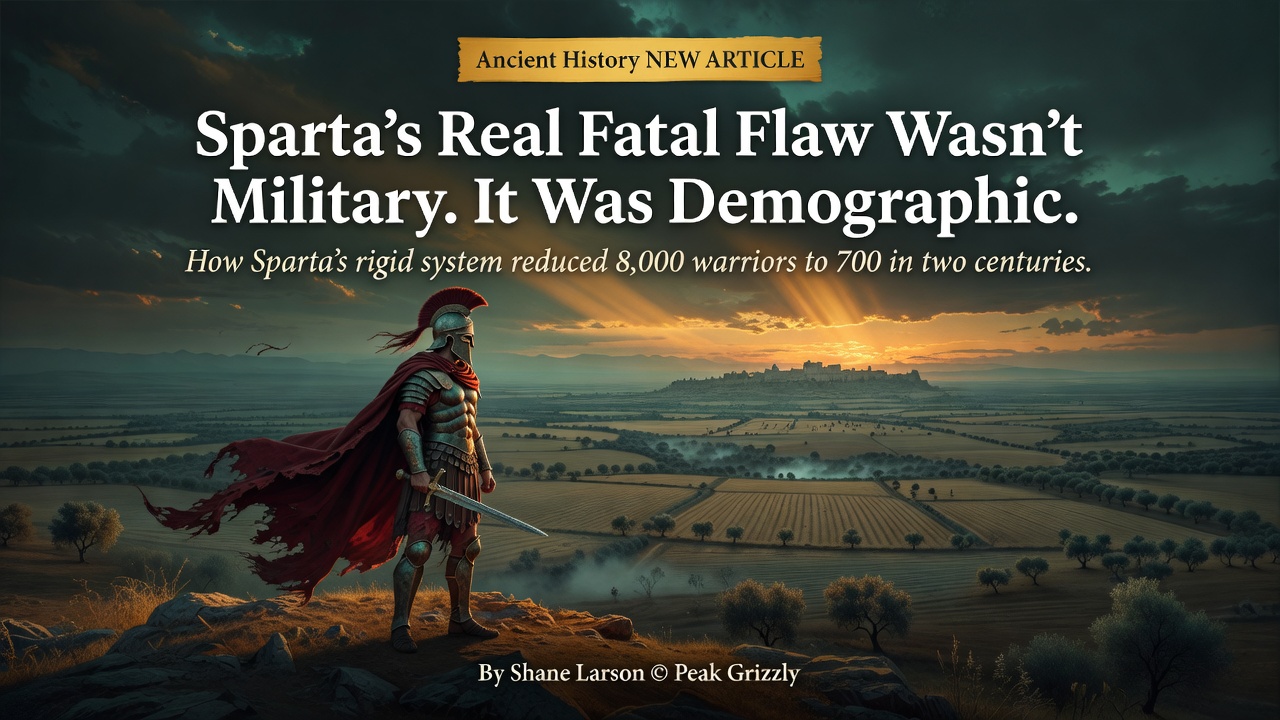
Sparta's Real Fatal Flaw Wasn't Military. It Was Demographic.
March 22, 2026 · 6 min read
At the time of the Persian Wars in 480 BC, Sparta could field roughly 8,000 full citizens -- the Spartiates, the homoioi or "equals" who had completed the brutal agoge training, maintained their contributions to the common messes, and held a land allotment worked by helot slaves. Eight thousand was already a small number by Greek standards. But it was enough. Eight thousand Spartiates made Sparta the most feared military force in the ancient world.
By 371 BC -- just over a century later -- the number had fallen to roughly 1,500. At the Battle of Leuctra, only about 700 Spartiates were present. Four hundred of them died in a single afternoon.
By 244 BC, the total number of full Spartan citizens had collapsed to approximately 700. Seven hundred, in a state that had once fielded eight thousand. A decline of over 90 percent.
The ancient Greeks had a word for it: oliganthropia -- too few men. Aristotle wrote about it. Xenophon worried about it. Everyone could see it happening. And Sparta, a society that prided itself on discipline and collective will, proved utterly incapable of stopping it.
The reason is the most instructive part of the story. Sparta's demographic collapse wasn't caused by an external enemy. It was caused by the same system that had made Sparta powerful in the first place.
The Ratchet That Could Only Turn One Way
The traditional Spartan system was built on a premise of equality. Every citizen received a kleros -- a plot of land worked by helots -- that provided enough income to cover his contribution to the syssitia (the common mess where all citizens ate together daily) and support his household. The land allotments were theoretically equal and inalienable. This was the foundation of the "equals" -- citizens who were materially similar enough that no one could claim superiority based on wealth.
Elegant in theory. Economically unsustainable in practice.
The first problem was inheritance. Even if the original distribution was perfectly equal, time created inequality. A family with one son kept its kleros intact. A family with two sons either divided the land -- making both shares potentially too small to support mess contributions -- or gave everything to one son, leaving the other without the economic foundation for citizenship. A family with daughters became a marriage target for wealthy families consolidating estates.
Aristotle identified the inheritance system as a key driver of inequality: "Nearly two-fifths of the whole country are held by women; this is owing to the number of heiresses, and to the practice of giving large dowries."
The second problem was the mess contribution itself. Every Spartiate was required to contribute a set amount of food each month. Non-negotiable. If you couldn't pay, you were out -- stripped of your status as a Spartiate, regardless of your lineage, your training, or your military service. The system designed to enforce equality had a built-in mechanism for destroying it: the moment a citizen's land produced less than the threshold, he fell out of the citizen class permanently.
Over generations, this created a ratchet effect. Estates consolidated upward. Citizens who lost their land had no way to get it back. Their children had no path to citizenship. Each generation had fewer full citizens than the last. The citizen body could only shrink.
By the fourth century BC, Sparta was a society of extreme inequality masquerading under the rhetoric of equality. A handful of wealthy families controlled vast estates. Hundreds of men who had been raised as Spartans, trained in the agoge, and fought in Sparta's wars found themselves unable to make their mess contributions and were quietly dropped from the rolls. They became hypomeiones -- "Inferiors."
Sparta
The Conspiracy That Revealed the Truth
The Inferiors weren't foreigners. They were men of Spartan blood with Spartan training and Spartan grievances. In 397 BC, a conspiracy led by a man named Cinadon -- himself an Inferior -- was uncovered before it could be carried out.
Xenophon's account is chilling. When asked how many were involved, Cinadon took his interrogators to the marketplace and told them to count. Out of four thousand people present, about forty were Spartiates. The rest -- perioikoi, hypomeiones, helots -- all had reason to resent the system. "Each of these groups," Cinadon said, "would gladly eat the Spartiates raw."
The conspiracy was suppressed with typical Spartan efficiency. Cinadon was tortured and killed. But you can kill a conspiracy. You can't kill a demographic trend.
Sparta had other mechanisms for shrinking its own citizen body. The institution of the tresantes -- "tremblers" -- stripped social standing from anyone accused of cowardice in battle. No one would wrestle with them. No one would share a fire. Their families were shamed. No father would give his daughter to a trembler in marriage. The purpose was to create pressure so intense that every Spartan would rather die than retreat. At the level of individual battles, it worked. At the systemic level, it meant that every soldier who survived a defeat under questionable circumstances was effectively removed from society.
After the Battle of Sphacteria in 425 BC, 120 Spartan survivors who surrendered rather than dying faced possible classification as tremblers. That was roughly 10 percent of the remaining citizen body. The ephors couldn't follow through without crippling the army. They suspended the rules temporarily -- revealing the fundamental contradiction of a system that demanded death before dishonor from a population it couldn't afford to lose.
The Comparison That Explains Everything
The contrast with Rome is devastating.
Rome had mechanisms for incorporating outsiders from its earliest days. Freed slaves could become citizens. Conquered peoples could receive partial or full citizenship. Allied communities earned citizenship through loyalty and service. The citizen body expanded constantly, and this expansion was one of the keys to Roman resilience. There was always a larger pool to draw from.
Sparta went the opposite direction. Citizenship required two Spartan parents, completion of the agoge, admission to a syssitia (one blackball vote from any member could keep you out), and lifelong maintenance of mess contributions. Each requirement was defensible on its own terms. Together, they created a system that could only shrink. There was no mechanism for growth, no path for outsiders to join, and multiple paths for insiders to fall out.
The obvious solution was land reform -- redistribute the concentrated estates, create new kleroi, admit more men to citizenship. Various Spartans recognized this over the centuries. None succeeded until it was far too late. The reason was straightforward: the people who would have to approve land reform were the people who owned the land. Asking them to redistribute their own wealth was, as the book puts it, like asking turkeys to vote for Thanksgiving.
Sparta's story is not primarily a military narrative. It is a case study in institutional rigidity -- what happens when a system optimized for one set of conditions encounters a changing world and cannot adapt. The same closed, rigid, uncompromising qualities that made the Spartan military unbeatable on a fifth-century battlefield guaranteed that the society behind it would slowly consume itself.
The real Sparta was stranger, more brutal, and more instructive than the movie. Not because of Thermopylae, but because of what came after -- the long, quiet collapse of a society that could produce the finest warriors in the ancient world but couldn't produce enough of them.
Sparta
New posts and releases, straight to your inbox. No spam, unsubscribe anytime.