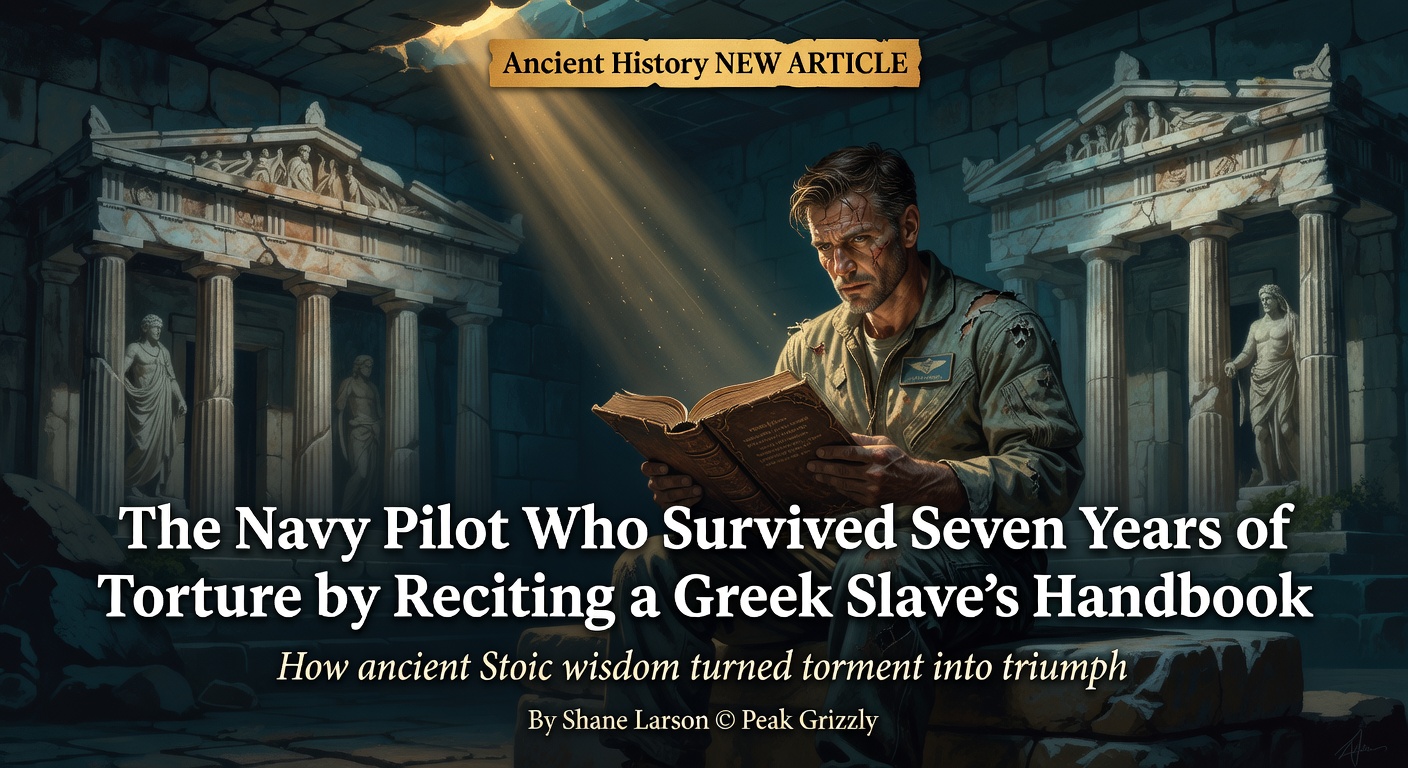
The Navy Pilot Who Survived Seven Years of Torture by Reciting a Greek Slave's Handbook
April 17, 2026 · 13 min read
The Navy Pilot Who Survived Seven Years of Torture by Reciting a Greek Slave's Handbook
On September 9, 1965, a forty-one-year-old Navy captain named James Stockdale was flying an A-4 Skyhawk over the Red River Delta in North Vietnam when antiaircraft fire shredded his aircraft. The controls went dead. The plane rolled over and started to fall. He pulled the ejection handle.
As his parachute opened and he drifted down toward a village where, he could already see, a crowd was gathering to meet him with fists and rifle butts, he said something out loud to himself. He repeated it later, in a lecture at Stanford in 1993, and it is one of the strangest sentences anyone has ever uttered in that situation.
"I'm leaving the world of technology and entering the world of Epictetus."
He meant it literally. He meant that the set of skills that had kept him alive in a fighter cockpit — radar discipline, weapons systems, energy-maneuverability tactics — was about to become useless, and a different set of skills would have to take over. The different set of skills had been taught to him fifteen years earlier by a crippled Greek slave who had died in the second century of the common era.
Stockdale would spend the next seven and a half years in the Hanoi Hilton. Four of them in solitary confinement. Two of them in leg irons. His left leg, broken during the ejection, was set wrong and stayed wrong for the rest of his life. He was tortured — actually tortured, not enhanced-interrogation tortured, the kind where they rope your arms behind your back and lift you off the ground until the shoulder joints tear — fifteen separate times.
He survived. He came home. He went on to write books, teach philosophy at the Hoover Institution, run for Vice President on Ross Perot's ticket in 1992, and spend the rest of his life arguing that what had kept him alive in that cell was not luck, not American grit, not the Code of Conduct, and not religion. It was a specific set of mental practices taught to him by a man he had never met, whose books he had been given as a going-away present by a Stanford philosophy professor fifteen years before the war.
The man was Epictetus. The book was the Enchiridion. And the reason the Enchiridion worked in a Vietnamese torture cell is exactly the same reason it was written in the first place: it was not written for comfortable people. It was written by a man who had been sold as property, whose master had broken his leg, and who had then decided that none of it could touch him.
What Stockdale knew that no one else in the cell knew
When the North Vietnamese captured a downed American pilot, they ran him through a standard sequence. First the beatings. Then the demands — a confession, a denunciation of the war, a propaganda tape. Then the isolation, the silence, the absence of calendar and clock. Then, when the prisoner was disoriented and exhausted and starting to fold, the offer: cooperate, and it all stops. Refuse, and it gets worse.
The men who broke in that system didn't break because they were weak. They broke because they had no framework for understanding what was happening to them. The pain was the obvious part. The hard part was that the pain arrived attached to a story — you are helpless, you are alone, no one is coming, your country has forgotten you, your wife is remarrying, you will die here — and the story was the thing that broke people. The body can take an enormous amount of damage. The mind can't take a story that says everything you are doing is pointless.
Stockdale had a different framework. He had spent the years before Vietnam reading, and rereading, and memorizing large sections of a slim Greek handbook that begins with the following sentence, in his Stanford-era translation:
"Some things are up to us and some things are not up to us."
On the surface, that looks like a truism. It is not a truism. It is an operating system.
Epictetus spent the rest of the Enchiridion — and his larger work, the Discourses, which are eight volumes of classroom notes taken by his student Arrian — explaining what is actually in those two categories. Up to us: our judgments, our desires, our aversions, our decisions, our response to what happens. Not up to us: our body, our possessions, our reputation, our social role, what other people do, what the weather does, what the Hittite army does, what the Roman emperor does, what the North Vietnamese interrogator does.
The operational consequence, Epictetus argued, is that a person who has trained himself to care only about the first category is a person that nothing external can touch. Not because the external events don't happen — they absolutely happen, the body is absolutely beaten, the cell is absolutely cold — but because the meaning of those events, the story attached to them, is a judgment, and a judgment is in the first category. It is up to us.
Stockdale walked into the Hanoi Hilton with that operating system installed. When his captors broke his leg during capture, he noted that his leg was broken; he did not tell himself a story about how his leg being broken meant his life was over. When they put him in solitary, he noted that he was in solitary; he did not tell himself a story about how being in solitary meant no one would ever find him again. When they tortured him into signing a statement he didn't want to sign, he noted that he had been tortured into signing, and then — this is the part that matters — he let the sign itself go. The interrogators had achieved their little external victory. They had not achieved anything in the category that was up to him. He was still him. He could start again tomorrow.
He called this, later, "the dichotomy of control." It is Epictetus's central idea, and it was Stockdale's operational doctrine.
Where a slave learns to ignore chains
The reason this framework worked for Stockdale is that it had been designed for conditions exactly like the ones he was in. It had been designed by a slave.
Epictetus was born around 50 CE, somewhere in the interior of Asia Minor — probably Hierapolis in Phrygia, in what is now western Turkey. He was born a slave. We do not know his original name, because nobody bothered to record it. "Epictetus" is not really a name; it is a Greek word meaning "acquired" or "purchased property." It is the word a slave trader wrote on a market placard.
He was purchased, at some point in the 60s CE, by a man named Epaphroditus, who was himself a freedman — a former slave who had risen to become the a libellis in Nero's court, the bureaucrat who received and routed petitions to the emperor. This was an astonishing social trajectory for anyone, and it meant that Epaphroditus's household was close to the center of Roman power. The young Epictetus, as that household's property, got a closer view of imperial politics than almost anyone else alive.
He also got an education. Epaphroditus permitted Epictetus to study philosophy — specifically, to study under Musonius Rufus, the most celebrated Stoic teacher in Rome. Musonius was sometimes called "the Roman Socrates," and his teaching method was famously confrontational. He did not lecture students about virtue; he tested them for it. Epictetus later said of him that he made his students feel, at the end of every lesson, that they were the worst people in the world. That was the point. If you left one of Musonius's lectures feeling good about yourself, you hadn't understood it.
At some point in his youth, Epictetus was crippled. Our best ancient source for this is Celsus, quoted much later by Origen. Celsus claims that one of Epictetus's masters — possibly Epaphroditus, though this is disputed — twisted his leg in anger. Epictetus, according to Celsus, warned calmly that the leg was going to break if the master continued. The master continued. The leg broke. Epictetus, according to the story, said only: "I told you it would break." Modern scholars are skeptical of the torture story — the leg injury may have been congenital, or the result of rheumatism — but whatever the cause, Epictetus walked with a severe limp for the rest of his life and taught from a seated position.
He was manumitted — freed — sometime after the death of Nero in 68 CE, as his master's political standing collapsed in the Year of the Four Emperors. He taught philosophy in Rome through the Flavian dynasty. Then, in 89 or 93 CE, the emperor Domitian expelled all philosophers from the city.
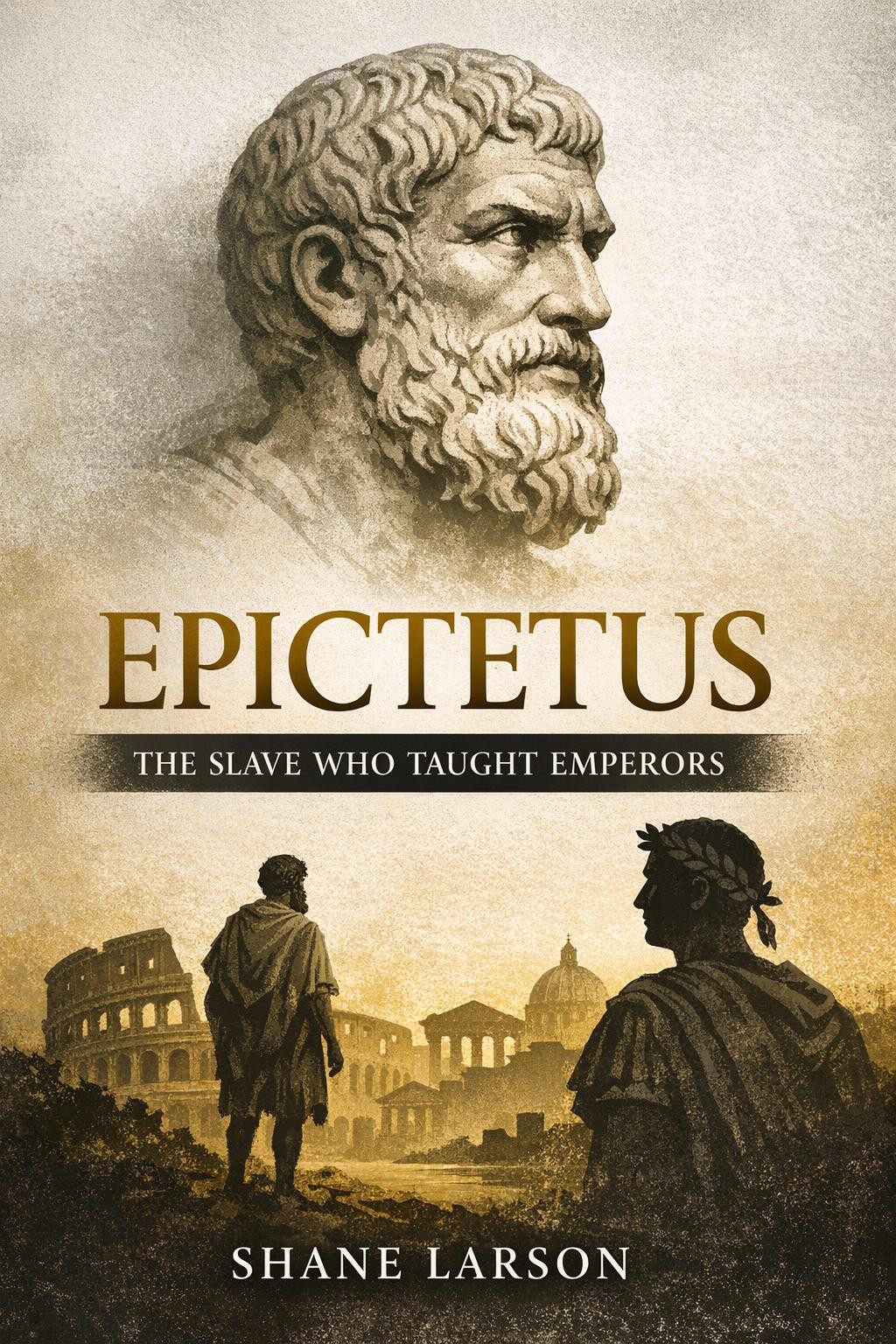
Epictetus
Stoic and Cynic philosophers were considered politically dangerous. They refused to flatter. They modeled independence of judgment. They had influence over senatorial youth. Domitian, who was paranoid and correct about his own vulnerability, wanted them gone.
Epictetus went to Nicopolis, a city on the western coast of Greece that the emperor Augustus had founded to commemorate his victory at Actium a century earlier. It was provincial, quiet, and not on the way to anything important. Epictetus set up a small school there. And for the next thirty or forty years, he taught.
He did not write. Everything we have of him was written down by his student Arrian, who later became a Roman governor and a historian of Alexander the Great. Arrian claimed — and we have no reason to doubt him — that he wrote the Discourses as literal transcripts of what he heard in the classroom. That is why they read the way they do. They read like recordings. There are abrupt beginnings, jokes that land and don't, moments where Epictetus interrupts himself to scold a student who has shown up late, moments of raw argumentative force where the teacher is visibly trying to shake a twenty-year-old Roman aristocrat out of his complacency.
The Enchiridion — Arrian's later compression of Epictetus's essential teachings into a single handbook — is the version Stockdale was handed in 1962. It is fifty-three short chapters. You can read it in an hour. You can spend the rest of your life applying it.
The clay cup
One of the most famous exercises in the Enchiridion is a specific mental practice Epictetus recommended. You pick something you are attached to — a cup, a pet, a favorite jacket, a person you love — and you make yourself remember, vividly and specifically, that it is mortal. The cup will break. The pet will die. The jacket will be lost. The person you love will, sooner or later, be taken from you. You do this exercise on purpose, while the thing is still intact, while the person is still alive.
It looks, at first glance, like pessimism. It is the opposite of pessimism. Epictetus is training you to see clearly now, so that you do not lose your footing later. If you tell yourself, today, that your child is mortal, and you sit with that thought and let it be true, then when your child trips and scrapes a knee, you do not lose composure. When your child gets sick, you do not collapse. When your child eventually dies — because eventually, if you live long enough, something like that will happen — you will not be destroyed by the shock of something you always knew was possible.
He called this exercise premeditatio malorum — the premeditation of evils. It is the ancestor of what modern cognitive behavioral therapists call exposure, what resilience trainers call mental rehearsal, and what athletes call visualization. It is one of the oldest continuously practiced pieces of psychological technology on Earth.
Stockdale practiced it in the Hanoi Hilton. He knew, in advance, that the interrogators would come. He knew that the ropes would come out. He knew that sooner or later he would say things under torture that he did not want to say. He had rehearsed all of this in his head before it happened. When it happened, it was horrifying but it was not surprising. Horror you can manage. Surprise is what breaks you.
This is what Stockdale later called — and what a thousand leadership consultants have since reduced to a single slide in a PowerPoint — the Stockdale Paradox. Be brutally realistic about how bad your current situation is. Be absolutely certain that you will come out the other side. Most people hold one end or the other. Very few can hold both simultaneously. Epictetus taught Stockdale how to hold both.
What happened to Epictetus's philosophy
Epictetus died around 135 CE. His philosophy should have died with him. It was a provincial teacher's oral curriculum, preserved only in the notebooks of one student, written in a dialect of Greek that not many Romans spoke well.
It did not die. This is the astonishing part of the story.
Marcus Aurelius, who became emperor of Rome in 161 CE, was given a copy of Arrian's Discourses as a young man by his Stoic tutor Junius Rusticus. He never met Epictetus — the old man had been dead for a generation by then. But he read the Discourses, apparently, until he had absorbed them into his bones. In the private notebook Marcus kept for himself during his campaigns on the Danube frontier — the notebook we now call the Meditations — he quotes Epictetus more than any other author. Over thirty times. An emperor, the most powerful man in the ancient Mediterranean world, writing to himself in Greek in a field tent, consulting a handbook written by a Greek slave.
That pattern — of an unlikely person in an impossible situation reaching for Epictetus — repeats across two thousand years of history.
The Enchiridion was copied by Byzantine monks, who sometimes adapted it into a Christian handbook by changing "Socrates" to "Paul." Thomas More read Epictetus while he was waiting to be executed. Frederick the Great carried a copy on campaign. Thomas Jefferson quoted him. Ralph Waldo Emerson wrote: "I am not much of an Epictetus, but I read and reread him." Matthew Arnold built a poem around him. Pierre Hadot, the French classicist, spent his career arguing that ancient philosophy was not a set of doctrines but a way of life, and used Epictetus as his central example.
Most importantly, two twentieth-century American psychiatrists — Albert Ellis and Aaron Beck — independently built the most successful psychotherapeutic framework in the modern world on a single sentence from the Enchiridion:
"People are disturbed not by things, but by the views they take of them."
That is cognitive behavioral therapy in one sentence. Ellis and Beck have both credited Epictetus explicitly as the founding source of their method. If you have ever been to a therapist in the last fifty years, there is a high probability that the techniques your therapist used on you were invented, in substance, by a slave in the first century.
Why this philosophy keeps working
There is a pattern here worth paying attention to. Epictetus's philosophy keeps getting picked up, in extremity, by people who do not have the luxury of comfortable options.
A Roman emperor exhausted by war. A statesman waiting for the axe. A Navy pilot in a torture cell. A therapist trying to keep a suicidal patient alive for one more week. A general trying to hold discipline in a broken army. A parent watching a child die. A person sitting alone with a bad medical diagnosis, trying to figure out how to spend the time they have.
These are the people who keep finding Epictetus useful. That is not an accident. Epictetus is not a philosopher for easy times. He is a philosopher for hard times — and he is a philosopher for hard times because the teaching was forged in a hard life.
He was bought as property. He was crippled. He was expelled. He died in a provincial Greek town that nobody remembers without a map. Almost nothing in his life was "up to him" in the external sense. Almost everything external was stripped from him, or could have been stripped from him at any moment, by forces he did not control.
What he figured out — and what his student Arrian preserved, and what Marcus Aurelius copied, and what monks transcribed, and what Stockdale recited to himself in a cell — is that almost everything you think is essential to your life is not actually up to you, and this is not a tragedy. It is a liberation. The things that actually are up to you — your judgments, your intentions, your responses — are small in number, entirely within your control, and sufficient.
You can live an entire life on that foundation. Epictetus lived one. Marcus Aurelius lived one. Stockdale lived one. It is still possible to live one. The instructions are sitting in a 2,000-year-old handbook that you can read in an afternoon.
That is the part I find hardest to stop thinking about. Most of the philosophy that has come down to us from the ancient world is beautiful, or interesting, or historically important, but not directly usable — you cannot, in any practical sense, structure your Tuesday around the metaphysics of Plotinus. Epictetus is different. You can open the Enchiridion at random, pick any numbered chapter, and use it before lunch. The philosophy was designed for use. It has been used, continuously, for nineteen centuries by the people who needed it most.
And it still works.
Epictetus
New posts and releases, straight to your inbox. No spam, unsubscribe anytime.