The Strait of Messina Is the One Place Homer Definitely Sailed
July 26, 2026 · 8 min read
Scholars have spent three thousand years arguing about whether any of Odysseus's wanderings happened in real places, and the argument is mostly a stalemate. The Cyclops has been planted on half a dozen coastlines. Calypso's island has been located everywhere from Malta to the mid-Atlantic. The land of the Lotus-Eaters drifts around North Africa depending on which century's map you consult. For nearly every stop on the voyage, the honest verdict is a shrug.
Except one.
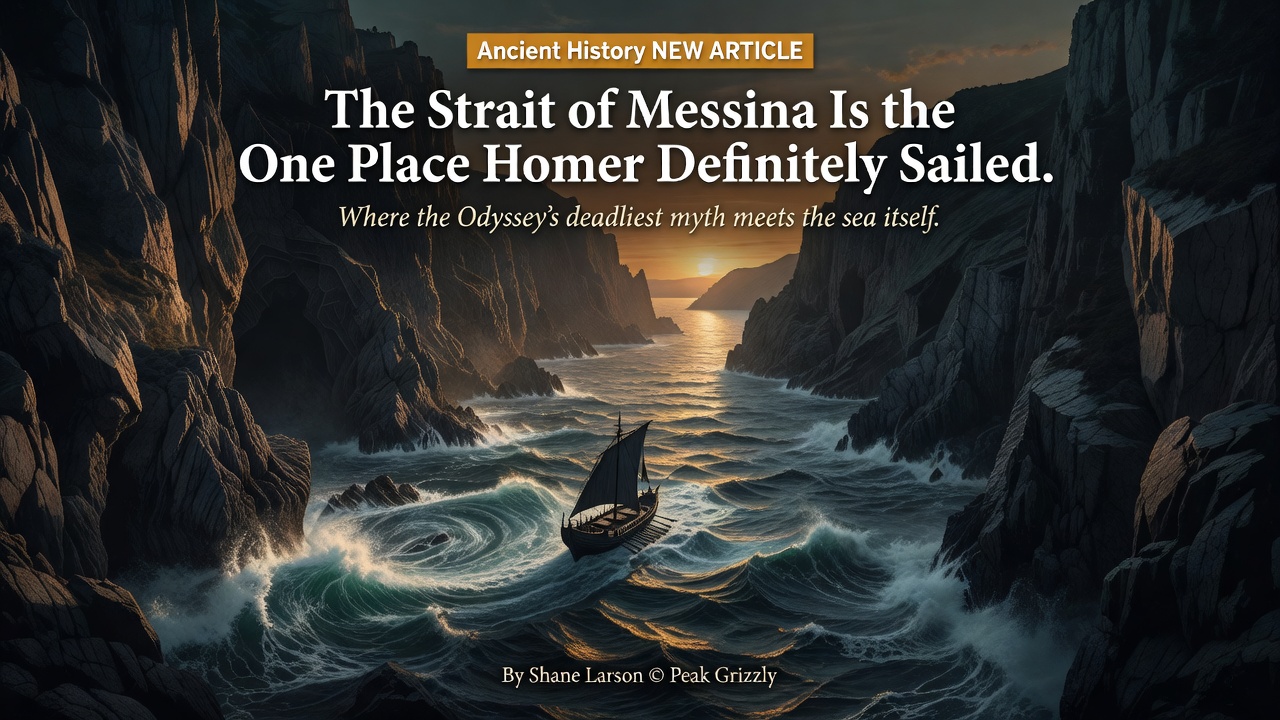
There is a three-kilometer-wide channel between the toe of Italy and the northeast corner of Sicily where the skeptics go quiet. The Strait of Messina is the one place on the entire route where the poem stops sounding like invention and starts sounding like something else entirely: a pilot's warning, passed from sailor to sailor until it hardened into myth. A monster on the rock to one side. A whirlpool that swallows the sea and vomits it back on the other. A passage so narrow that steering wide of one hazard delivers you to the second.
Every element of that nightmare exists. You can visit it today. And once you understand what the strait actually does to the water — and what a Bronze Age ship could and couldn't do about it — the case stops being romantic speculation and becomes something closer to forensics.
A Whirlpool You Can Still Visit
The Strait of Messina is a hydraulic freak, and the mechanism behind it is elegant enough to explain in a paragraph.
The strait connects two seas — the Tyrrhenian to the north, the Ionian to the south — and those two bodies of water refuse to cooperate. Their tides run out of phase: when one basin is high, the other is low, roughly six hours apart. Twice a day, enormous volumes of water are forced through a channel three kilometers wide at its narrowest, with a submerged sill where cold dense Ionian water and warmer Tyrrhenian surface water shear across each other. The result is a tide race: currents that reverse direction every six hours, reaching several knots at springs, colliding with wind-driven waves and with each other.
Where the moving water meets the sill and the narrows, the surface breaks into phenomena that Sicilian fishermen have their own vocabulary for. There are boils — smooth domes of upwelling water that shove a boat sideways without warning. There are lines of standing overfalls where current meets opposing wind. And there are true whirlpools, spinning vortices that form, wander, and collapse, historically at their worst off the Sicilian shore near a spot whose name gives the game away: Cariddi. Charybdis has kept her address for three thousand years.
Across the channel on the Calabrian side stands a bold rock headland above deep water, with reefs at its foot. The town that clusters beneath it is called Scilla. It, too, has held its name since antiquity.
Now consider what the poem actually asks its audience to picture — not the monsters, but the geometry. Two hazards, facing each other across a passage. Close enough that a helmsman avoiding one is delivered to the other. A high crag on one side above deep water; on the other, a churning gulf that alternately gulps the sea down and spews it up — and a warning that being near it when it swallows means no rescue for anyone. Strip out the six heads and the divine ancestry, and what remains is a sailing direction: favor the rock side, accept losses there if you must, because the whirlpool side loses the whole ship. Hug the cliff, stay off the Sicilian shore, time your passage. That is not how fantasy is usually built. Fantasy doesn't give you a preferred course.
The recognition has struck sailors for centuries, and it struck at least one so hard it changed his life. In 1955, Ernle Bradford — a former Royal Navy man who had sailed these waters — was taking a small boat through the strait when the tide turned against the wind and the surface stood up around him into boils and eddies he could not steer through. He went on to spend years sailing the whole proposed route of the wanderings and wrote a classic book arguing all of it was real. About most of the route, reasonable people still disagree with him. About the strait, almost nobody does.
Why a Bronze Age Ship Had No Way Out
Here is where most retellings stop, and where the more interesting half of the argument begins. To feel what the strait meant to the sailors who first carried this story, you have to understand their ship — because the ship is the reason the passage was a genuine deathtrap and not merely a dramatic stretch of water.
A galley of the late Bronze Age or early Iron Age was a low, open boat carrying a single square sail on a single mast. That rig has one overwhelming limitation: it works only with the wind somewhere behind the beam. A modern yacht, with its fore-and-aft sails and deep keel, can claw its way upwind in zigzags. A square-rigged galley cannot. Against a foul wind its sail is useless cloth, and the crew's options collapse to two: row, or be taken wherever the wind and current decide. There was no third choice. This is why, when the Odyssey's fleet is caught by a gale at Cape Malea and driven for nine days into unknown seas, the poem is describing engineering rather than exaggerating for effect. For this ship, weather wasn't an obstacle on the route. Weather chose the route.
Mapping the Voyage
Add the rest of the envelope. Steering came from an oar over the quarter — effective enough with steerageway, feeble in turbulent water that keeps stealing the ship's momentum. Freeboard was low; a breaking overfall could flood her. The crew's rowing endurance was the fuel gauge, and a hard current could outlast any rowers alive. These ships hugged coasts, beached at night, waited out foul winds on the sand, and stayed home entirely for the winter half of the year, when the Mediterranean turns violent. The sailors who worked them were not timid. They were realists operating a machine with narrow margins, in a sea that punished optimism.
Now put that machine into the strait on a bad tide. The current reverses every six hours, so local knowledge of timing is everything — and a foreign crew has none. If the stream is against you, you row; if the race is running faster than your oarsmen, you go backward while rowing forward, toward whatever the water wants to show you. The boils shove the bow off course faster than a steering oar can answer. The whirlpools wander. And the channel is too narrow to simply stand off and think: the Calabrian rock is on one hand, the Sicilian churn on the other, and the current is carrying you through the gap whether your plan is ready or not.
That is the situation the poem encodes with such uncomfortable precision: not a monster encounter but a forced passage — a corridor where a helmsman must commit to a side, where the safer side still costs you, and where hesitation costs everything. The detail that the hero is told to lose six men to the rock rather than the ship to the whirlpool is the coldest and most professional line of seamanship in ancient literature. It is the arithmetic every pilot of a dangerous channel eventually learns: minimize the worst case. Somebody paid for that advice before it ever reached a poet.
What One Real Place Proves — and What It Doesn't
It's tempting to run the logic forward: if Scylla and Charybdis are the Strait of Messina, then the voyage is real, the map is recoverable, and we can pin the Cyclops and Circe and Calypso to their own coastlines with enough diligence. Sailors and scholars have been yielding to that temptation since antiquity, and it deserves respect — but it doesn't hold, and the reasons it doesn't hold are as instructive as the strait itself.
The ancient world already understood the problem. The geographer Strabo championed a western Mediterranean setting for the wanderings. Eratosthenes — the polymath who measured the circumference of the Earth and ran the Library of Alexandria — answered with one of the great put-downs in the history of scholarship: you'll trace Odysseus's route, he said in essence, when you find the craftsman who stitched the bag that held the winds. And when you test the rest of the route the way a navigator would — against real winds, real currents, real sailing seasons, real rowing ranges — Eratosthenes keeps winning individual battles. One stop describes summer days so long they imply latitudes no Mediterranean route can honestly reach. Another is an island explicitly defined by being beyond all shipping lanes, unreachable by design. Distances that should take days are covered in impossible times; courses that should be constrained by prevailing winds wander freely. Much of the voyage doesn't just resist the atlas — it reads as if it was built to resist the atlas, the way the land at the top of the beanstalk resists a street address.
So the strait proves something narrower and, I'd argue, more interesting than "the map is real." It proves the poem has anchors — that woven into a deliberately unmappable fairyland are patches of hard, local, professional knowledge that could only have come from sailors who had been there, been terrified, and carried the warning home. The Odyssey is not a chart, and it is not pure invention. It is the sea as sailors actually transmitted it: real pilotage and real fear, braided into story because story is how oral cultures store what must not be forgotten. The right question was never "is the voyage real?" It was always "which legs feel sailed, which feel dreamed — and how can you tell?"
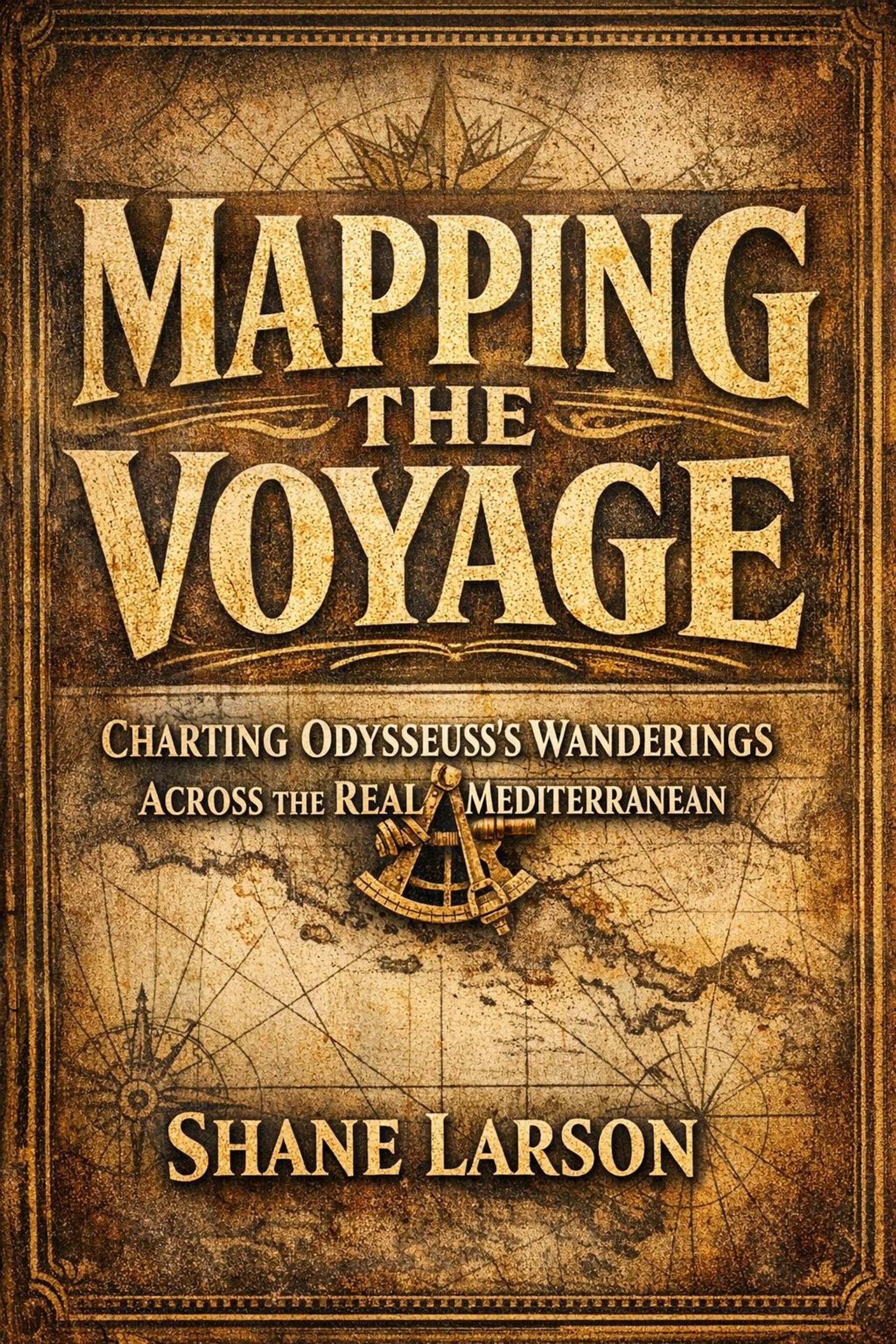
Answering that question stop by stop — with currents, winds, sailing seasons, and the hard limits of a square-rigged galley as the referees — is the project of my new book, Mapping the Voyage: Charting Odysseus's Wanderings Across the Real Mediterranean. It walks every landfall from the Cicones to the Phaeacians, lays out three thousand years of proposed identifications, and lets the sea judge each one. The strait is the strongest yes. Some of the others may surprise you — including the ones where the most honest answer turns out to be the most revealing.
Mapping the Voyage
New posts and releases, straight to your inbox. No spam, unsubscribe anytime.