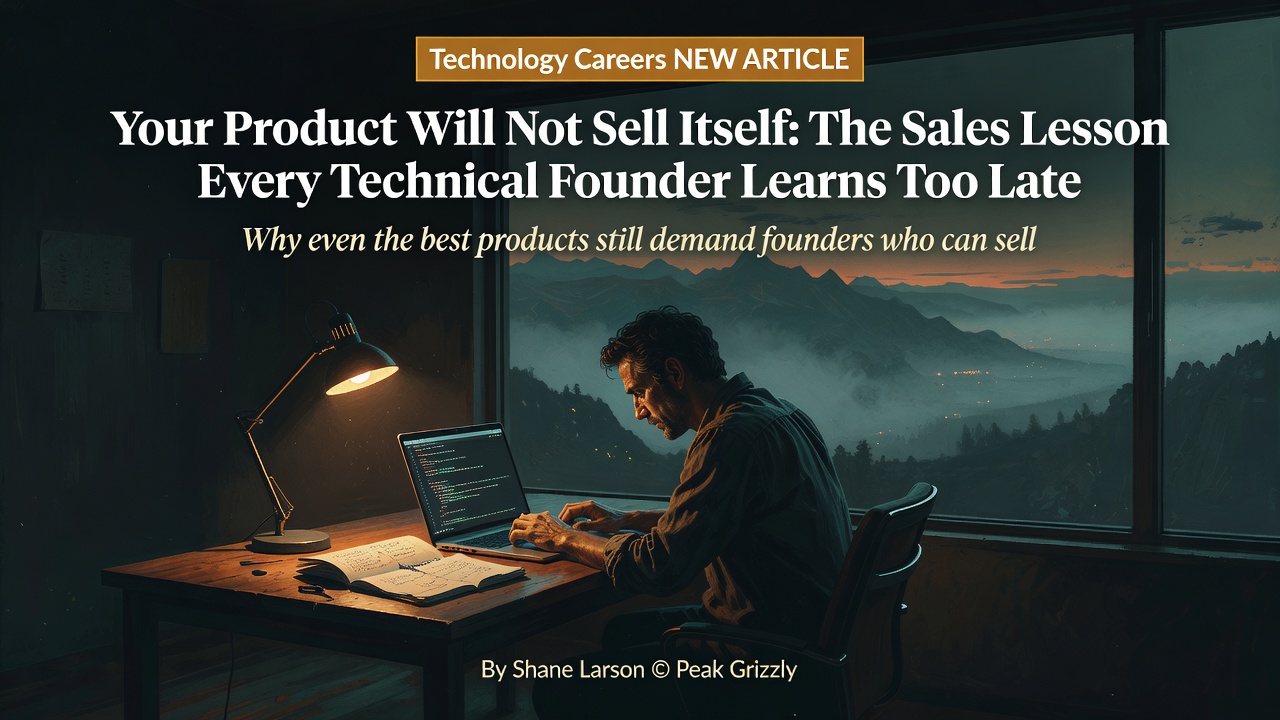
Your Product Will Not Sell Itself: The Sales Lesson Every Technical Founder Learns Too Late
September 22, 2026 · 6 min read
The foundational delusion of technical founders is that a great product generates its own demand. Build something excellent, put it out there, and customers will find it, try it, love it, and pay for it. No selling required.
This does not happen. It has never happened.
Slack looks like a product that sold itself. Its own founder said otherwise. In 2013, before the product had meaningful revenue, Stewart Butterfield wrote a memo to his team, later published, arguing that Slack was not selling a chat application at all. Nobody wakes up wanting group messaging software, so what customers actually had to be sold was a change in how their organization worked, and every part of the product and the writing around it existed to make that change intelligible and desirable. The free tier, the onboarding, the decision to land inside teams rather than sell to executives: all of it was designed, tested, and revised on purpose. The word of mouth was the output of that work, not a substitute for it.
Dropbox looks like it grew through word of mouth. Drew Houston has presented the numbers publicly, and they tell a different story. Early growth came from a screencast posted to the sites where Dropbox's target users already were, which drove the beta waiting list from a few thousand to tens of thousands in a day, and from a referral program that gave free storage to both the referrer and the person referred. By Houston's account the referral program produced a large and sustained increase in signups. Someone chose the channel, made the video, designed the incentive, and measured the result. The "word of mouth" was engineered.
The world is full of excellent products that nobody uses. Products that are technically superior to their successful competitors. Products built by brilliant engineers who assumed that quality would be sufficient. Those products failed not because they were bad but because nobody knew they existed, nobody understood why they mattered, and nobody was compelled to switch from whatever they were already using.
The default state of a new product is not mediocre visibility. It is complete obscurity. And the only way out of obscurity is the thing engineers dread most: sales.
Sales Is Not What You Think It Is
If there is one word that makes engineers recoil, it is "sales." The word conjures slick talkers, high-pressure tactics, and everything antithetical to the engineering mindset.
But the kind of sales that early-stage startups need has almost nothing in common with that archetype. Early-stage sales is conversations. Talking to people who have the problem you are trying to solve, understanding their version of that problem in their words, and exploring whether your product is a good fit. It is asking questions more than making statements. Listening more than talking. Learning more than persuading.
Rob Fitzpatrick's The Mom Test nails this: most founders have customer conversations backward. They tell people about their product and ask if it sounds good. Of course it sounds good — people are polite. The useful conversation is the one where you ask about their problem without mentioning your product, and they tell you what they are actually struggling with, what they have tried, and what they would pay for.
For an engineer, reframe it this way: early-stage sales is user research with commercial intent. You are gathering requirements, but the requirements are for the business case, not for features. Does this person have the problem I think they have? How painful is it? What are they currently doing about it? How much would they pay to make it go away?
These are engineering-style questions applied to a business context. The data just comes from conversations instead of logs.
The Technical Founder's Reality Check
And engineers have natural advantages they consistently underestimate. Deep product knowledge — you built the thing and can answer technical questions immediately. A problem-solving orientation that turns sales conversations into collaborative debugging sessions. Credibility that no hired salesperson can replicate. And a bullshit detector that prevents overselling — which, counterintuitively, is a sales asset.
Your first ten customers will not come from marketing or a viral launch. They will come from direct outreach to specific people you have identified as potential users. Write a short, personal message that demonstrates you understand their problem. Have the conversation. Ask questions first, pitch second. And when someone is interested, do the thing that technical founders consistently freeze on: ask for the sale. "Can I send you an invoice?" is not aggressive. It is respectful of their time.
The Pricing Trap That Costs You Everything
Engineers undercharge because they evaluate their product through the lens of effort and cost. "It only took me three months to build, so I cannot charge much." "The marginal cost is basically zero, so it should be cheap."
These are the wrong frameworks. Pricing is not about your costs. Pricing is about the customer's value. If your product saves a company ten hours of work per week at an average employee cost of $80 per hour, that is $3,200 per month in value. Charging $200 per month for something that delivers $3,200 in value is not expensive — it is a bad deal for you.
A rule of thumb: your price should be roughly 10-20 percent of the value your product delivers. If you cannot articulate the value in dollar terms, you do not understand your value proposition well enough to price the product.
The specific traps to avoid:
Pricing based on features. Engineers love features and assume customers pay for them. Customers pay for outcomes. A product with one feature that delivers a clear outcome is worth more than a product with fifty features that delivers unclear value.
Pricing based on competition. "The competitor charges X, so I should charge less." This is often wrong. If your product is better, charge more. Competing on price is the weakest competitive strategy and it is where you end up when you do not have a clear value proposition.
Giving it away too long. Free trials are useful. Free products that never convert to paid are charity. If people will not pay, that is critical market signal. Do not suppress it.
Being afraid to raise prices. If zero customers push back on your price, you are too cheap. If every customer pushes back, you are too expensive. If some push back and others pay willingly, you are in the right range. Raise your prices until you feel slightly uncomfortable, and then hold.
The engineers who are most successful at startup sales are the ones who approach it as a learning discipline. They bring the same curiosity and analytical rigor to understanding customers that they bring to understanding systems. They track conversion rates, analyze failures, and iterate on their process the way they would iterate on code.
You do not have to love sales. You do have to do it.
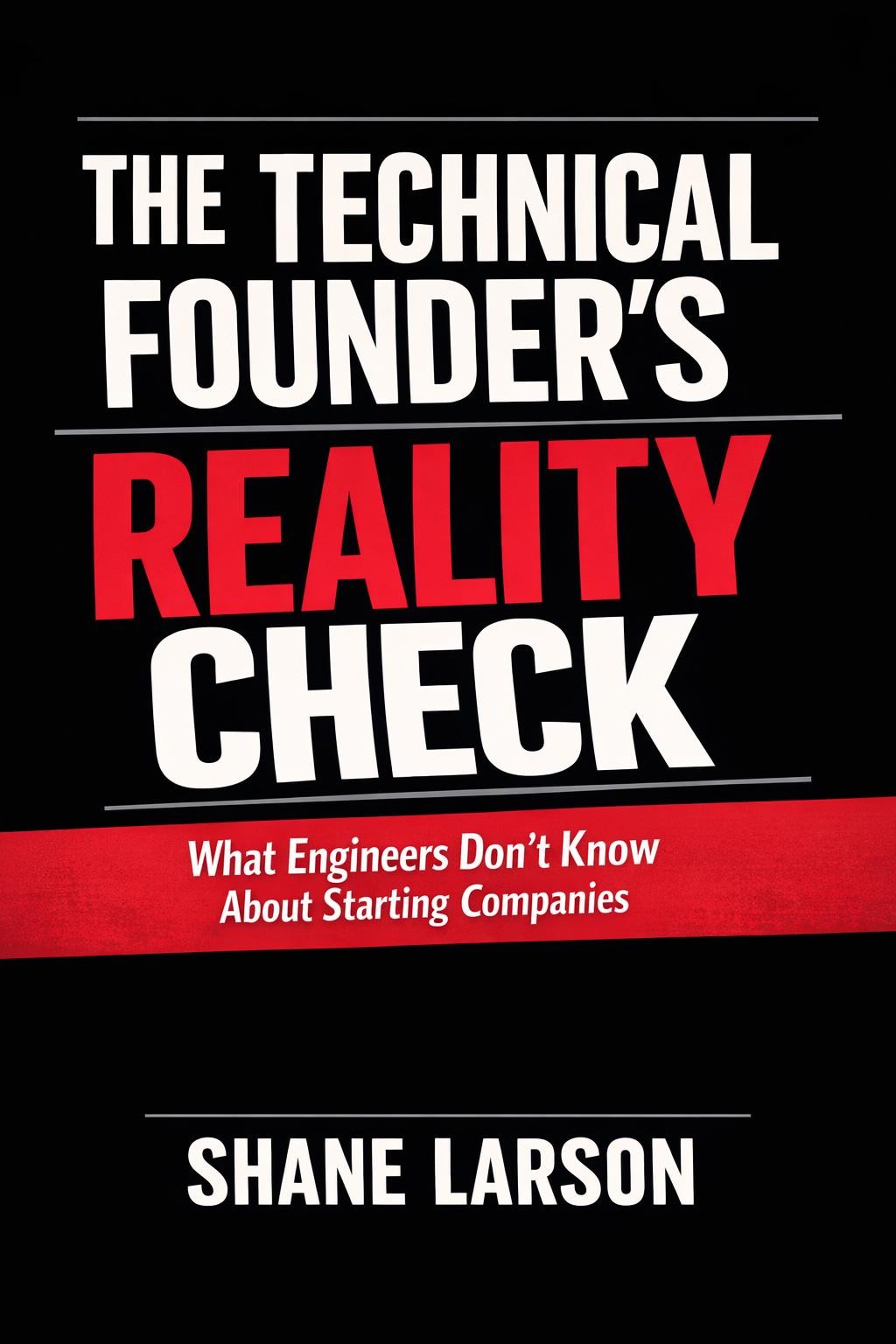
This article draws on material from The Technical Founder's Reality Check: What Engineers Don't Know About Starting Companies — a book built not from one founder's story but from outcome data, published research, and post-mortems written by the people who lost. Learn more about the book
The Technical Founder's Reality Check
New posts and releases, straight to your inbox. No spam, unsubscribe anytime.