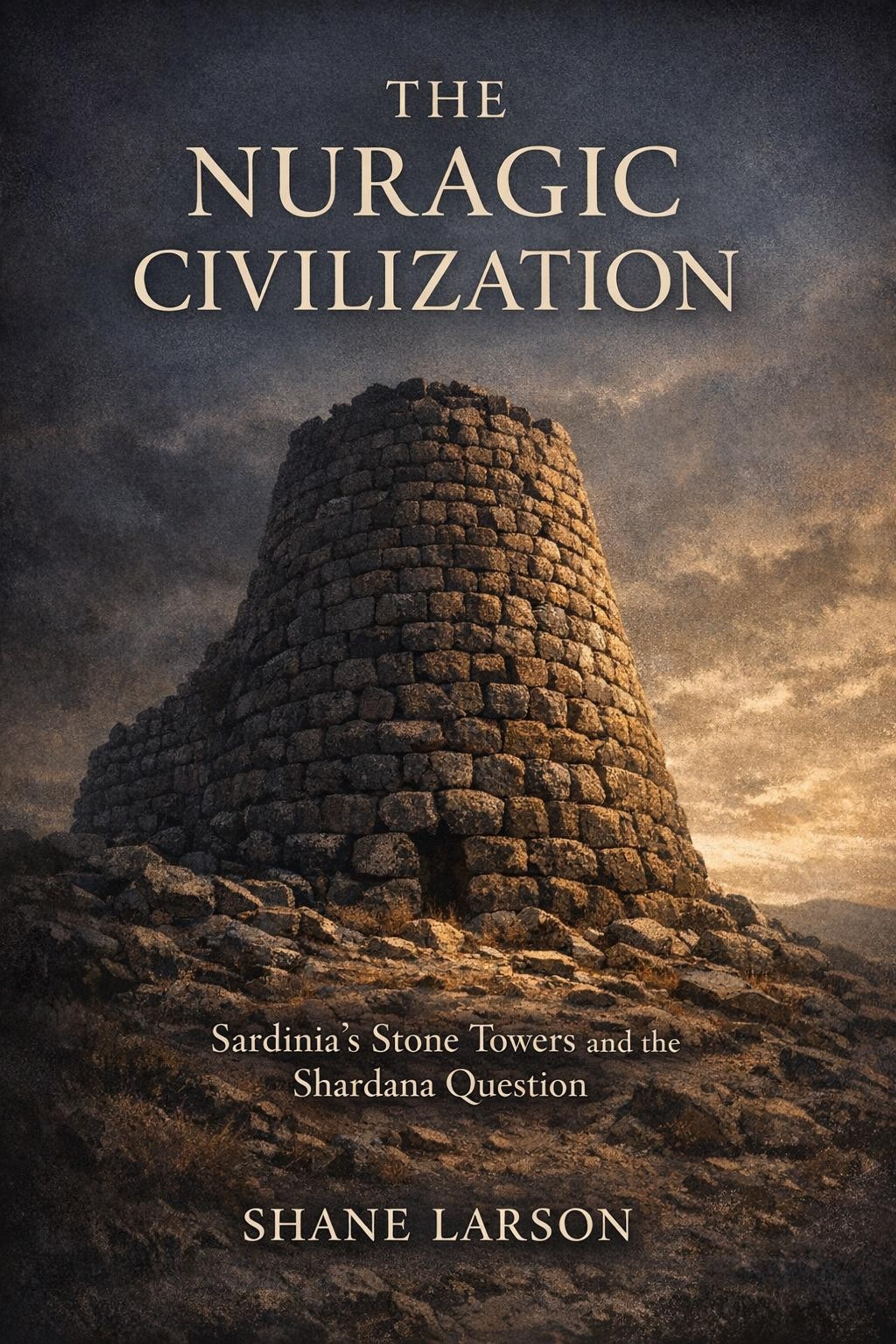
The Nuragic Civilization
Sardinia's Stone Towers and the Shardana Question
By Shane Larson
About This Book
At a place called Santa Cristina, in the middle of western Sardinia, a flight of stone steps descends into the earth. The stair narrows as it goes, its side walls converging in clean symmetry, until it reaches a pool of spring water at the bottom of a vaulted shaft. The blocks are cut and fitted so exactly that visitors routinely doubt the date. It looks machined. It was built around three thousand years ago, by hand, by people who never wrote anything down.
The same people worked out how to roof a round stone chamber using nothing but stone. Their answer was the corbelled vault — ring laid upon ring, each course stepping slightly inward over the one beneath, until the circle closes overhead and the ceiling hangs on its own balanced weight. No mortar anywhere. Many of their chambers are still intact, dark and dry, after thirty centuries of earthquakes, winters, and stone-robbing.
Then there is a laboratory result. Sardinia has copper ore of its own, demonstrably worked in antiquity. Yet when the oxhide-shaped ingots found at Sardinian sites were run through lead-isotope analysis, a striking number proved to be smelted from Cypriot copper, carried some two thousand kilometres from the far end of the Mediterranean. Whatever the Bronze Age looked like from Sardinia, it was not isolation.
The people behind all of this are known as the Nuragic civilisation, after their towers — the nuraghi — and they are one of the strangest blind spots in popular ancient history. Between roughly 1800 and 1000 BC they built monumental architecture at a density no other Bronze Age society in Europe approached, cast hundreds of small bronze images of themselves, and raised over-lifesize stone statues that would not be found until a tractor hit them in 1974. The scholarship on them lives almost entirely in Italian excavation reports and regional journals; until now there has been no serious general-reader account in English at all.
This book builds that account from the ground up, and it shows its work: the object or the site, what can be measured about it, the inference, and the exact point where inference stops being knowledge and becomes argument. For a society with no texts, that discipline is the whole method.
Running underneath everything is the question in the subtitle. Egyptian scribes of the thirteenth and twelfth centuries BC recorded a warrior people whose name resembles the name of this island — first as coastal raiders, then as soldiers in the royal bodyguard, finally among the groups modern scholars call the Sea Peoples. Were they Sardinians? The debate began in the nineteenth century and has never closed. This book gives each side a full chapter, written the way its own best advocates would write it — and then declines to hand down a ruling the evidence cannot support. On Sardinia the identification is a matter of real and understandable pride, and the question is taken seriously here for exactly that reason: what remains open stays open, with the reasons on the table.
Why I Wrote This
I first met the Shardana from the other side, writing about the Sea Peoples — a named contingent in the Egyptian record whose most-argued homeland is Sardinia. I went looking for the one good English book on the people at the other end of that argument and found there wasn't one. Not a dated one, not a thin one: none. Seven thousand Bronze Age towers on a single island, built by a society that left no readable text, at the centre of an identity debate that has run for a century and a half — and everything written about it for a general reader stops at a paragraph in someone else's book. The real material sits in Italian excavation reports almost nobody outside the field will ever open. That gap seemed worth a year of work. This is the book I wanted to hand to my earlier self.
Frequently Asked Questions
What is a nuraghe?
A nuraghe is a Bronze Age tower of dry-laid stone — no mortar — with a corbelled inner chamber and, usually, a staircase inside the thickness of the wall. Some are single towers; the largest are complexes of several towers joined by curtain walls. Roughly seven thousand survive on Sardinia, built between about 1800 and 1000 BC, and nothing closely comparable exists anywhere else.
Does the book conclude that the Nuragic people were the Shardana?
No. It argues each side in a full chapter of its own and leaves the verdict open — because that is where the evidence honestly leaves it. The name resemblance can be read in more than one direction, the key artifacts are hard to date, and the matching equipment is less diagnostic than it first appears. An announced answer would be selling certainty nobody currently owns.
Do I need any background in Bronze Age history to read it?
No. It assumes you have never heard the word nuraghe and know nothing of the Bronze Age Mediterranean. Everything needed is built up inside the book.
What is Mont'e Prama?
Mont'e Prama is a site on Sardinia's Sinis peninsula where, in 1974, a plough turned up fragments of over-lifesize stone statues — boxers, archers, and warriors with staring circle-and-dot eyes — from a culture nobody had suspected of monumental sculpture. The figures had been deliberately broken and buried in antiquity, their date is still fought over, and the site is only partly excavated.
Can you visit the nuraghi today?
Yes. Many are open sites, and the major ones are managed and ticketed: Su Nuraxi at Barumini is a UNESCO World Heritage Site, and Santa Cristina's well temple is open year-round. Appendix A is a gazetteer of the principal sites and what was found at each.
How long is the book?
About 76,000 words — roughly 260 pages in print. Fourteen chapters plus an introduction, a conclusion, and three appendices: the site gazetteer, a source-by-source catalogue of the Egyptian records of the Sea Peoples, and a guide to reading a Nuragic bronze figurine.
If You Liked This, You Might Like
- Sea Peoples: Raiders of the Bronze Age — the same mystery from the opposite shore: the raiders as Egypt recorded them, including the Shardana this book follows home to their most-argued point of origin.
- When the World Burned: The Complete Story of the Bronze Age Collapse — the fall of the connected eastern world around 1200 BC, which Sardinia experienced from the far western edge of the network and largely survived.
- The Bronze Age World — the full system of palaces, ships, and metal routes that Sardinian copper and Cypriot ingots moved through, for readers who want the whole map.
Nobody knows what the tower-builders called themselves, and nobody ever will. But the stair at Santa Cristina still leads down to water, the vaults still hold their own weight in the dark, and an island can be read even when it cannot be quoted.
What You'll Learn
- Why the book starts with geography: how Sardinia's position — remote enough to develop on its own terms, close enough to trade — explains more about this civilisation than any other single fact.
- The labour arithmetic of a tower: how many hands, how many seasons, and what it means that a society without writing could direct building crews for eight hundred years.
- The long dispute over what the towers were for — fortress, residence, granary, temple, boundary marker — with each interpretation given its strongest form and the reader trusted to weigh them.
- Life in the villages of round stone huts around the towers, and how much social structure can honestly be read from architecture alone.
- Santa Cristina and the water cult, with the astronomical-alignment claims presented alongside both their evidence and their sceptics.
- How Egyptian scribes recorded the Shardana across two centuries — as enemies, as captives, and eventually as trusted troops of the crown — and what those records cannot establish about their homeland.
- Mont'e Prama: the giant statues of boxers, archers, and warriors, the decades of reconstruction from thousands of fragments, and why the fight over their date matters so much.
- What reached Sardinia when the Mediterranean system failed around 1200 BC, and the island's long afterward under Phoenicians, Carthage, and Rome.
New Ancient History releases and free chapters — no spam, unsubscribe anytime.