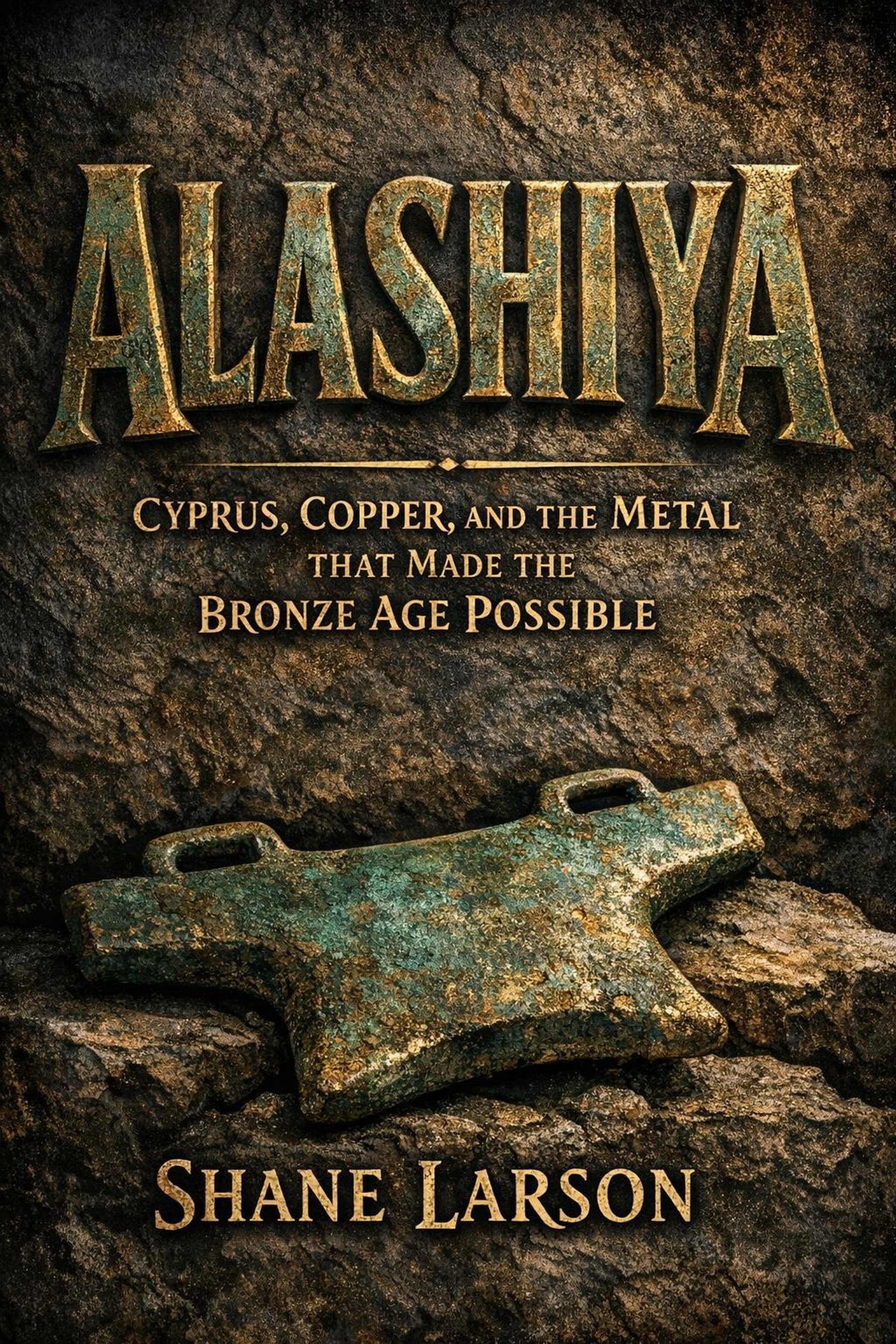
Alashiya
Cyprus, Copper, and the Metal That Made the Bronze Age Possible
By Shane Larson
About This Book
Ninety million years ago, in an ocean that no longer exists, hot water circulating through young volcanic seafloor left dense bodies of copper sulphide around the vents. Nearly all ore formed that way is eventually dragged back into the earth when the plates converge. This ore was not. A slice of that seafloor, caught between colliding plates, went up instead of down — lavas, dykes, ore bodies and all — and was stranded above the waves. Geologists call the result an ophiolite, and the Troodos range is the textbook case: a mountain that is, in cross-section, ocean floor lying on its side. Copper formed on the Tethys seabed ended up weathering out of hillsides within reach of natural harbours.
Getting metal out of that rock consumed the island's other resource. A Bronze Age furnace ran on charcoal, and the arithmetic is merciless: kilograms of charcoal for every kilogram of finished copper, and many kilograms of seasoned wood for every kilogram of charcoal. Multiply that through the slag the industry left behind and the answer comes out in forests. Centuries of smelting ate Cypriot woodland the way the furnaces ate ore. The most important supply line of the age ran, at its source, on trees.
And in 1960, off a headland on the southern Anatolian coast, archaeologists excavated a shipwreck on the seabed for the first time. The ship at Cape Gelidonya was small and scrappy: scrap bronze, broken tools, a smith's kit, balance weights — a travelling metalworker's operation, not a royal consignment. Three decades later and a few days' sail away, the Uluburun wreck yielded the other end of the scale. The two ships bracket the trade this book reconstructs, from the palace-level shipment down to the man buying broken sickles by weight.
That trade existed because of an inconvenient fact of geochemistry. Bronze needs copper and tin together, and the processes that concentrate the two metals have almost nothing to do with each other, so they nearly never share an address. The lands that used bronze hardest had no tin at all. The age's defining material was therefore an assembled product, its ingredients travelling months from opposite directions to meet in a crucible. No power controlled that chain from end to end. Every power depended on it.
At the copper end sat a kingdom the textbooks barely mention. In the diplomatic archives of Egypt, the Hittites and Ugarit it is called Alashiya, and its rulers corresponded with pharaohs in the language reserved for kings of equal rank — while remaining individually nameless. No Alashiyan annal survives, and the island's own script is still undeciphered, so its history has to be built from its metal, from two sunken ships, and from the filing cabinets of its customers. That reconstruction is what this book does, with disagreements left visible and inference labelled as such.
A history of a supply chain ends the way supply chains end: not with a battle but with an interruption. The final chapters follow the system through its thirteenth-century peak — maximum volume, total interdependence, no reserve — and then through the decades around 1200 BC, when the ports that moved the tin burned and the recipe could no longer be assembled. What came next was not an upgrade. It was an improvisation in a mediocre, ubiquitous metal that needed no ships at all.
What's Inside
- The practical metallurgy of bronze, built from the object up: what adding one part tin in ten actually does to copper, and why that difference decided harvests, battles and prices.
- The mines and furnaces as the excavators found them — galleries propped with pine, ore hauled out in baskets by lamplight, and slag heaps large enough to be cored and dated like an archive.
- The king of Alashiya's correspondence, paraphrased: copper by the hundreds of ingots, a plague offered as the reason a shipment ran small, and the everyday haggling of a monarch whose power was a product.
- Both shipwrecks, cargo by cargo, and the argument they ignited over whether Bronze Age trade was royal gift-exchange or private commerce — a fight that reshaped the field.
- Lead isotope analysis with its limits on the page: how a laboratory ties an ingot from a Sardinian hoard to a specific ore body, and where the method's critics have a point.
- The collapse from underneath: the last letters written at Ugarit, the hoarding and frantic recycling of old bronze, and why iron won by default rather than by merit.
- Three reference appendices: how bronze was made, the Uluburun cargo itemised, and every document that mentions Alashiya in one place.
Why I Wrote This
We name the whole period after bronze. Bronze takes two metals, and the earth almost never puts them in the same place — so the age's namesake material was a logistics achievement before it was anything else. Pull on that thread and you find one island that supplied the copper to practically everyone, corresponded with pharaohs as an equal, and is remembered, when it is remembered at all, as a footnote in other people's archives. Not one of its kings has a name we can read. That gap between how much a place mattered and how little it is remembered seemed worth a book on its own. The plainer reason: the evidence is wonderful. Two intact cargoes on the seabed, a mountain of industrial waste that can be weighed and dated, and chemistry that reads a 3,000-year-old ingot like a shipping label. Few ancient subjects let you build so much from things rather than claims.
Frequently Asked Questions
Do I need to read other Bronze Age books before this one?
No. The book assumes no prior knowledge and explains every kingdom, archive and technique as it arrives. If you have read collapse-first histories, this one supplies the machinery underneath them.
Is Alashiya really Cyprus?
Yes — and the closing of the question is a story in itself. For seventy years the identification rested on geography and context, always with room for doubt. The decisive move was to treat the letters as objects: petrographic and chemical analysis of the clay of the Alashiya tablets found in Egypt and at Ugarit matched them to specific Cypriot clay sources near major Late Bronze Age centres. Decades of argument about the text; the answer was in the mud.
What does the Uluburun shipwreck actually prove?
That the trade was real, enormous, and international at the level of a single voyage: ten tonnes of copper and a tonne of tin — the bronze ratio, pre-measured in one hold — alongside goods from a dozen lands. A royal letter can flatter or exaggerate; a cargo can only be what it is.
Does the book cover the Sea Peoples and the Bronze Age collapse?
Yes, from the supply side. The last four chapters follow the interruption through the metal: the final correspondence at Ugarit, the hoards and recycling that mark a starving bronze economy, and the forced turn to iron. The book does not adjudicate a single cause; it shows what failing looked like in the one commodity everything else ran on.
How much metallurgy or chemistry do I need to follow it?
None. Every technique, from smelting to isotope analysis, is explained from scratch where it appears. If you can follow a recipe, you can follow the metallurgy.
How long is the book?
About 75,000 words — roughly 250 pages in print — in fourteen chapters plus an introduction, a conclusion and three appendices.
If You Liked This, You Might Like
- The Amarna Letters: Diplomacy at the End of the World — the archive in which the king of Alashiya's correspondence survives, given a whole book of its own.
- The Last Good Year: A City's Last Letters Before the Bronze Age Burned — Ugarit, the port that moved Alashiya's copper, seen from inside its own walls in the months before the fire.
- When the World Burned: The Complete Story of the Bronze Age Collapse — the full account of the catastrophe that this book watches from the supply room.
A civilisation ran for centuries on metal from an island whose kings have no names. This is what can be recovered of them — from rock, from two drowned ships, and from the letters their customers kept.
Included with Kindle Unlimited — read it free if you're a member.
New Ancient History releases and free chapters — no spam, unsubscribe anytime.