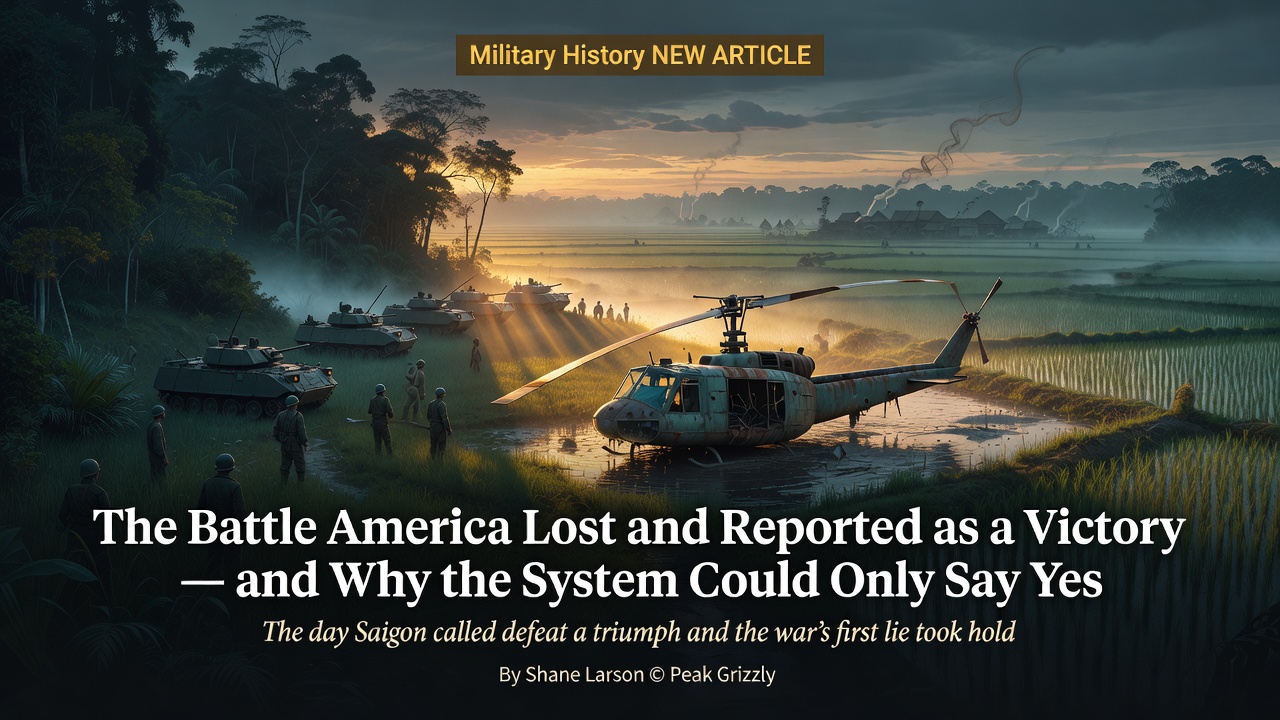
Hanoi Lost the Tet Offensive on Every Objective It Set. Eleven Weeks Earlier, Washington Had Already Decided What the Attack Would Mean
October 25, 2026 · 8 min read
Start with the military verdict, because almost nobody does.
The offensive that erupted across South Vietnam on the night of January 30–31, 1968 — attacks on thirty-six of forty-four provincial capitals, five of six autonomous cities, and nearly every significant American base in the country, launched during a truce declared for the most important holiday in the Vietnamese calendar — failed on every objective its planners set for it. This is not a revisionist claim. It is the consensus of the military historiography on both sides, and Hanoi's own official history concedes the substance of it in its own vocabulary.
The plan required three things to happen at once. The urban population of South Vietnam was to rise in a general uprising, led by cadre who would surface from years of concealment to lead it. The South Vietnamese army was to dissolve or come over. And the Saigon government was to collapse, presenting the Americans with nothing left to defend. None of the three occurred. The uprising did not come — not in Saigon, not in Hue, not anywhere. The South Vietnamese army, caught at half strength on a truce night specifically chosen to find it dispersed, fought — by the general assessment of its allies and its enemies alike, better than anyone had predicted — and did not lose a single formation to defection. The attackers held no city except Hue, and Hue was retaken within a month. And the cost fell on the one asset that could not be replaced: the southern cadre force, the political and military infrastructure the National Liberation Front had spent a decade building, surfaced because the plan required it to and was destroyed as a fighting force in a few weeks. It never fully recovered. From 1968 forward the war was prosecuted increasingly by regulars from the North, and the campaigns of 1972 and 1975 would be designed as conventional invasions — never again as risings expected to be joined.
By any military accounting, Hanoi lost, and lost badly.
And within nine weeks of the first attacks, the president of the United States had halted the bombing over most of North Vietnam, offered negotiations, and announced he would not seek re-election.
Nearly everyone who writes about 1968 reaches at this point for the word paradox — a battlefield victory that functioned as a defeat, one of history's great ironies. The word should be resisted, because the relationship between the military result and the political result was not paradoxical. It was causal. And the cause was not built in January 1968. It was built the previous November, in Washington, on purpose.
The campaign that came first
In the autumn of 1967, the Johnson administration ran a coordinated public-relations operation its own planners called a progress campaign. The ambassador, the head of pacification, and the commanding general of American forces were rotated through Washington to brief Congress, sit for the networks, and assure the public that the strategy was working. Its centerpiece came in the third week of November, when General Westmoreland — flown home for the purpose — told the National Press Club that the war had reached the point at which the end begins to come into view, and that American withdrawal could begin within two years.
The campaign was mounted because the president had concluded that the most dangerous front of the war, by late 1967, was the patience of the American public. And it rested, from top to bottom, on a reporting system that could not support it: a body count generated by the units whose performance it graded and verified by no one, and an enemy strength estimate that had just been negotiated downward — over the objection of the analysts who did the counting — at exactly the moment the government most needed the total to fall.
While the campaign ran, the enemy it described was moving into the cities in civilian clothes, with the weapons following in produce trucks and false-bottomed vehicles. That is the collision Tet staged: not between an army and an army, but between an event and a description.
The mechanism, stated plainly
Here is the whole machinery in one sentence: the shock of Tet was proportional not to the military event but to the distance between that event and what the public had been promised eleven weeks earlier — and that distance had been opened deliberately, by a government campaign asserting an outcome its own reporting system could not support.
A government that manufactures an expectation has mortgaged its credibility against events it does not control. In January 1968 the events arrived, and the mortgage was called.
The American embassy in Saigon is the argument in a single incident. A small sapper team blew a hole in the compound wall; every attacker was dead or dying within hours; none reached the chancery. As a military event it was nearly weightless. As a political event it was a catastrophe, because it happened inside the one acre the autumn's assurances had made a symbol of everything under control. The same event, arriving against a government that had spent the autumn saying this will be long and hard and the enemy retains the capacity for spectacular attacks, lands as confirmation. Arriving against the end has begun to come into view, it lands as exposure. The event was identical. The mortgage was not.

Two Hundred Thousand More
What the polling actually shows
The popular counter-story — that a supportive country was turned against the war by catastrophic television coverage — does not survive contact with the numbers, and it is worth being precise about which numbers.
American support for the war had been eroding for two and a half years before Tet, on a curve that tracks the accumulation of American dead. The judgment that the war had been a mistake reached a plurality in October 1967 — three and a half months before the first attack. And the public's immediate response to the offensive was hawkish by nearly three to one: the country's first instinct in February 1968 was to hit back, which is the opposite of what a public stampeded by disaster footage would produce. The famous late-February broadcast did not turn a hawkish country dovish overnight; the crude version of the media thesis is false, and the polling closes it.
But the numbers cut the other way too, and honesty requires saying so. The coverage of Tet was systematically wrong in the direction of disaster — the scale of Hanoi's defeat went largely unreported, the embassy attack was misdescribed after the facts were available, and the South Vietnamese army's performance was omitted almost entirely; Peter Braestrup's catalogue of those errors has never been seriously overturned. Meanwhile the polling found something subtler and more damning than a collapse in support: the 1967 progress campaign had raised the share of Americans who believed the war was being won without raising the share who believed the government was telling the truth about it. The November claim was a conclusion suspended over nothing. That is why it went all at once.
What actually cannot be recovered from the record is the direction of causation in the collapse that mattered most — the reversal among the men around the president, which happened in the same six weeks as the press commentary's turn, in the same city, among men who were reading each other. The government's own classified reassessment reached conclusions closer to the pessimistic coverage than to its own briefings, which the press's critics must accommodate; the commentary turned after the elite fractured, not before, which the press's defenders must accommodate. Anyone who tells you this question is settled, in either direction, is selling a tidier 1968 than the evidence contains.
The number that ended the argument
What finally converted a general unease into a decision was not footage. It was arithmetic.
In late February 1968 the Chairman of the Joint Chiefs flew to Saigon and returned carrying a request for roughly 206,000 additional men — a number that meant mobilizing the reserves, extending tours, and raising taxes in a straining economy, and that abandoned every projection the public had been given in the autumn. On March 10 the number appeared on the front page of the New York Times. It did what no month of broadcast film had done on its own: it made the gap between the promised war and the actual war specific, priced, and legislative — and it did so in the government's own arithmetic, which could not be dismissed as pessimistic reporting because it was not reporting at all. Three weeks later the president withdrew.
Territory can be retaken, and was, within weeks. Armies can be rebuilt, and were. A government's word, once mortgaged and called, is not recoverable on any terms — and no one in this story recovered it. The offensive was defeated in February. The description was defeated in March. That the war went on for seven more years in the second condition rather than the first is what Tet actually decided — and there is nothing paradoxical about it. Any institution that reports on its own performance, grades itself on numbers it generates, and then promises the public an outcome it does not control is running the same mortgage. The Vietnam case is simply the one where the foreclosure happened on live television.
This article draws on the research behind Two Hundred Thousand More: Tet, Khe Sanh, Hue, and the Year America Stopped Believing, 1968, the fifth volume of The Vietnam War Chronicles from Peak Grizzly Publishing. The book runs from the siege of Khe Sanh through the night of the attacks, the recapture of Hue, and the reassessment in Washington, to the deadliest months of the war — which came after Tet — and the election that handed the war to Nixon. The hardest subjects of the year, including the Hue mass graves and My Lai, are covered from the inquiries and the records, with contested figures given as ranges with a named source at each end, and the arguments the evidence cannot settle left honestly open.
Two Hundred Thousand More
New posts and releases, straight to your inbox. No spam, unsubscribe anytime.