What Really Happened in the Gulf of Tonkin on August 4, 1964?
October 4, 2026 · 7 min read
Ask what happened in the Gulf of Tonkin and you will get one of two answers, and both are wrong.
The first is the answer Americans were given in August 1964: that North Vietnamese torpedo boats attacked two US destroyers on the open sea, twice in three days, and that the retaliation and the congressional resolution that followed were the natural response to unprovoked aggression. The second is the answer that has largely replaced it in popular memory: that the whole thing was faked — a manufactured incident, invented to give a president the war authorization he wanted.
The record supports neither. It supports something less dramatic and, once you see how it worked, considerably more unsettling. To follow it, you have to keep three questions separate — what occurred on the water, what was reported up the chain, and what the decision-makers believed when they acted. Nearly every bad account of the Gulf of Tonkin, credulous or conspiratorial, comes from collapsing those three questions into one.
August 2: the attack that happened
Start with what is not in dispute. On the afternoon of 2 August 1964, three North Vietnamese torpedo boats attacked the destroyer USS Maddox in international waters off the North Vietnamese coast. The Maddox and aircraft from the carrier Ticonderoga drove them off, damaging the boats; a single machine-gun round hit the destroyer. Nobody contests this engagement. North Vietnam's own official history claims it.
Context matters here, and it was context Congress was not given. The Maddox was on a signals-intelligence mission called a DESOTO patrol, and days earlier South Vietnamese commando raids — part of a covert American-run program called OPLAN 34A — had struck two North Vietnamese islands, Hon Me and Hon Ngu. Washington regarded the two programs as unrelated. From a radar screen in Haiphong they did not look unrelated. The attack on the Maddox was real, and it was not unprovoked in the way the administration described.
August 4: the night that almost certainly produced nothing
Two nights later, the Maddox and a second destroyer, the Turner Joy, were back on patrol in heavy weather — low cloud, thunderstorms, no moon, rough seas. For more than two hours that night the two ships reported themselves under sustained attack: high-speed radar contacts, more than twenty torpedoes in the water, evasive maneuvering, hundreds of rounds fired at attacking boats.
Almost none of it survives examination. No torpedo hit anything. No wreckage, oil slick, or debris was ever found. Aircraft overhead, flying low over the destroyers for much of the engagement, saw no enemy vessels and no torpedo wakes. The torpedo reports came overwhelmingly from a single sonar operator on the Maddox — a young man on his first patrol — and analysis later concluded he was very likely hearing the beat of his own ship's propellers reflected off the rudder as the destroyer swung through hard evasive turns: every turn produced a "torpedo," and the ship was turning constantly. The radar contacts behaved the way weather returns behave, appearing and vanishing without wakes or gun flashes. And the crews were primed — they had been attacked, genuinely, two days before, and they had been told more was coming.
This is the point where the story usually goes wrong in one direction or the other, so state it precisely: the men on those ships were not lying. They reported what their instruments showed them and what they believed was happening, at night, in bad weather, at general quarters, expecting an attack. What occurred and what was reported had already come apart — with everyone acting in good faith.
The doubt existed the same night — and it was sent up the chain
Here is the detail that the "it was faked" version cannot accommodate, because it is the opposite of a cover-up: the doubts were raised immediately, on the scene, by the officer in command, and transmitted to Washington within hours.
The on-scene commander of the task group cabled that a review of the action made "many reported contacts and torpedoes fired appear doubtful," that "freak weather effects on radar and overeager sonarmen may have accounted for many reports," that there had been no actual visual sightings from the Maddox, and that he suggested a "complete evaluation before any further action taken." That message is in the record. It reached Washington while the retaliation was still being planned.
The Tonkin Decision
The evaluation he asked for never got the chance to matter. Over the following hours, requests for confirmation went out and fragments came back — an aircrew report here, a reinterpreted intercept there — and each relay in the chain, under pressure to produce a usable answer before the president spoke, resolved a little of the ambiguity in the direction of certainty. The strongest single piece of evidence, intercepted North Vietnamese communications that seemed to describe an attack, was the clincher for the decision-makers in Washington. Decades later, the National Security Agency's own declassified internal history concluded that those intercepts had been misassociated — they concerned the real action of 2 August, not the phantom one of 4 August — and its verdict on the night itself was blunt: it is not that there is a different story as to what happened; it is that no attack happened that night.
By the evening of 4 August in Washington, none of that layered doubt was visible in the product. Retaliatory airstrikes were ordered. Just before midnight the president went on television to announce that American ships had been attacked on the high seas and that the response was underway. He was describing, almost certainly, an engagement that had not occurred — and describing it as he believed it to be. What was reported and what was believed had merged; what had occurred was already unrecoverable.
The resolution that was waiting
Three days later, Congress passed the Gulf of Tonkin Resolution — 416 to 0 in the House, 88 to 2 in the Senate — authorizing the president to take all necessary measures to repel armed attack against US forces and to prevent further aggression. It became the legal foundation for the entire American war in Vietnam. No fuller authorization was ever sought.
Two things about that vote reward attention. First, the resolution was not written in response to the incident. A draft had been prepared months earlier, in the spring of 1964, and was waiting for an occasion. That is not proof of a manufactured pretext — contingency drafting is what governments do — but it explains the speed: the machinery did not have to be built, only switched on. Second, Congress voted without knowing about the 34A raids, without the on-scene commander's cable, and without any hint that the evidence for the second attack was contested inside the government the same night it was reported. The two senators who voted no, Wayne Morse of Oregon and Ernest Gruening of Alaska, were vindicated so completely that it did neither of them any political good at all.
Why "faked" is the wrong word — and why the truth is worse
So: was the Gulf of Tonkin incident faked? No. The 2 August attack was real. The 4 August reports were made in good faith by crews deceived by weather, equipment, and expectation. The doubts were raised honestly and promptly by the man best placed to raise them. No one had to invent anything.
And that is precisely the problem. A hoax requires a hoaxer, and a hoaxer can be caught, exposed, punished. What the Tonkin record shows instead is a reporting system doing what reporting systems under time pressure are built to do: take ambiguity in at the bottom and deliver a usable answer at the top. At every relay, "we are not sure" became "probable," and "probable" became "confirmed," because a chain of command facing a decision deadline has no box on the form for we don't know. Within hours, a picture assembled from false sonar returns and misread intercepts had hardened into a certainty solid enough to bomb on and to legislate on — and when the doubts caught up, days and then years later, the authorization they had produced remained in force. The machinery worked as designed. The information was wrong. Nobody needed to lie.
That is why the episode still matters, and why the conspiracy version of it is not just wrong but a missed lesson. A fabricated incident would tell you to watch out for liars. The real one tells you to watch how institutions metabolize uncertainty when the clock is running — which is a live problem in every intelligence failure since, and not only in intelligence.
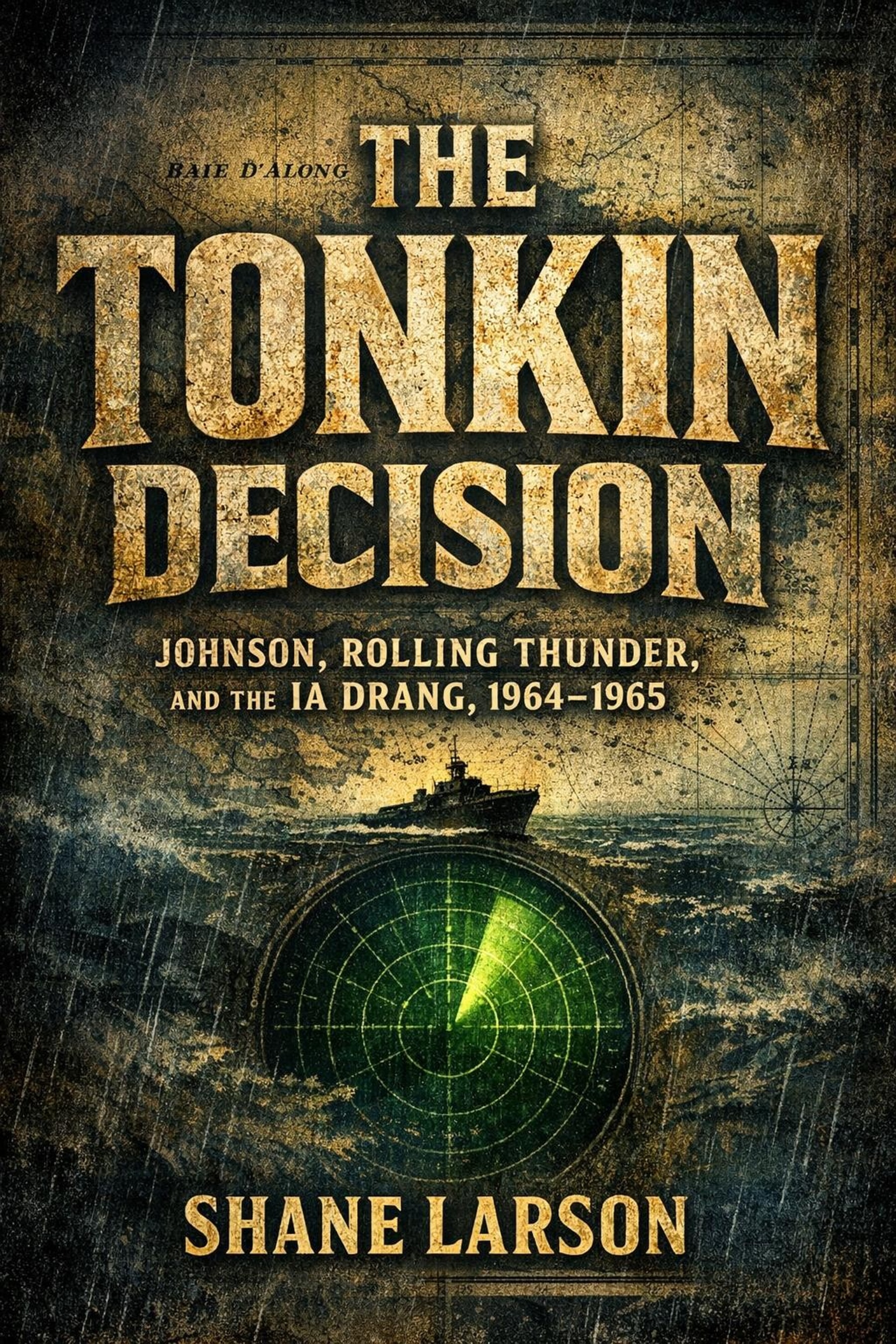
This article draws on the research behind The Tonkin Decision: Johnson, Rolling Thunder, and the Ia Drang, 1964–1965, the third volume of The Vietnam War Chronicles from Peak Grizzly Publishing. The book gives the Gulf of Tonkin a full evidence-by-evidence appendix — the ships' reports, the weather, the intercepts, and the NSA's declassified reassessment — and follows the eighteen months in which the war's real scale was chosen and never announced.
The Tonkin Decision
New posts and releases, straight to your inbox. No spam, unsubscribe anytime.