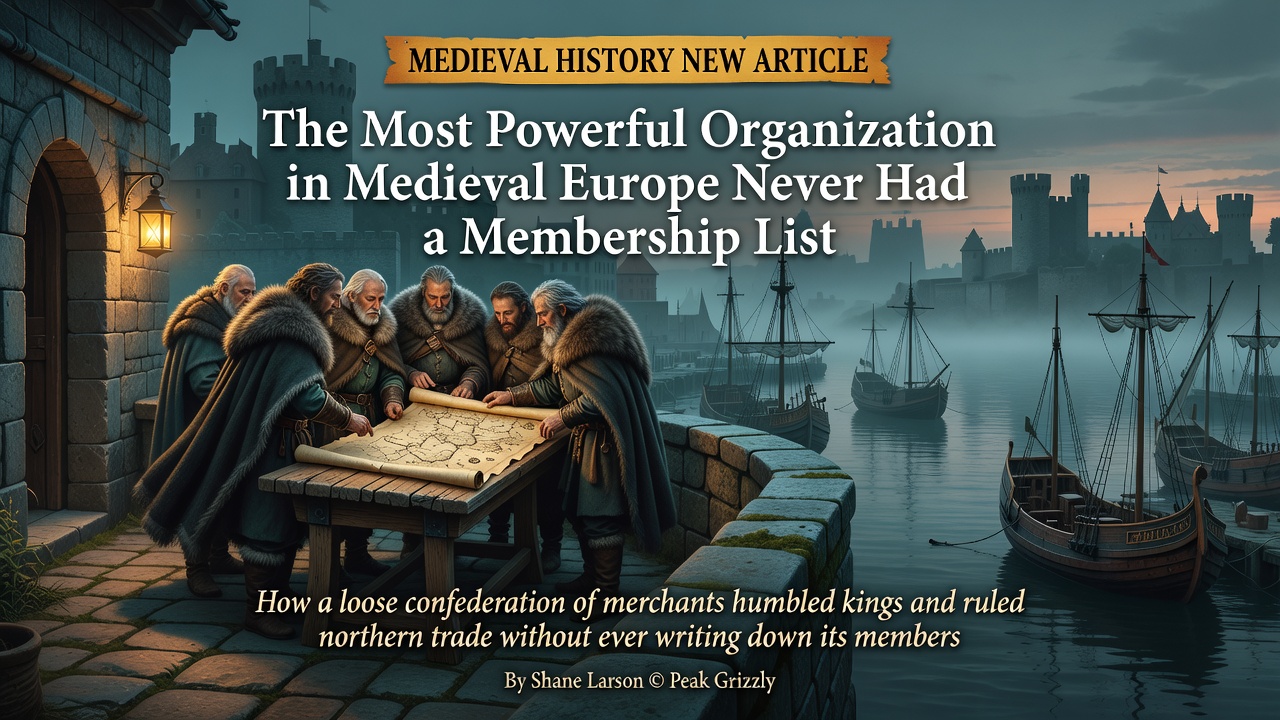
The Most Powerful Organization in Medieval Europe Never Had a Membership List
September 3, 2026 · 7 min read
On May 24, 1370, in the Baltic port of Stralsund, the Kingdom of Denmark surrendered to a group of merchants. The terms were staggering. The four castles commanding the Sound — the strait through which nearly all Baltic trade passed on its way to the rest of the world — were handed over to a confederation of trading towns for fifteen years, along with two-thirds of the toll revenue collected beneath their walls, something like fifteen percent of the Danish crown's entire customs income. And then, in a clause without precedent anywhere in Europe, the treaty provided that no successor to the Danish throne would be chosen without the consent of the towns. A merchant confederation had fought a war against a kingdom, won it, occupied its most valuable fortresses, and acquired a veto over its royal succession.
Now the strange part. If you had stopped one of the victorious envoys on the steps afterward and asked him basic questions about the thing that had just won — what it was called, where its capital was, who led it, how many members it had — he could not have answered. Not because the answers were secret. Because there were no answers.
The Hanseatic League had no capital city. It had no head of state, no permanent officials, no treasury, no standing army; the fleet that blockaded the Sound had been hired for the occasion and had already dispersed. It had no founding charter and no written constitution. It did not even have a birthday — historians cannot fix a date on which it began, because nobody ever founded it. The word hanse is old Germanic for a band or troop of men; it drifted into commercial use for a company of merchants trading abroad, and at some unfixable point in the thirteenth century the German merchants of the northern seas and the towns they came from had become, without anyone deciding it, a single thing that other people needed a name for.
And it had no membership list. This is the detail worth sitting with, because it was not sloppiness. In four hundred years of existence, no such list was ever drawn up. When outsiders demanded one — and English and Danish negotiators demanded one repeatedly, on the reasonable grounds that they wanted to know whom they were dealing with — the towns declined to provide it. Partly this was tactical. But partly they genuinely could not. Membership was a matter of degree, of behavior, and of who showed up. Historians have now been arguing about who was in and who was out for a hundred and fifty years, and the honest modern answer is that the question assumes a sharper edge than the thing ever had. Depending on what you count, the Hanse had seventy towns, or a hundred, or two hundred.
Every piece of machinery we assume a powerful institution must have, the Hanse lacked. It beat kingdoms anyway.
One punishment
The League's assembly, the Hansetag, met irregularly — roughly every three years in a good stretch — and was chronically underattended; rarely did more than a third of the towns send anyone. Its decisions bound only those who had come and chosen to be bound. A town that disliked a resolution could simply stay home. There were no fines the League could compel, no prisons, no enforcement arm of any kind.
What it had instead was exactly one sanction. The towns called it Verhansung: exclusion. A town or a merchant who broke the rules was cut out of the network entirely — no partners, no credit, no cargo space, no legal standing in the trading posts abroad, no access to the privileges the League had negotiated in foreign ports. That was the whole arsenal. And it worked for four centuries, on proud and powerful cities. Bremen was excluded and eventually sought readmission. Brunswick, after a rising against its merchant council in 1374, was excluded and did public penance to get back in. The punishment had no force behind it whatsoever, and it was ruinous, because the network was worth more to almost everyone inside it than anything that could be gained by cheating it.
That sentence is the entire constitutional theory of the Hanseatic League. There is no other.
The Hanseatic League
Living behind walls in other people's kingdoms
Where the network touched foreign soil, it built the strangest institutions of the European Middle Ages: the four kontore, fortified colonies of German merchants living under their own law inside someone else's realm. At Novgorod, deep in the Russian forest zone, the Peterhof compound locked its gate every night; its rulebook, the schra, regulated residence, weapons, gambling, and credit, and forbade teaching the Russian language to outsiders — the trade ran on interpreters, and the interpreters ran on being scarce. At Bergen, the merchants of the Bryggen wharf wintered over under a rule forbidding them to marry local women, on the logic that a merchant with a Norwegian family was a Norwegian with a German employer. At London, the Steelyard compound paid customs rates below what English merchants paid — and held, in one of the oddest bargains of the era, the standing obligation to maintain one of the city's gates, Bishopsgate, in repair. Only at Bruges, the great international market where the Hanse was one trading nation among many, was there no wall — and it is no accident that Bruges was where the League's leverage was weakest, and where its one effective outward weapon was to pack up the entire trading post, move it to a smaller town, and wait for Bruges to feel the loss.
Exclusion, again. It was always exclusion. The Hanse's power, everywhere, was the power to leave.
The veto was used once
Which brings us back to that unprecedented clause in the Treaty of Stralsund, because what happened next is the most revealing thing the League ever did.
Valdemar IV of Denmark died in 1375, five years after the treaty, leaving no son. The succession clause came due. The mightiest commercial power in northern Europe now held a lawful voice in the choice of a king — a power no merchant body had ever held anywhere. What did the towns do with it? They asked the Danish royal council to confirm their trading privileges, received the confirmation, and acquiesced in the candidate the Danes preferred anyway: the five-year-old Olaf, whose formidable mother, Margaret, would spend the next generation assembling a united Scandinavian crown that the towns would come to regret. The veto was exercised once, gently, for what amounted to a toll discount, and then never again.
It is tempting to read that as a failure of nerve. It was not. It was a revelation of what the thing was. A confederation of merchants wanted what merchants want — privileges, security of trade, predictable tolls — and had no use for a crown-making power, because using it would have required permanent envoys, standing commitments, a policy sustained across decades: precisely the machinery the Hanse had declined, for its whole existence, to build. The refusal to keep a membership list and the refusal to use the veto are the same refusal. The League stayed cheap, flexible, and impossible to decapitate — no capital to seize, no king to capture, no treasury to drain — and the price of that was being unable to act like a state even when it had won the right to.
For a long time the price was worth paying. Then the world filled up with states. Exclusion works on those who want in; it has no purchase at all on those who do not. Ivan III took Novgorod and closed the Peterhof in 1494. The Bergen privileges eroded. Elizabeth I shut the Steelyard in 1598. The kingdoms around the Baltic consolidated, taxed their own trade, and built the navies and treasuries the Hanse never had. The last Hansetag met in 1669, attended by nine towns, and ended without deciding to dissolve anything — there was nothing to dissolve. An organization with no founding date finished symmetrically, by simply never meeting again.
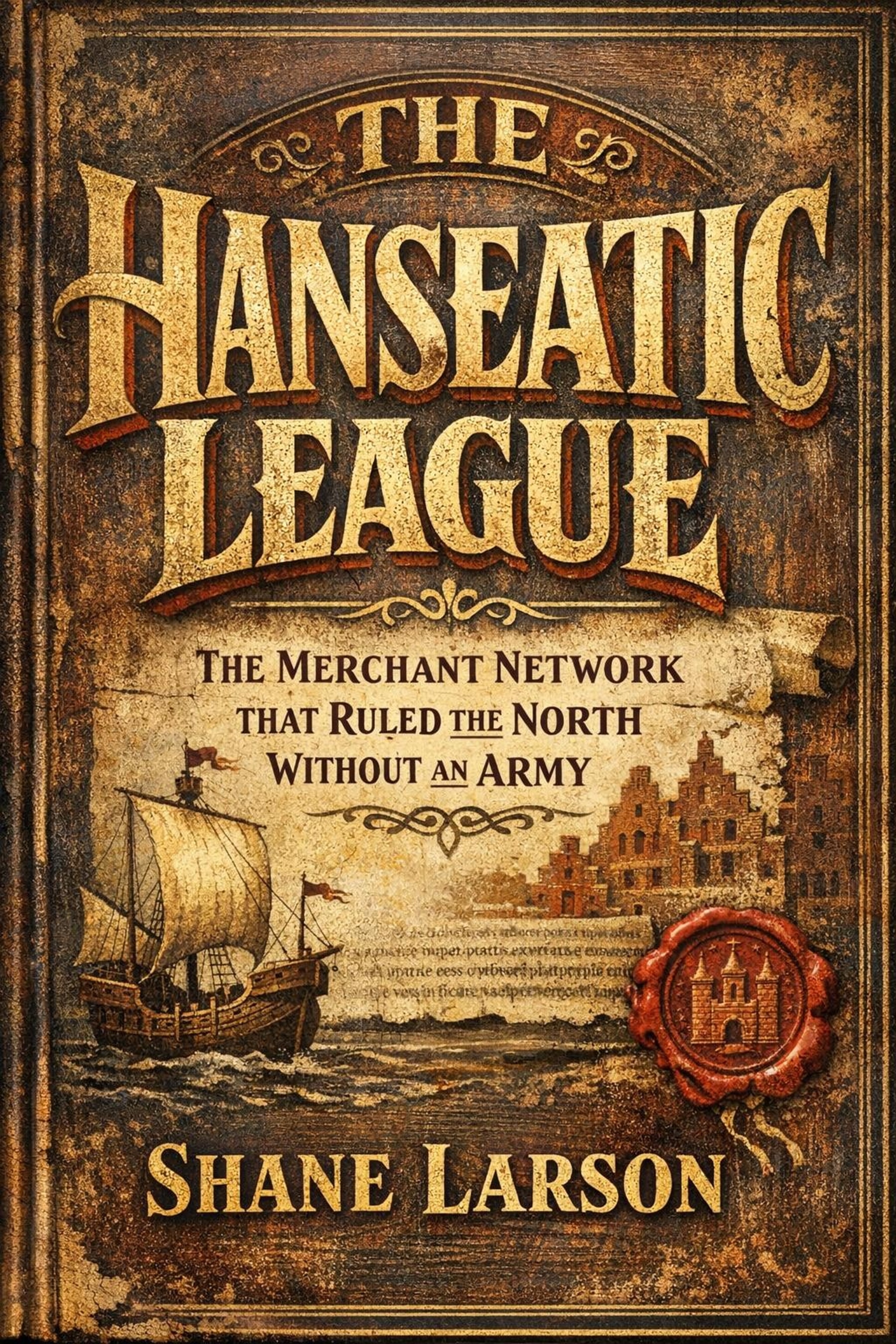
The full story — the salt and herring the network was built on, the ships and contracts that made a merchant trust an agent he would not see for a year, the four kontore and their four very different bargains, the war that humbled Denmark, and the long defeat by states that could compel — is the subject of my book The Hanseatic League: The Merchant Network That Ruled the North Without an Army. If the idea of a great power with no capital, no army, and no membership list strikes you as impossible, the book is about the four hundred years in which it wasn't.
The Hanseatic League
New posts and releases, straight to your inbox. No spam, unsubscribe anytime.