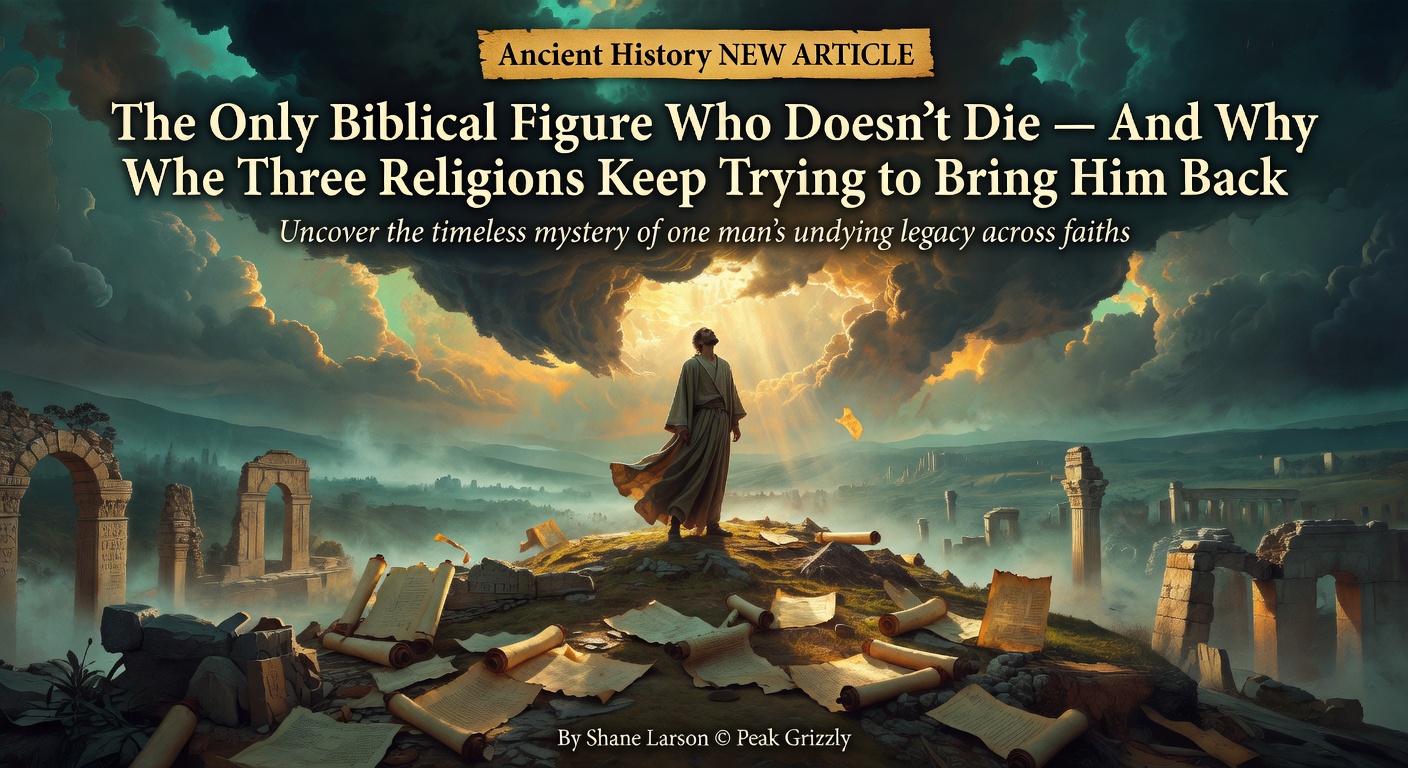
The Only Biblical Figure Who Doesn't Die — And Why Three Religions Keep Trying to Bring Him Back
April 20, 2026 · 14 min read
Every major character in the Hebrew Bible eventually dies, a pattern that underscores the text's deep preoccupation with mortality, legacy, and the proper handling of the dead. In ancient Near Eastern cultures, burial was not just a ritual but a cornerstone of social and religious order, ensuring a person's spirit found rest and their descendants maintained ties to the land. The text is unusually fastidious about this, detailing not only where Abraham was buried alongside Sarah in the Cave of Machpelah, but also the familial and covenantal significance of that site as a perpetual inheritance for his lineage. It tells you that Moses was buried by God himself in an unmarked grave on Mount Nebo, a deliberate act to prevent idolatry or rival cults from forming around his remains, and that "no man knows of his sepulcher unto this day," emphasizing a divine secrecy that guarded against human veneration. It gives Aaron a death scene on Mount Hor, complete with his son Eleazar stripping the priestly garments from his body and putting them on, symbolizing the orderly transfer of priestly authority and the continuity of the Levitical line. David dies old in bed after giving Solomon a long, politically pointed speech that not only settles scores but also reinforces the monarchy's divine mandate, while Samuel's death marks the end of an era of judges, and Saul's spectacular demise on Mount Gilboa, alongside Jonathan, serves as a tragic cautionary tale about disobedience and divine rejection. Solomon dies, his reign's excesses fading into obscurity, and even the prophets like Isaiah, sawn in half by later traditions if not the text itself, Jeremiah, who met his end in Egyptian exile amid political turmoil, and Ezekiel, who perished in Babylonian captivity, each receive at least a mention to anchor their stories in the earth's finality. The Twelve Minor Prophets each get at least a line, their legacies tied to specific locales or messages that echo through history.
Elijah does not get a line. Elijah gets a whirlwind and a chariot of fire, a vivid departure that stands out against this backdrop of meticulous burials. That is not a minor detail; it represents a profound narrative choice in the Hebrew Bible, one that echoes the ancient storytelling techniques of the region, where ascensions and divine transports were rare motifs borrowed from myths like those of Enoch or Mesopotamian heroes, yet applied here to signal something uniquely transformative. This decision has become the single most consequential element in the entire Hebrew Bible, shaping eschatological frameworks in Judaism, Christianity, and Islam for over three thousand years, as these faiths have woven it into their visions of redemption and renewal. Once you notice it, you cannot unnotice it, as it invites endless questions about why the authors left this gap—perhaps to symbolize an unbroken link between the divine and human realms or to keep Elijah as a timeless figure. The book I've just published is, in large part, an attempt to take the noticing seriously, exploring how this one absence has fueled theological debates and rituals across millennia.
The text is weirder than you remember
Here's what 2 Kings 2 actually says, a passage that unfolds like a mystical relay race, heavy with symbolism drawn from the broader ancient Near Eastern lore of prophetic succession and divine encounters. Elijah and his student Elisha are walking from Gilgal toward the Jordan, a journey that mirrors earlier biblical travels like the Exodus crossing, emphasizing themes of transition and inheritance. Elijah keeps trying to send Elisha away, perhaps testing his disciple's resolve or hinting at the weight of the spiritual mantle about to be passed, a common motif in mentor-student dynamics seen in other ancient texts, such as the Sumerian tale of Gilgamesh and Enkidu. Elisha refuses to go, demonstrating the loyalty and persistence required for prophetic continuity. At the Jordan, Elijah rolls up his hair mantle—likely a symbol of his authority, akin to a king's robe or a shaman's garment in contemporary cultures—strikes the water, the water parts, and the two of them cross over on dry ground, echoing the parting of the Red Sea and reinforcing Elijah's role as a figure of miraculous power. On the far side, Elijah asks Elisha what he wants before he leaves, a moment that highlights the personal stakes of succession, as Elisha requests a double portion of his master's spirit, invoking the legal rights of a firstborn son in ancient Israelite inheritance laws, which typically allotted a larger share to ensure family leadership.
Then, in the text's own words: "And it came to pass, as they still went on, and talked, that, behold, there appeared a chariot of fire, and horses of fire, and parted them both asunder; and Elijah went up by a whirlwind into heaven." This whirlwind isn't just a dramatic exit; it's laden with cosmological imagery, similar to storm gods in Canaanite mythology like Baal, whom Elijah had confronted earlier, turning the tables on pagan narratives by associating Yahweh with the very elements rivals claimed. Elisha tears his clothes in grief, picks up the fallen mantle, walks back to the Jordan, strikes the water with it—Where is the Lord God of Elijah?—and crosses back, the water parting as proof of the spirit's transfer, a tangible sign that prophetic power persists beyond the individual. Fifty men from the prophetic guild at Jericho, watching from a distance, assume the Spirit has dropped Elijah on some nearby mountain, reflecting a common ancient belief in localized divine abductions, as seen in Greek myths of heroes like Heracles. They insist on searching for the body, perhaps driven by cultural norms demanding burial rites, but Elisha tells them not to bother, underscoring the text's insistence on Elijah's complete removal. They search for three days anyway, a period that parallels other biblical narratives of quests and revelations, like Jonah's time in the fish, yet they find nothing, leaving the story deliberately open-ended. Read cold, without three thousand years of devotional overlay, it is a strange, haunting, deliberately incomplete passage, one that feels like a calculated narrative device, akin to unresolved cliffhangers in oral traditions, designed by a people who knew exactly what they were doing when they chose not to tell you where the grave was, perhaps to keep Elijah eternally relevant.
Malachi opens a door
About five centuries later, at the tail end of what we call the prophetic period—a time of Persian imperial rule and religious rebuilding after the Babylonian exile—a book called Malachi ends with this: > Behold, I will send you Elijah the prophet before the coming of the great and dreadful day of the Lord. This wasn't just a casual sign-off; it capped the prophetic canon in a way that linked the old stories to future hopes, much like how ancient Near Eastern prophecies often blended historical reflection with eschatological visions to rally a community. That is the last sentence of the Christian Old Testament and the last sentence of the Hebrew prophetic canon in the old Jewish arrangement, a placement that scholars see as intentional, positioning Elijah as a bridge between eras, especially in a collection where books were arranged to build toward messianic anticipation. Malachi—or Malachi's editors—looked back at the whirlwind passage, noticed that Elijah had not been accounted for, and decided that the absence of a death scene was not an absence at all but a promise, a seed planted for later generations to cultivate amid the uncertainties of exile and restoration. For example, in the broader context of Second Temple Judaism, this promise countered the despair of displacement by offering a figure who could return to set things right, much like how other ancient cultures used undying heroes to symbolize renewal.
From that moment forward, Elijah stops being a ninth-century BCE prophet from Gilead and becomes the herald, the one who comes back to announce the divine intervention, a role that resonated with the cyclical patterns of renewal in agricultural societies, where prophets like him were tied to seasons of drought and rain. Every Jewish Passover seder since has built a piece of its ritual around that promise, not just as a symbolic act but as a living expression of hope; a cup is poured for Elijah, representing hospitality and the expectation of redemption, while a chair is set, evoking the empty thrones in royal courts for absent monarchs. At a particular point in the meal, the youngest child is sent to open the door so that Elijah, if this is the year, can walk in, a moment that transforms a family gathering into a microcosm of national redemption, drawing on the prophet's history of sudden appearances, like his arrival at Mount Carmel. It is a small domestic ritual that carries the weight of twenty-five centuries, blending everyday life with sacred history, and in Jewish tradition, he also attends every circumcision—a chair is placed for him, unoccupied, at every bris—positioning him as the prophet of transitions, present at the door that a Jewish life opens into, much like a guardian at the threshold in folklore traditions worldwide.
Elijah
The Gospels pick up the same door
The Gospels inherit Malachi and work with it directly, building on the Jewish expectation of a returning prophet to frame the arrival of Jesus within a familiar prophetic lineage. When Jesus starts his public ministry, people immediately begin speculating about whether John the Baptist is Elijah, drawing parallels to the wilderness preachers of old who challenged corrupt powers, as John did with Herod's court, and this buzz reflected the first-century CE messianic fervor amid Roman occupation. Jesus eventually says, flatly, that John was Elijah, "if you are willing to receive it"—a statement that could be interpreted as a spiritual reincarnation, echoing ideas of prophetic spirits in ancient Jewish texts like the Dead Sea Scrolls, or as a typological fulfillment where John's role prefigured Elijah's, depending on which commentator you read and their theological lens, from early church fathers to modern scholars. And then there is the Transfiguration, a pivotal event where Jesus goes up on a mountain with Peter, James, and John, evoking Moses's own mountain encounters and positioning the scene as a divine endorsement.
His face changes, his clothing becomes radiant, and two figures appear and speak with him—not archangels or long-dead patriarchs, but Moses and Elijah, a duo that represents the full spectrum of Israel's revelation: Moses as the lawgiver from Sinai, and Elijah as the prophet who did not die, together framing Jesus in the authority of both the Torah and the prophetic tradition. It matters, theologically, that Elijah could appear, as his whirlwind exit left him narratively unmoored, available for such moments, whereas Moses's bones were in some unmarked grave on Mount Nebo, intentionally hidden to prevent cultic worship, as Deuteronomy notes. The Book of Revelation later conscripts what appear to be two figures closely modeled on Moses and Elijah as the "two witnesses" of the end times—they shut up the sky so it does not rain, a direct nod to Elijah's drought miracle, they turn waters to blood, echoing Moses's plagues, they are killed, they rise—the iconography is Elijahn, pulling from the original stories to fuel apocalyptic imagery, the theology is Christian, reinterpreting Jewish hopes through the lens of resurrection, and the structural move is still Malachi's, keeping that door ajar for ongoing fulfillment.
The Qur'an names him Ilyas
Islam inherits the same prophet through a slightly different channel, weaving him into the tapestry of monotheistic revelation as a link between Abrahamic traditions. The Qur'an names him Ilyas (in Sura 37, which recounts his confrontation with idolaters, and Sura 6, which places him among the righteous prophets), firmly establishing him in the line of messengers sent by God, much like how Islamic texts harmonize biblical figures with their own narratives to create a unified prophetic history. It references the confrontation with Baal, portraying it as a timeless stand against polytheism, similar to other Qur'anic stories of prophets like Noah or Abraham facing community resistance, and the tradition that developed around the figure—both in tafsir, the exegetical commentaries that explain the text's deeper meanings, and in Sufi literature, which explores mystical encounters—sometimes merges or twins him with another deathless figure, al-Khidr, the Green One, an immortal guide of mystics who appears in stories like Moses's quest for knowledge in Sura 18.
In folk piety from the Balkans through Anatolia and out into Central Asia, the feast of Elijah and the feast of al-Khidr fall on the same summer day, a convergence that highlights how local customs blended Islamic, Christian, and pre-Islamic elements, with shared shrines and rituals reflecting the cultural syncretism of medieval empires; for instance, in Turkish villages, pilgrims might visit a hilltop site dedicated to both, offering prayers for rain or protection, drawing on Elijah's storm associations. The Orthodox Christian world has its own version: Saint Elias, celebrated on July 20, with mountaintop churches dedicated to him from Mount Athos to the Lebanese coast to rural Greece, where these sites often served as beacons for communities reliant on agriculture, the chapels almost always on hilltops because the saint is associated with weather—thunder, lightning, rain, phenomena that ancient peoples attributed to divine chariots—and with the fiery chariot that drives the storm clouds across the sky, a motif that echoes the original biblical account while adapting it to Christian hagiography.
Why the missing grave matters
You could read this as a coincidence of textual history—an old legend that happened to get picked up by later traditions—and the historical evidence, from archaeological finds like ancient inscriptions or comparative myth studies, does not let you disprove that reading, especially when similar undying figures appear in other cultures, such as the Egyptian Osiris or the Greek Achilles. But I think it misses the more interesting fact, which is that the authors of Kings knew what they were doing, drawing on a repertoire of literary techniques from their exilic context in the sixth century BCE, when the Babylonian destruction of Jerusalem forced scribes to rethink identity through texts alone. They buried Moses in an unmarked grave specifically so no one could build a cult at the site, a precaution against the very idolatry that had plagued Israel, as seen in the golden calf incident, while they noted the graves of the patriarchs specifically so the cult sites could continue as centers of worship and memory. They chose, for Elijah, a third option—no grave at all, no cult site possible, no body to venerate or fight over—perhaps as a way to emphasize his role as a critic of earthly powers, leaving a deliberate structural gap in the text that invited interpretation rather than closure, a gap that has been filled, over and over, by every generation since, from medieval mystics to modern theologians.
If you want to understand how messianic expectation functions, this is the original case study, showing how a narrative choice made by a handful of exilic scribes in the sixth century BCE, amid the trauma of displacement and the need to preserve identity, is still shaping what a Jewish family does on the night of Passover, what a Christian painter depicts on the mount of Transfiguration—often including Elijah in Renaissance art to symbolize continuity—and what a Muslim mystic writes about the Green One, all because that missing grave transformed a historical prophet into an eternal symbol of hope and return.
The rest of the book
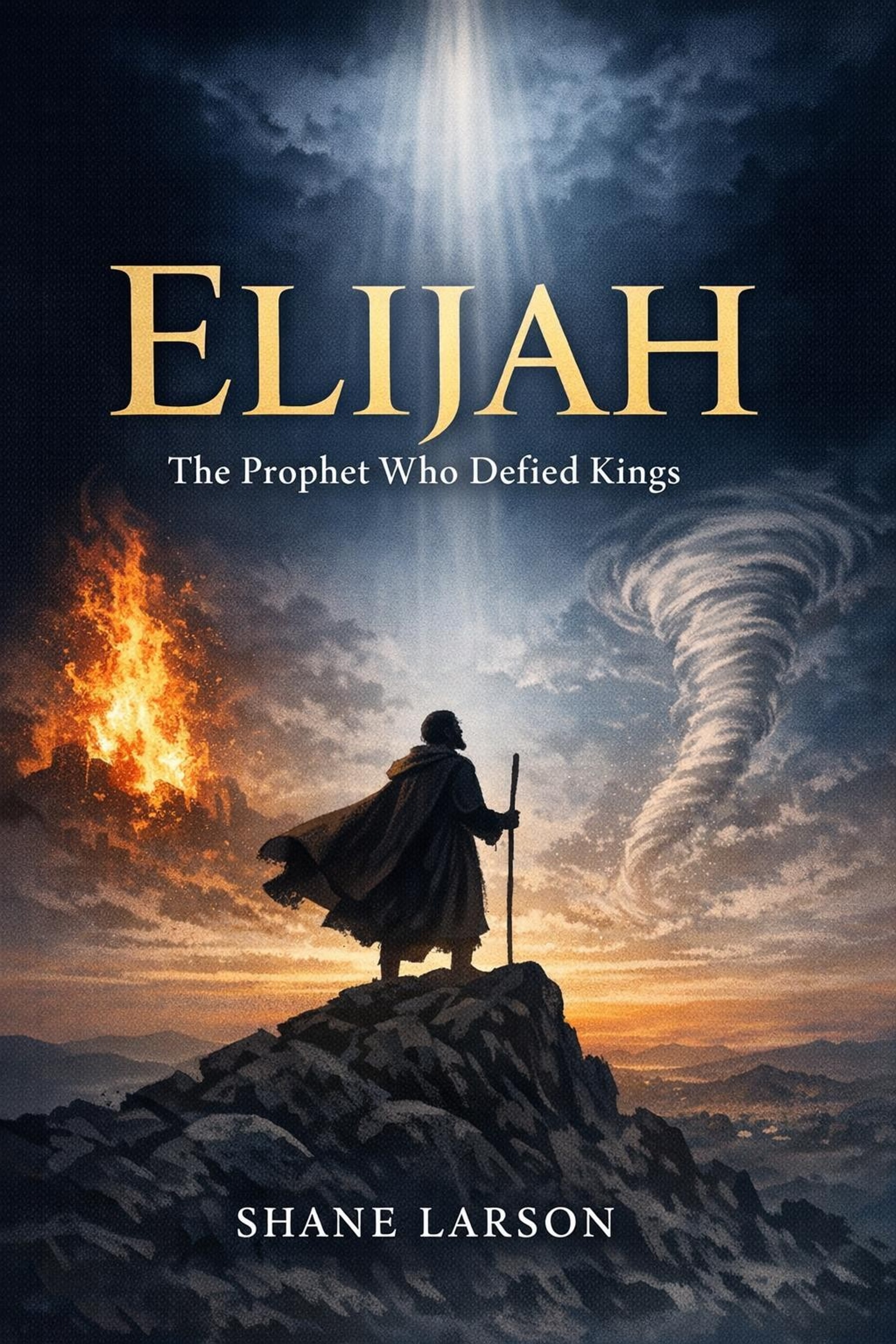
The book I've just put out, *Elijah: The Prophet Who Defied Kings*, spends its opening chapters on the ninth-century BCE world Elijah actually walked into, delving into the political intrigue of the house of Omri, Israel's rise as a regional power, and the Tyrian alliance through the princess we call Jezebel (she was a real Phoenician royal, not a cartoon; for example, her marriage to Ahab was a strategic move to secure trade routes, as I explored in detail in *The Purple Merchants*, which examines the economic networks of the ancient Mediterranean). It covers the god-war between Yahwism and state-sponsored Baalism, a conflict rooted in the competition for allegiance in a polytheistic world, and the wars with Aram-Damascus that bracketed Ahab's reign, highlighting how Elijah's actions intersected with these geopolitical shifts.
The middle chapters work through the famous narrative beats, expanding on the three-and-a-half-year drought as a demonstration of divine control over nature, akin to ancient weather curses in Assyrian texts; the widow at Zarephath, whose story of miraculous provision underscores themes of faith across ethnic lines; the ravens at the brook, a bizarre detail that might symbolize God's use of unclean animals to sustain his prophet, challenging purity laws; the Mount Carmel contest, a high-stakes showdown that echoes trial-by-ordeal rituals in other cultures; the flight to Horeb, where Elijah's encounter with God in the thin silence (the Hebrew qol demamah daqqah, a phrase that conveys not just quiet but a profound, almost auditory absence, contrasting with the dramatic winds and fires) represents a counterpoint to his earlier fiery displays; the calling of Elisha, marking a reluctant passing of the torch; Naboth's vineyard, a tale of injustice that exposes royal corruption; Ahab's death at Ramoth-Gilead, tying personal prophecy to battlefield outcomes; and the whirlwind, as the ultimate non-ending.
The closing chapters do the afterlife, tracing Malachi's influence on Second Temple Elijah traditions, where he became a symbol of messianic preparation; the Gospels, with their reinterpretations amid Roman oppression; the Qur'an, integrating him into a global prophetic chain; the rabbinic figure who shows up at every Passover door, as a guardian of covenant renewal; Saint Elias on every Greek hilltop, evolving from biblical prophet to patron of sailors and farmers; and the long strange journey of a prophet the text refuses to let die, illustrating how sacred stories adapt to new contexts, from medieval illuminated manuscripts to contemporary festivals. You can read it as history, grounded in artifacts like the Tel Dan Stele that mention the "House of David," or as a case study in how sacred texts keep doing work three thousand years after they were composed, their gaps and ambiguities fueling endless reinterpretation. Either way, I think Elijah earns the attention, as his story has been a touchstone for resistance and hope since 850 BCE.
Elijah
New posts and releases, straight to your inbox. No spam, unsubscribe anytime.