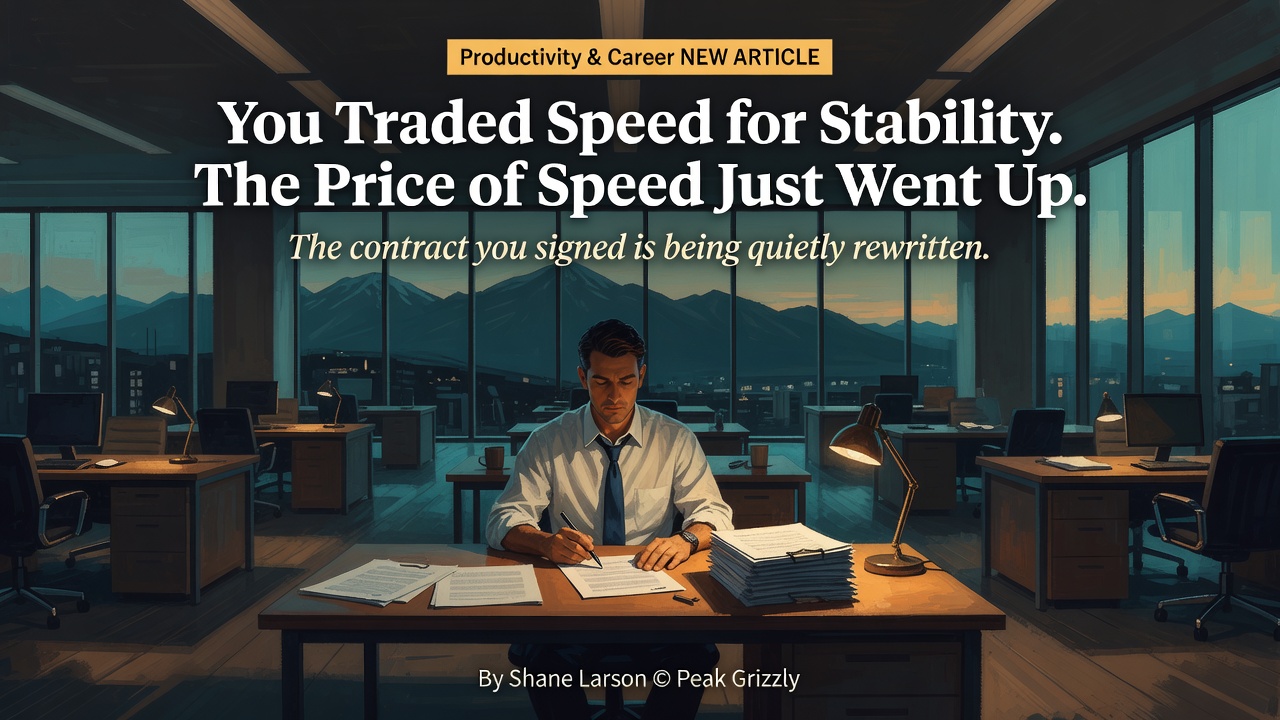
You Traded Speed for Stability. The Price of Speed Just Went Up.
August 5, 2026 · 5 min read
You remember saying yes.
Maybe it was the number on the offer letter, which felt like validation for every late night learning this stuff. Maybe it was the benefits, the match, the relief of knowing where the next paycheque was coming from after years of scraping.
You took the job at the large company. For a good while, it was the right call.
Nobody gives you a document explaining the rest of the deal, but both sides understand it perfectly.
The Terms
What you agreed to give up:
Speed. You will not ship on your timeline. You will ship on the organisation's, which includes security review, architecture committee, change advisory, and the availability of the seven people who need to approve the change.
Autonomy. You will not choose the stack, the approach, or frequently the problem. Those decisions are made above you by people with more context about the business and less about the work.
Ownership. What you build belongs to the company, is maintained by a rota, and will be renamed in the next reorganisation.
What you got:
Stability. A salary that arrives whether or not the project succeeds. Insurance. A retirement account. The ability to plan a life.
Scale. Problems that only exist at volume, and resources — data, infrastructure, colleagues — that a small company cannot assemble.
Insulation. Somebody else worries about revenue.
For most of the last thirty years that was a defensible trade, and millions of capable people made it every year for entirely sound reasons. It is not a story about selling out. It is a story about pricing risk.
What Changed on One Side of the Ledger
The trade assumed something that was true and is becoming less true: that shipping software fast, alone, was not really available to you anyway.
If an individual could not build much on their own, then giving up speed cost little. The organisation's resources were the only route to building anything substantial, and the process tax was the price of admission to a capability you could not otherwise have.
That assumption has weakened considerably. A single competent person with current tooling can now build, deploy, and operate things that would have required a team a few years ago. The floor moved. What one person can produce in a weekend has changed materially, and it keeps changing.
Which means the thing you traded away has appreciated, and nobody sent you a revised offer.
That is the actual source of the feeling — and it is worth naming precisely, because it is usually experienced as something less accurate. It does not present as the terms of my employment have shifted. It presents as frustration, then cynicism, then a slow sense that you are becoming worse at your job.
What It Feels Like From Inside
The specific texture of it is what makes it hard to talk about.
You can see the solution. You could implement it in an afternoon. Instead you write a proposal, then a design document, then attend three meetings where the proposal is discussed by people who have not read it, and the work is scheduled for a quarter in which it will be deprioritised.
The Builder's Bargain
Meanwhile your ability to actually do the thing degrades quietly, because capability is maintained by use. Two years of writing documents about work is two years of not doing work, and the skills do not politely wait.
And the compensation is real, which makes it worse. If the job were bad, leaving would be easy. The job is comfortable, the people are decent, the money is good, and you are slowly becoming someone who talks about building.
That combination — comfortable and hollow — is much harder to act on than outright misery, and it is why people stay in it for years.
The Part Where Process Is Not the Villain
It would be easy to write this as a complaint about bureaucracy, and that version is wrong in a way that matters.
Most of the process exists because something went badly once. The change advisory board exists because an unreviewed change took down production. The security review exists because of a breach. The architecture committee exists because three teams built the same service.
In regulated industries — finance, healthcare, aviation — the constraint is legal, non-negotiable, and protects people. An engineer who finds that intolerable is objecting to the existence of the requirement, not to its implementation.
The organisational failure is not that controls exist. It is that they accumulate and are never removed, so an environment shaped by twenty years of incidents ends up imposing the full historical cost of all of them on every change, regardless of risk.
That is a real problem and it is not one you can fix from a mid-level position by being frustrated about it.
The Three Honest Options
There are only three, and pretending otherwise is how people spend a decade.
Accept the deal knowingly. Decide the stability is worth it, at this stage of your life, for these reasons, and stop treating the constraint as an outrage. This is a legitimate choice and it is far more bearable made deliberately than endured by default.
Build in the cracks. Find the parts of the organisation where autonomy still exists — internal tooling, new initiatives, the work nobody has written a process for yet — and get yourself there. Most large companies have these pockets and they are not advertised. This buys real years.
Leave. Not as a gesture. As a calculation, made with a clear view of what you are giving up, because stability is genuinely valuable and the people telling you it isn't usually have savings.
What does not work is the fourth option, which is what most people actually do: stay, resent it, and wait for the organisation to change. It will not, and the cost of that waiting is charged entirely to you.
The Builder's Bargain: Finding Your Path When You Can't Build works through the whole thing — the fear-driven organisation, the widening gap, naming the tension, assessing the deal honestly, working inside regulated constraints, building in the cracks, changing things from within, and knowing when to go.
The Builder's Bargain
New posts and releases, straight to your inbox. No spam, unsubscribe anytime.