The Uluburun Shipwreck: One Sunken Cargo That Explains the Entire Bronze Age
September 21, 2026 · 6 min read
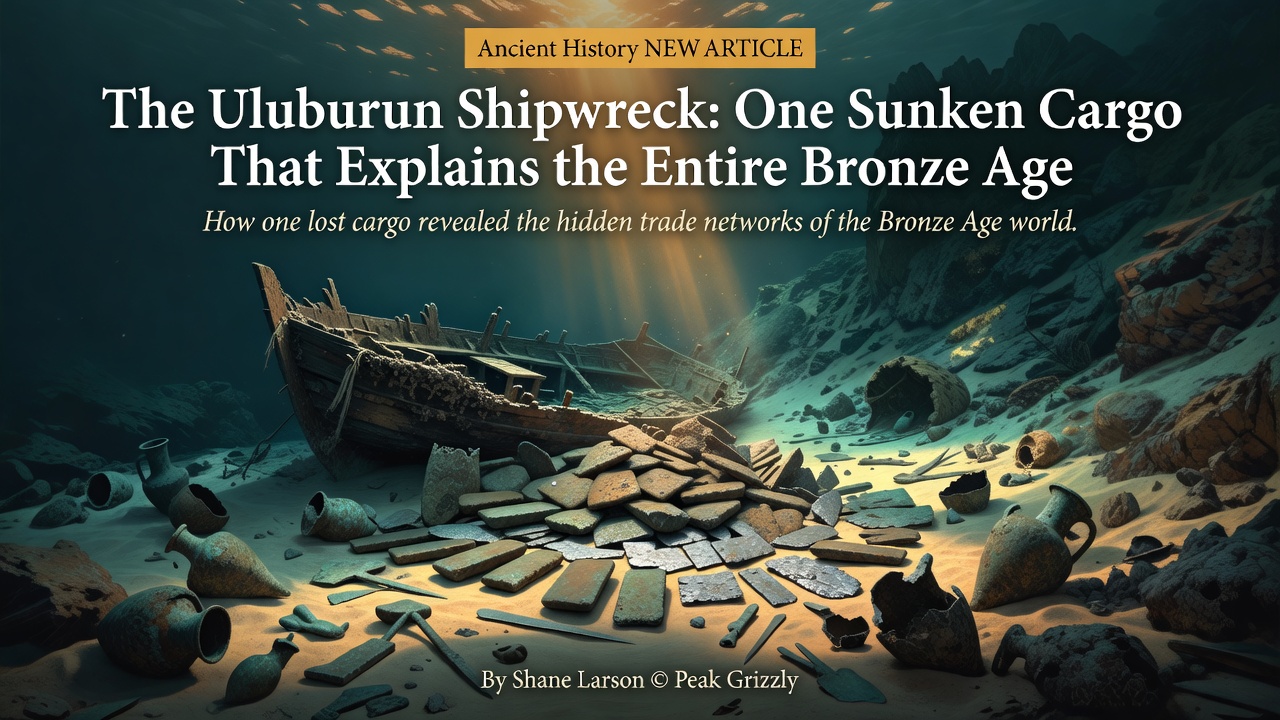
In the summer of 1982, a Turkish sponge diver working the steep drop-off at Uluburun, a rocky headland on the country's southern coast, came up from a dive and described something odd lying on the seabed: metal biscuits with ears.
His captain knew what that meant, because sponge divers along that coast had been briefed to watch for exactly this. "Biscuits with ears" are oxhide ingots — flat slabs of copper, about sixty centimetres long, weighing near thirty kilograms, with four handles drawn out at the corners so a man could carry one on his shoulder. They are the standard industrial unit of the Late Bronze Age, and finding them stacked on a slope forty-plus metres down could mean only one thing: a trading ship had gone down there, a very long time ago, with its cargo still aboard.
It turned out to be the oldest seagoing shipwreck ever excavated, and one of the most important archaeological discoveries of the twentieth century. The ship sank around 1300 BC. Archaeologists spent eleven seasons on it, logging more than twenty thousand dives to depths between about forty-four and sixty-one metres — close to the working limit for compressed air, which meant each diver got roughly twenty minutes on the bottom, twice a day, for a decade. What they brought up was not treasure in the usual sense. It was better. It was a complete commercial cargo, frozen at the moment of loss, from a world that otherwise survives mostly in palace ruins and diplomatic correspondence.
Ten tonnes of copper, one tonne of tin
Start with the numbers, because the numbers are the story.
The main cargo was 354 copper oxhide ingots, stacked in the hold in neat overlapping rows like roof tiles, plus dozens of smaller bun-shaped ingots of the same metal: about ten tonnes of copper in all. Beside it lay roughly one tonne of tin.
Ten to one. That ratio is not an accident of loading. Bronze — the alloy that named the age, the metal of every sword, spearhead, plough point, cauldron, razor, and chariot fitting in the eastern Mediterranean — is roughly nine parts copper to one part tin. The Uluburun ship was carrying the recipe, pre-measured, in a single hull. Somebody at the loading port knew exactly what this shipment was for, and it was not ornament. It was the raw material of an entire civilisation's toolkit, enough to cast something like eleven tonnes of bronze: thousands of swords, or tens of thousands of tools, depending on what the buyer needed that year.
And the two metals in that hold had travelled absurdly different distances to end up side by side. Chemical fingerprinting ties the copper to the ore bodies of Cyprus, a few days' sail from the wreck site. The tin had come much further — from sources so remote that archaeologists are still using isotope chemistry to pin them down, with the mountains of Central Asia among the leading candidates. The earth almost never puts copper and tin in the same place. The defining metal of the age could only exist where long-distance trade functioned well enough to marry them, which means every bronze object ever cast is a small certificate of logistics.
A dozen lands in one hold
The metal was only the beginning. Packed around and above it was a manifest that reads like a gazetteer of the Late Bronze Age world.
There were about 175 ingots of raw glass, mostly a deep cobalt blue — an expensive, high-technology material at the time, travelling as ingots because glassworking and glassmaking were separate trades in separate countries. There were around 150 Canaanite storage jars, most filled with terebinth resin, a fragrant tree product burned as incense and used in perfume — half a tonne of it. There were logs of African blackwood, the ebony of Egyptian luxury furniture. There was ivory: elephant tusk and hippopotamus teeth. Ostrich eggshells for making into vessels. Baltic amber that had crossed the whole of Europe before it ever saw a ship. Mycenaean pottery and swords. Canaanite jewellery. A gold scarab bearing the name of Nefertiti, queen of Egypt. Tools, weapons, fishing gear, sets of merchant's weights calibrated to more than one regional standard — the Bronze Age equivalent of a trader carrying multiple currencies. Even the crew's food survives in traces: almonds, figs, olives, pomegranates, coriander.
Alashiya
Count the origins represented in that single hull and you reach a dozen or so distinct lands, from the Baltic to tropical Africa to Central Asia. One ship, perhaps fifteen metres long, built of cedar planks joined with pegged tenons, was carrying the output of an entire connected world — and it was a working freighter, not a royal barge.
What a cargo proves that no letter can
Here is why Uluburun matters more than almost any document from the period.
The Late Bronze Age left us letters — thousands of them. Kings wrote to kings about shipments of copper and gold, about gifts and marriages and grievances. But a letter is rhetoric. Kings exaggerate their generosity, minimise their obligations, flatter, posture, and lie, exactly as governments do now. Reading Bronze Age diplomacy for economic data is like reconstructing a modern economy from press releases.
A cargo cannot lie. The ship carried what it carried. The ratio of copper to tin in that hold is a fact about Bronze Age industry that no scribe shaded for effect. The mix of luxury goods and bulk raw material is a fact about how trade actually worked — high-value items riding on top of a base cargo of metal, the way container ships today carry electronics above grain. The multiple weight standards are a fact about the commercial sophistication of the people sailing. Archaeologists argued for decades about whether Bronze Age trade was really royal gift-exchange dressed up in commercial language, or real commerce dressed up in diplomatic language. Uluburun is the closest thing to an answer anyone has ever pulled out of the sea: a single voyage in which the two are physically stacked in the same hold.
There is a smaller, humbler wreck that completes the picture. At Cape Gelidonya, along the same coast, a ship went down about a century later carrying roughly a tonne of scrap bronze and a metalsmith's tool kit — no royal treasure, just a travelling craftsman-trader working the coast, buying broken tools and casting new ones. Its excavation in 1960 essentially founded underwater archaeology as a rigorous discipline. Together the two wrecks bracket the whole trade: the palace-scale consignment and the itinerant tinker, the container ship and the delivery van.
The shipment that survived by failing
There is one more thing worth sitting with. Bronze was endlessly recyclable — a broken sword went back into the crucible and came out a sickle — so virtually every ingot that reached its destination was consumed, melted into objects, remelted, and melted again down the centuries until nothing traceable remained. The trade's successes erased themselves. What survives for archaeology is, almost by definition, the failures: the cargoes that sank. The Uluburun ship is the best evidence we have for the Bronze Age economy precisely because, on one bad day around 1300 BC, it was the exception — the delivery that never arrived. Everything we know about the system that worked, we know from the one shipment that didn't.
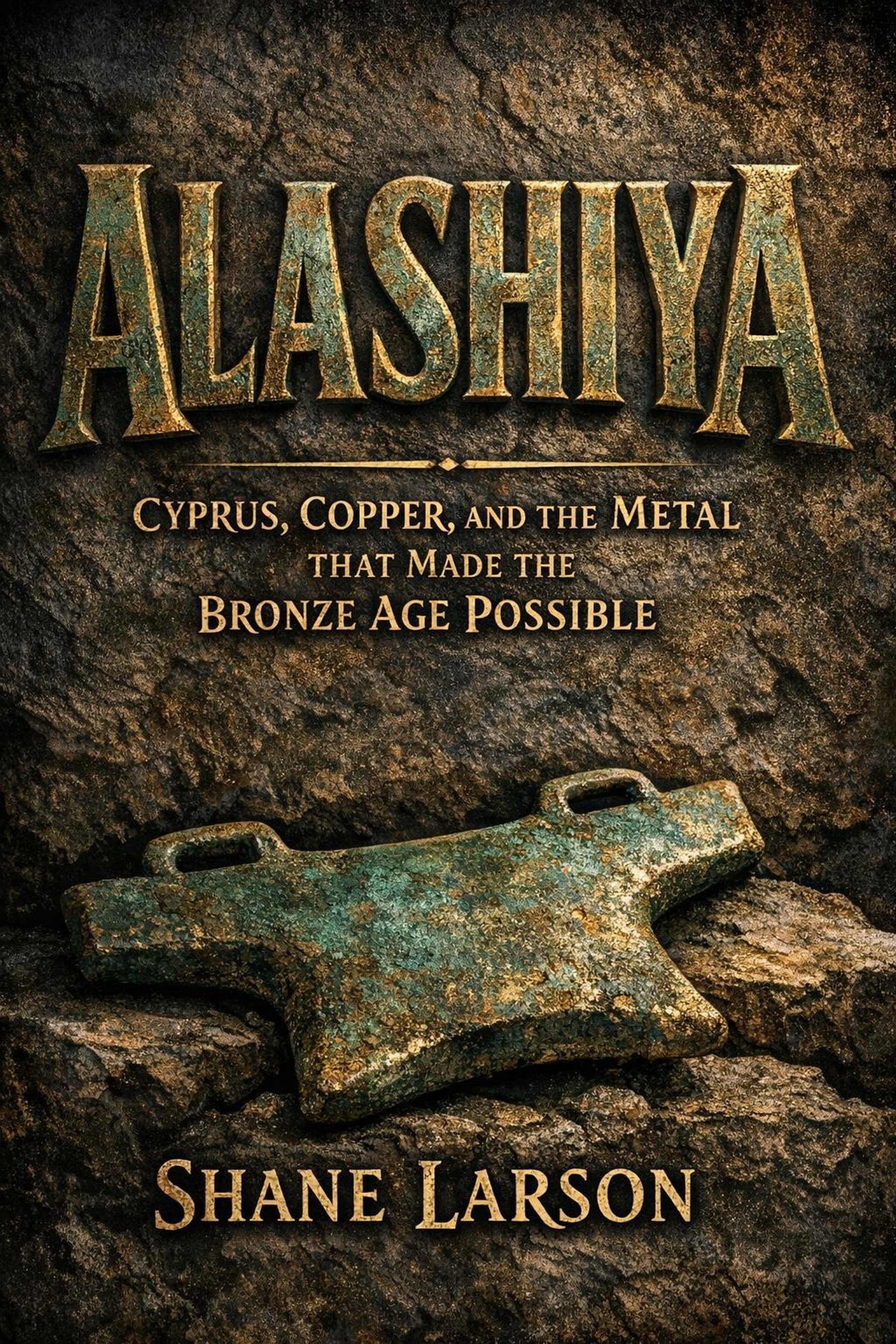
That system — where the ten tonnes of copper came from, the island kingdom that produced it, the king who apologised to a pharaoh when a plague among his coppersmiths shorted a delivery, and what happened to an entire civilisation when this metal finally stopped moving — is the subject of my book *Alashiya: Cyprus, Copper, and the Metal That Made the Bronze Age Possible*. The Uluburun ship gets a full chapter, and its complete cargo, itemised, gets an appendix of its own. If a single sunken hull can hold a whole world, it deserved nothing less.
Alashiya
New posts and releases, straight to your inbox. No spam, unsubscribe anytime.