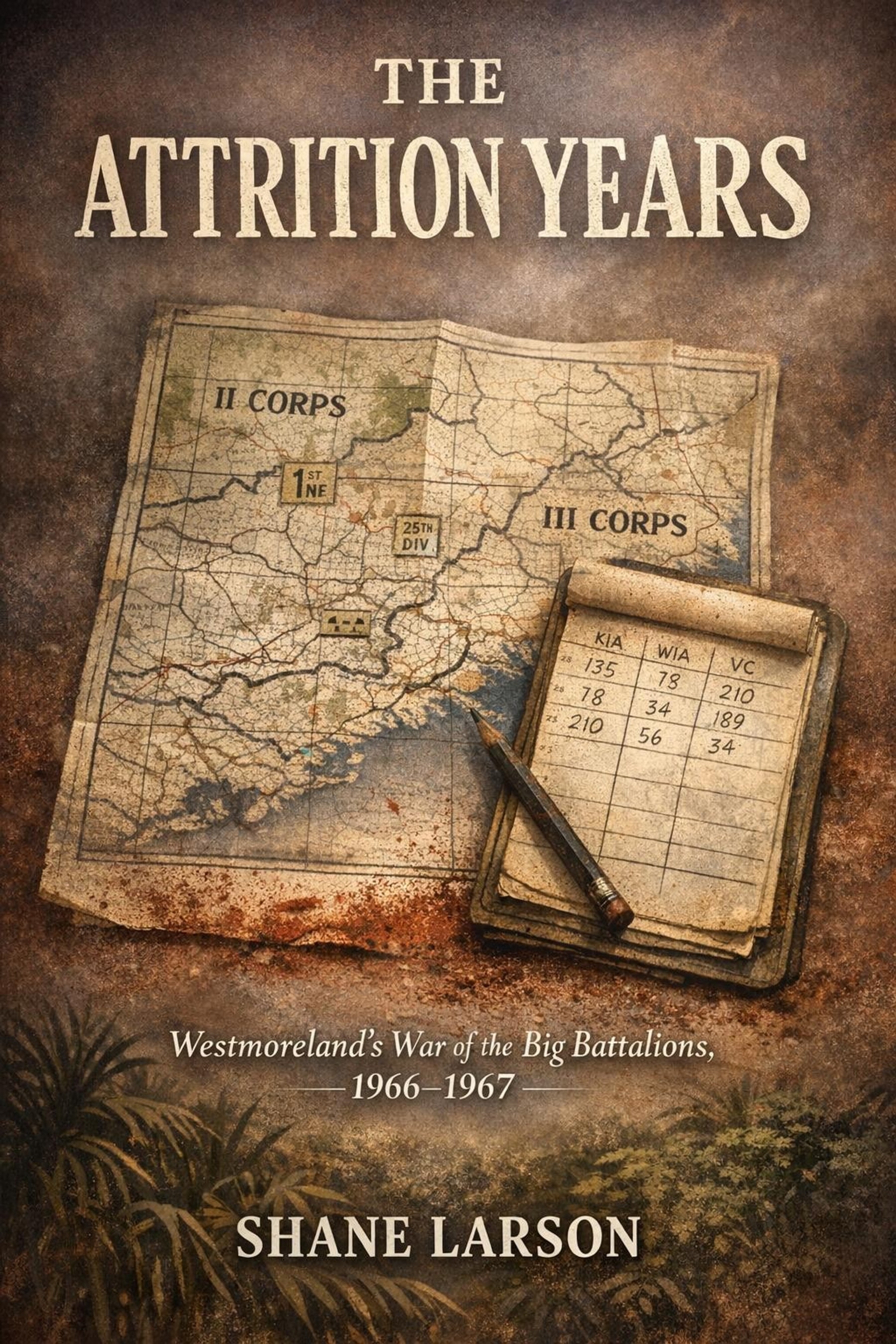
The Attrition Years
Westmoreland's War of the Big Battalions, 1966-1967
By Shane Larson · The Vietnam War Chronicles (Book 4)
About This Book
In January 1967, American and South Vietnamese troops surrounded the village of Ben Suc, in the bend of the Saigon River known as the Iron Triangle. Over the days that followed, the village's population — roughly six thousand people, by the Army's own account — was moved out by helicopter, truck, and boat, along with their livestock and whatever they could carry. Then the village was razed, its tunnels demolished, and the ground scraped and burned so that it could never again shelter the enemy. The operation was called Cedar Falls, and it was the largest of the war to that date. The command's reasoning was straightforward: Ben Suc sat inside a base area that had resisted clearing for twenty years, and removing the population was the only way to deny it to the enemy permanently.
Within months, the enemy was back.
That sequence — a massive operation, competently executed, achieving its stated objective, and then meaning almost nothing — is the Vietnam War of 1966 and 1967 in miniature. If ground taken was given back, what did winning consist of? The American command had an answer, and the answer was a number.
The Vietnam War Chronicles' fourth volume covers the two years between the Ia Drang valley and the Tet Offensive — years the popular account treats as a lull, when in fact they were the period in which the entire American war was built, deployed at full scale, and measured. Nearly half a million men. The two largest ground operations of the war. The heaviest stretch of the Rolling Thunder air campaign. A pacification effort rebuilt from scratch under a single command. And running underneath all of it, the measurement that held the enterprise together: the body count, generated at company level, aggregated upward through a chain in which every rank benefited from its size, and checked by no one — because in the field conditions of that war, checking it was impossible.
This is not a book about lying, and it is not the familiar indictment of a general too dull to understand his own war. Two decades of scholarship have dismantled that caricature, and this account accepts the correction: attrition was a considered response to a genuinely unmeasurable war, adopted under constraints Washington imposed and never lifted, and pacification received far more of the command's attention than the folklore admits. The failure this book traces is structural. A number that decides promotions and reinforcements, produced by the units it grades, will inflate no matter how honest the men producing it are — and in 1967 that inflated number was used to tell the American public the end of the war had come into view. The distance between the war being reported and the war being fought is the subject of this volume, and the week it collapsed is the subject of the next.
Why I Wrote This
Somewhere in this series, a preoccupation became a thesis, and this is the volume where I stopped pretending otherwise. The Jason study did it. In 1966 the government convened its best scientists to evaluate the bombing campaign; they concluded it was not working; the report went to the people who had asked for it; the bombing expanded. An institution that had the information it needed and could not act on it — that is what I keep finding, war after war, and 1966–67 in Vietnam is the purest case I know.
What surprised me was Westmoreland. I expected to write about a stubborn man and found I couldn't, honestly. Attrition was a defensible answer to a war that offered no way to measure itself, chosen inside constraints he did not set. The rot was in the measure, not the man — a harder book to write, and I think a more useful one.
Frequently Asked Questions
Was the body count deliberately faked?
Mostly, no — and the honest answer is more unsettling than fabrication would be. Individual falsification occurred and some of it is documented, but the inflation was primarily structural: estimates made in fear and darkness, double counts, guesses rounded upward, each layer of the chain passing along a number it had an interest in and no means of checking. A system built that way does not need liars to produce a false total. The book gives what is known about the scale of the inflation as a range, with named sources at each end.
Does this book blame Westmoreland for losing the war?
No. It presents the case for his strategy at its strongest before assessing it, and accepts the modern scholarship showing the corpse-counting caricature is wrong. What it holds responsible is the metric and the reporting architecture built on it — and the decision, in late 1967, to stake a public campaign of reassurance on figures that could not carry the weight.
Do I need to read the earlier volumes first?
No. The Introduction opens with a compressed account of the war from the French defeat through the end of 1965, so a reader can start here. The earlier volumes deepen the story, but nothing in this book assumes you have read them.
What was the crossover point?
The theoretical moment at which the enemy was being killed faster than Hanoi could replace the losses, past which the war would supposedly become unsustainable for the North. In the autumn of 1967 the administration publicly claimed it had been reached. Whether that claim was a lie, a self-deception, or an artifact of how the enemy was counted is one of the oldest arguments about this war, and the book presents all three readings without settling it.
Does the book cover the North Vietnamese side?
Yes — a full chapter, built from the translated Vietnamese record rather than American sources, on Hanoi's 1967 conclusion that the war could not be won on attritional terms and its decision to plan the Tet Offensive instead, including the internal dissent and the purge that followed it, which American accounts routinely leave out.
If You Liked This, You Might Like
- The Institutional Collapse Pattern — the general theory of what this book documents in one war: institutions losing legitimacy when the numbers they report stop describing reality.
- The Empire Collapse Pattern — how great powers are undone by their own internal machinery rather than by their enemies, the pattern 1966–67 Vietnam fits with uncomfortable precision.
- The Trung Sisters — Vietnam's first recorded war against a foreign occupier, fought nineteen centuries before the Americans arrived, and part of the long history the planners of 1966 never weighed.
A war that could not be measured was given a number, and the number was believed until the morning it wasn't. The Attrition Years is the fourth volume of The Vietnam War Chronicles, an eight-volume history of America's war in Vietnam.
What You'll Learn
- **Ben Suc and the Iron Triangle** — the removal and destruction of a village, with the command's reasoning and the outcome side by side, and what Cedar Falls actually accomplished once the bulldozers left.
- **The arithmetic of attrition** — how a body count was physically produced, from a platoon in elephant grass to a MACV briefing slide, and why every such figure in this book is reported as what the command claimed.
- **The one-year tour and the six-month command rotation** — an army that replaced itself annually could not accumulate experience, and its officers had half a year to show results.
- **The Jason study of 1966** — a scientific panel commissioned by the government concluded the bombing of the North was not working, delivered its finding, and changed nothing.
- **CORDS and the other war** — the real institutional achievement of unified pacification in 1967, and the open question of whether the big-unit war starved it or merely overshadowed it.
- **The war on the population, on both sides** — free-fire zones, defoliation, and the refugee camps, alongside NLF assassination and taxation of the villages, stated with sourced figures, ranges, and no atmosphere.
- **Hanoi's decision** — a full chapter from the translated Vietnamese record on the 1967 resolution to launch the General Offensive, including the internal opposition and the arrests that silenced it.
- **The order-of-battle fight** — MACV and the CIA spent 1967 unable to agree on the enemy's strength because they could not agree on who counted as an enemy, and the number that reached the President was the smaller one.
Included with Kindle Unlimited — read it free if you're a member.
New Military History releases and free chapters — no spam, unsubscribe anytime.
More in The Vietnam War Chronicles
View series →