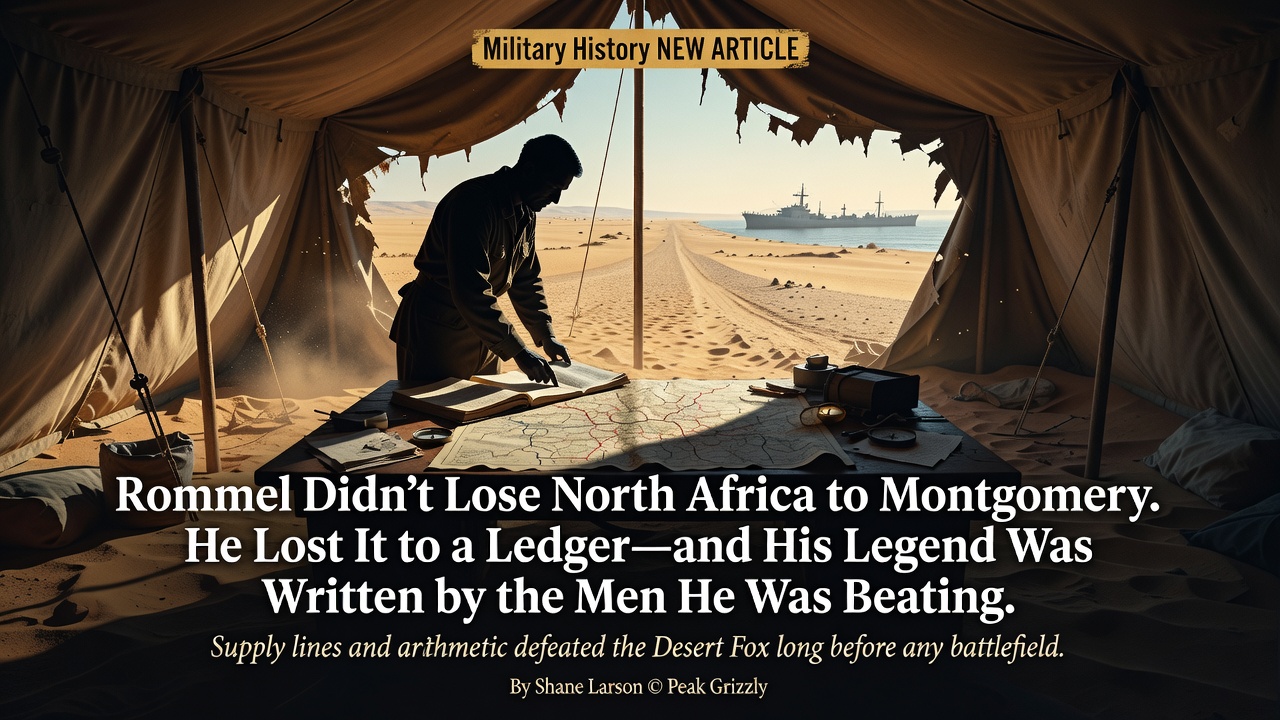
Rommel Didn't Lose North Africa to Montgomery. He Lost It to a Ledger—and His Legend Was Written by the Men He Was Beating
September 14, 2026 · 7 min read
In the last days of August 1942, Erwin Rommel stood sixty miles from Alexandria, closer to victory in Egypt than any Axis soldier would ever stand again, waiting for tankers. The attack he was about to launch at Alam Halfa depended on fuel that was, at that moment, crossing the Mediterranean. The tankers went down one after another—some within a day's sail of Tobruk—and the attack went in anyway, on captured stocks and promises. It stalled in the sand, partly for want of the fuel to swing wide around the British flank, and the Axis high-water mark in Africa receded from there to the end.
The legend says Rommel was finally outfought—that Montgomery arrived, the Eighth Army found its confidence, and the Desert Fox met his match. There is a different account, kept in tonnage tables rather than memoirs, and it says something simpler: the desert war was a logistics problem wearing the costume of a tank battle, and Rommel lost it to arithmetic he never respected. That account does not make him smaller as a commander. It makes the campaign make sense.
A corridor that punishes winners
The Western Desert is a corridor roughly eight hundred miles long—the Mediterranean on one side, sand no army can live in on the other. Everything an army needed came up a single coastal road from one of two ports, Tripoli at one end and Alexandria at the other, and the trucks that hauled fuel forward burned fuel to do it. Past a certain distance, a truck consumed a large fraction of its own cargo making the round trip. The rule that follows governed the whole campaign: every mile you advance makes you weaker, and every mile you retreat makes you stronger, because you are falling back onto your own supplies while your enemy strains away from his.
Between September 1940 and November 1942 the front swept the corridor's full length four times, and every reversal obeyed the rule. The British halted at El Agheila in early 1941 with a victorious but mechanically finished armored division at the end of a five-hundred-mile haul. Rommel halted in front of Tobruk that spring, and again at El Alamein in 1942, because the fuel to go farther did not exist. The Eighth Army twice reached El Agheila going the other way and stopped—the same arithmetic with the signs reversed. Generals on both sides were knighted and sacked over a front line that was set, within a few dozen miles, by the tonnage arriving behind it.
At El Alamein in October 1942, the Panzerarmee sat at the far end of a fourteen-hundred-mile haul from Tripoli with its fuel reserve measured in days. The army facing it had a railhead a morning's drive behind its line. Whatever happened when the barrage opened, that disparity had already happened first.
The 85 percent alibi
Here is the number that seems to acquit the convoy war, and doesn't. Between June 1940 and January 1943 the Axis dispatched somewhere between 2.2 and 2.5 million tons of materiel to Libya—the spread depends on how fuel and vehicles are counted—and roughly 85 percent of it arrived. An overall loss rate of 15 percent looks survivable, and it has tempted some writers into concluding that Rommel's supply crisis was exaggerated.
The aggregate is an alibi. The losses were not spread evenly across three years; they were concentrated—on particular months, and on particular cargoes—precisely when concentration hurt most. In November 1941, as the British Crusader offensive opened, the proportion of Axis shipping sunk on the Libya run passed sixty percent by the most conservative count, and Rommel fought that battle counting shells. In late August 1942 the sinkings fell on the tankers whose arrival was the precondition for Alam Halfa. A supply line does not fail on its average. It fails on the week the fuel does not come, and the weeks were not chosen at random.
The island doing the choosing
Malta sits almost exactly on the convoy route between Italy and Africa, and the campaign's real decisive position was not any ridge in Egypt but that island. The Axis understood this well enough to bomb it into rubble and bring its population near starvation, and planned an invasion that was repeatedly deferred and never launched—a decision German officers had reason to regret at leisure. The British understood it well enough to pay almost any price to keep Malta fighting; in August 1942 the Pedestal convoy lost nine of fourteen merchant ships getting through, and the tanker Ohio, bombed, torpedoed, and kept afloat by the destroyers lashed to her sides, was towed into Grand Harbour with the fuel that kept the island's aircraft flying. From Malta, bombers, torpedo aircraft, and submarines worked the sea lanes all the way to the African coast.
The Desert and the Boot
What made the work surgical rather than lucky was intelligence. British codebreaking—the Ultra secret—was reading the Axis convoy schedules: sailings, routes, cargoes. The strikes could be laid on the ships that mattered most, which is how the losses came to concentrate on fuel at the worst possible moments. Acting on intelligence that precise risks revealing its existence, so an elaborate cover was maintained: reconnaissance aircraft were sent out to be seen "finding" convoys whose positions were already known, so that every sinking had a visible, innocent explanation. The Axis fed its supply schedule into the air nightly, and the Mediterranean collected.
What Rommel actually was
None of this requires diminishing him, and honesty requires the opposite. Sent to Libya in early 1941 with a blocking force and orders to hold, he conquered Cyrenaica inside a fortnight instead. At Gazala in 1942 he beat a larger army sitting in a fortified line. At Kasserine Pass in early 1943 he handled a green American corps roughly enough that the US Army rebuilt its doctrine, its training, and much of its command afterward. As an operational commander he belongs in the first rank of the war, and the record establishes it without any help from mythology.
But operations sit on logistics, and there he was indifferent at best. He treated his quartermasters' arithmetic as pessimism to be overridden rather than as the boundary of the possible. Twice he drove his army to positions its supply demonstrably could not sustain, and when the starvation arrived on schedule he blamed Rome, Berlin, and the navy—rarely the man who had ordered the advance. The most famous general of the desert war never solved, and never truly engaged, the problem the desert war actually was.
The legend has authors
Military myths usually condense anonymously. This one had builders, and they can be identified—starting with the side he was beating. The British press needed a story in 1941 and 1942, and the British Army needed an explanation for its defeats that was not its own tank design, its own habit of committing armor unsupported, or its own generalship. A German wizard served where an institutional reckoning would have hurt. The legend grew until the British commander in the theater circulated an order telling his officers to stop speaking of Rommel as a superman—an order that mostly proves how far things had gone—and Churchill, needing to dignify a run of disasters in front of Parliament, publicly ranked him a great general. Every superlative was doing domestic work.
After the war, different hands with different needs finished the portrait: an admiring biography by a former British opponent, the general's own papers—curated by a family with a name to protect—edited into print by a British military theorist who found in them confirmation of his own prewar ideas, and a rearming West that needed a German soldier clean enough to stand beside. Rommel's forced suicide in 1944, after he was implicated in the plot against Hitler, met that last need exactly, by supplying a martyrdom. None of this makes him a fraud. It makes his fame, to an unusual degree, a record of what other people required him to be.
Beaten by a ledger
So the answer to the question is layered. Was Rommel overrated as a tactician? No—the operational record stands on its own. Did Montgomery beat him? At Alamein, with a materiel superiority that the shipping war had spent two years constructing, yes. But the campaign was decided at sea, by an island that would not fall, decrypts that chose the targets, and a corridor that taxed every advance—a ledger kept far from the battlefield, closing month by month. The men who planned the invasion of Normandy had spent years watching that ledger work, and they designed an operation that was its opposite: an assault that brought its ports with it, in pieces, and grew stronger with every mile it advanced. The desert taught that lesson four times, at full price, to both sides.
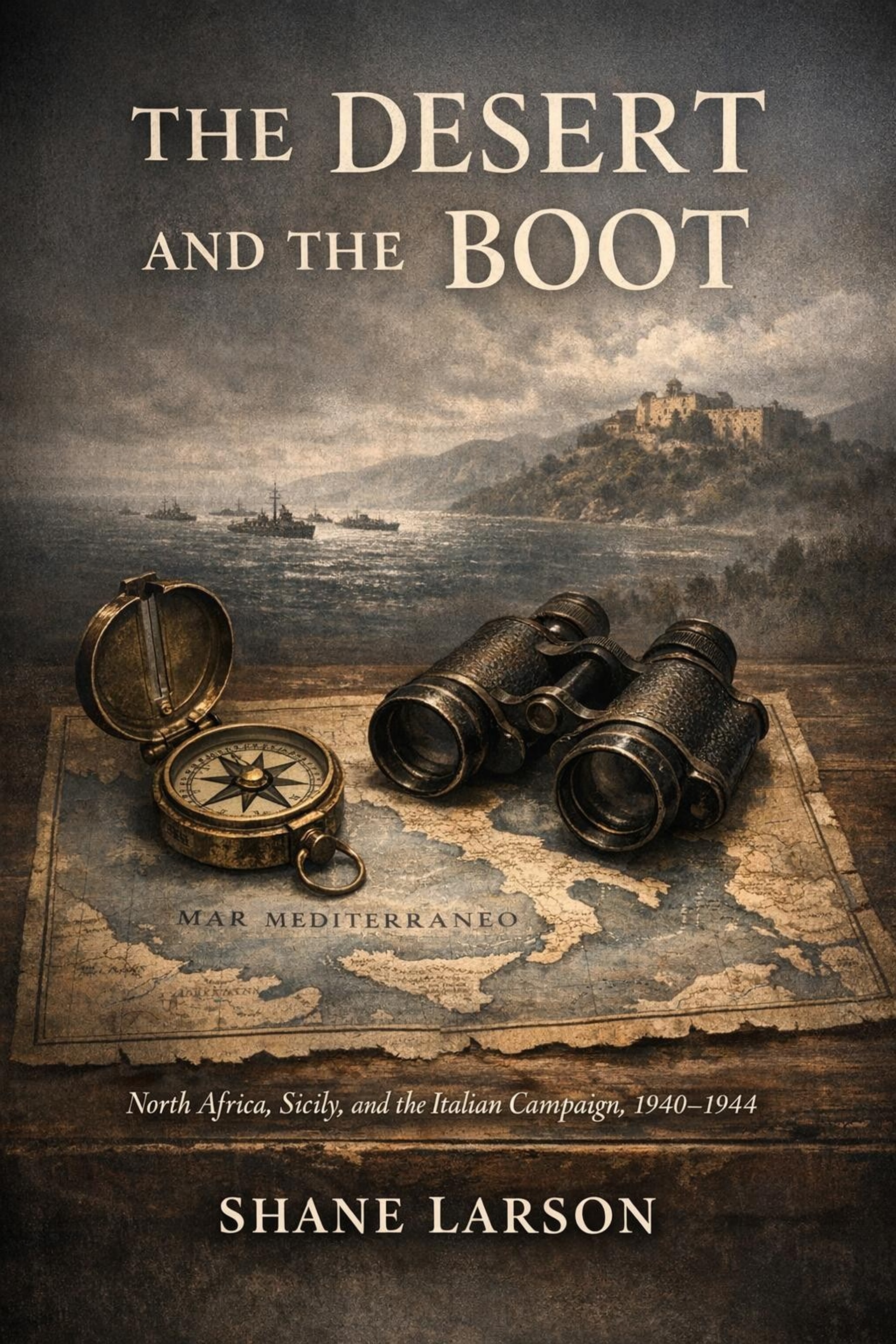
I tell the whole story—the corridor, Malta, the convoy war, and then the harder question of Italy, a campaign whose worth is a genuine argument the book actually conducts—in The Desert and the Boot: North Africa, Sicily, and the Italian Campaign, 1940-1944, the seventh volume of my Second World War Chronicles. The supply argument gets its own appendix there: Axis tonnage shipped against tonnage sunk, month by month, with the Panzerarmee's fuel state alongside, because an argument about arithmetic should show its arithmetic.
The Desert and the Boot
New posts and releases, straight to your inbox. No spam, unsubscribe anytime.