Writing Was Invented to Count Sheep, and the First Named Person in History Was an Accountant
August 5, 2026 · 6 min read
The earliest writing we have is not a prayer, a poem, or a law. It is a record of barley.
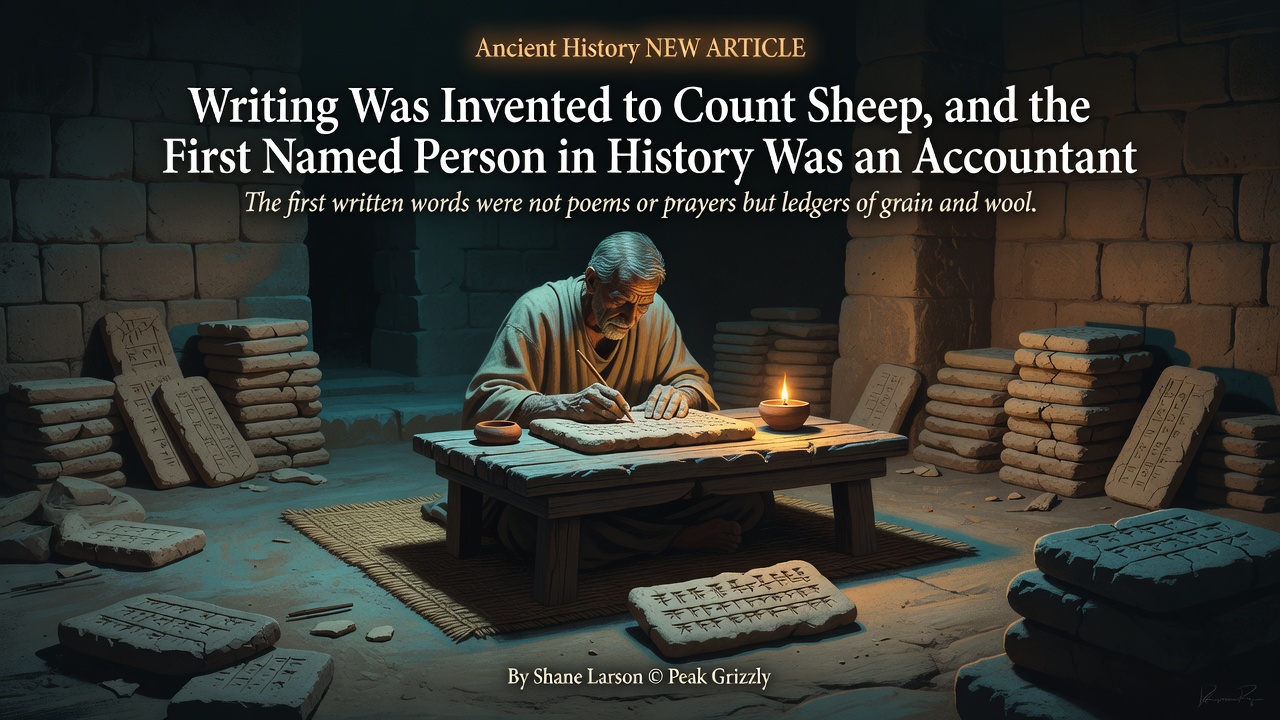
Around 3300 BC, in the southern Mesopotamian city of Uruk, scribes began pressing marks into wet clay to record quantities of commodities — grain, sheep, beer, textiles — and who owed what to whom. The tablets are inventories. Receipts. Ledger entries. They list precise amounts of barley distributed to laborers or held in temple storehouses, often with the names of officials who authorized the movement of goods. Many survive only as fragments, but enough remain to show a consistent system of tracking inflows and outflows.
And the earliest personal name that appears in the human record, on several of those tablets, appears to belong to an administrator responsible for barley allocations. A name usually read as Kushim. One tablet records him signing off on the distribution of 120 units of barley to a group of workers over a period of months. Another lists him in connection with the management of beer rations tied to the same grain supply. Not a king. Not a prophet. Not a hero. The first person whose name we can read was, functionally, an accountant signing off on stock.
Why It Had to Be Accounting
This is not an accident of preservation. It follows from what the cities needed.
Uruk in this period was something genuinely new — a settlement of tens of thousands of people, which is far past the scale at which everyone knows everyone. The economy ran through temple and palace institutions that collected agricultural surplus, stored it, and redistributed it: rations to workers, allocations to households, materials to craftsmen, offerings to gods. Fields were measured in precise units, canals maintained by crews whose labor days were tallied, and finished goods such as textiles or oil tracked from workshop to warehouse. That is a system with an enormous bookkeeping requirement and no way to meet it. Human memory does not scale to thousands of transactions across hundreds of people over years, and disputes about who delivered what cannot be settled by recollection when the parties disagree and both are sincere.
The evolution is legible in the archaeology, and it is one of the more satisfying sequences in the whole record. Small clay tokens of different shapes had been used for counting goods for millennia. A cone might stand for a measure of grain, a sphere for a jar of oil. Then tokens began to be sealed inside hollow clay balls to preserve a transaction — which created the obvious problem that you had to break the container to see the contents. So the tokens were impressed on the outside of the ball before being sealed inside. At which point somebody noticed that the marks on the outside carried the information and the tokens inside did not need to exist. Flatten the ball into a tablet and you have writing, arrived at by a series of practical adjustments by people solving a storage problem. The earliest tablets still show the impressions of those older token shapes alongside the new incised signs.
Seven Hundred Years of Receipts
The part that surprises people is how long it stayed that way.
For roughly seven centuries after the first tablets, the written record is overwhelmingly administrative. Quantities, commodities, names, dates, institutional transfers. The script expands and becomes more capable — moving from pictures toward the wedge-shaped signs of true cuneiform, gaining the ability to represent sounds rather than only things — but what people choose to write remains inventory. Scribes developed signs for numbers that could be combined in more flexible ways, added qualifiers for different types of grain or livestock, and began noting months and years with greater consistency. Yet the content stayed practical: lists of sheep delivered to the temple, tallies of wool collected from herds, records of workers receiving monthly barley payments.
Twilight of the Ziggurats
Literature, myth, law codes, letters, and royal inscriptions all come later. Gilgamesh is written down more than a thousand years after the first tablets. The great flood story and the adventures of the hero appear in writing only after generations of scribes had already spent their careers perfecting columns of numbers and names.
That gap says something worth sitting with. Writing was not invented because someone wanted to record the great stories, which existed and were transmitted orally by people with far better memories for them than we have. It was invented because an institution needed to track grain, and it took centuries before anyone thought to use it for anything else. The technology was not built for its most famous application. It was built for the boring one, and the famous one arrived once the infrastructure was already lying around.
What the Ledgers Actually Show
Because the earliest records are administrative, we know things about ordinary Sumerian life that we do not know about far later societies with more literary sources.
We know what workers were paid, in barley and beer, and how the rations differed by role and sex. A male laborer might receive sixty liters of barley a month while a female weaver received thirty; supervisors and skilled craftsmen received larger shares, sometimes supplemented with oil or wool. We know how the irrigation system was organised and maintained, because the labour was recorded. Crews of twenty or thirty men are listed digging or clearing specific canal sections, with the amount of earth moved noted in volume. We know the scale of temple herds, the yields of specific fields, the prices of specific commodities and how they moved. One set of tablets tracks the exchange rate between barley and silver across several years, showing seasonal fluctuations tied to harvest size.
This is the material an economic historian dreams about, and it exists because a bureaucracy needed it — not because anyone thought posterity would be interested.
The ziggurats get the photographs, and they deserve them: massive terraced platforms rising above the flat floodplain, visible for miles, built to put a temple closer to the sky. But the tablets are the more consequential artifact. The ziggurat is what a society builds when it has surplus. The tablet is how it got the surplus organised in the first place.
The Long Afterlife
Sumer as a political entity did not survive. The city-states were absorbed, first by Akkad and later by others, and Sumerian eventually died as a spoken language.
Then something unusual happened. It kept being written.
For something like two thousand years after the last native speaker, Sumerian remained in use as a scholarly and liturgical language across Mesopotamia — learned by scribes who spoke Akkadian, preserved in bilingual word lists, copied in schools, used for religious texts. Scribes in later Babylonian and Assyrian cities still copied Sumerian lexical lists that traced back to the first Uruk tablets, and temple rituals continued to be recited in the old tongue even when no one spoke it at home. A dead language maintained deliberately, for millennia, because the institutions that used it considered it worth the effort.
The people who invented writing to count sheep produced a script and a scribal culture durable enough to outlive their language, their cities, and their gods.
That is the actual legacy, and it is stranger and more impressive than the monuments.
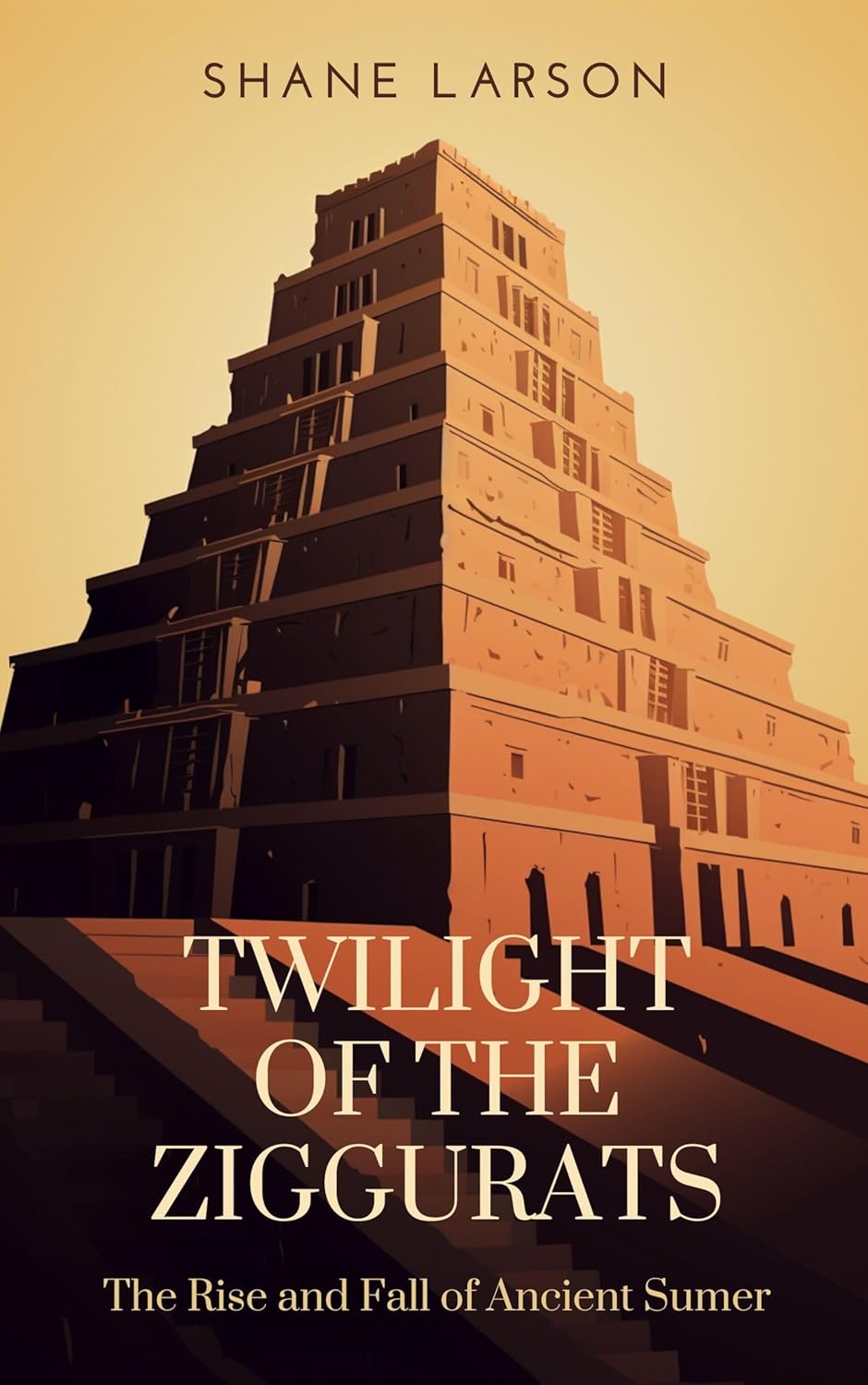
Twilight of the Ziggurats: The Rise and Fall of Ancient Sumer covers the whole arc — the first cities, the invention of cuneiform, the temple economy, the ziggurats, the city-state wars, and the long absorption that ended Sumer as a power and preserved it as a tradition.
Twilight of the Ziggurats
New posts and releases, straight to your inbox. No spam, unsubscribe anytime.