The Castrated Slave Who Commanded the Largest Fleet in History
April 1, 2026 · 7 min read
Here is a biography that should not exist.
A boy is born in 1371 in Yunnan Province, in the far southwest of China. His family is Muslim — ethnic Hui, claiming descent from a governor who served under the Mongol Yuan Dynasty. When the boy is ten years old, the Ming armies come. They are conquering Yunnan, wiping out the last Mongol holdout in southern China. The boy's father is killed or dies in the chaos. The boy himself is captured. He is castrated — standard practice for war captives destined for palace service — and shipped north to serve in the household of Zhu Di, the Prince of Yan, one of the emperor's sons.
The boy's name is Ma He. He is ten years old, mutilated, orphaned, enslaved, and sent to serve a prince in a court where eunuchs are simultaneously indispensable and despised. His life, by any reasonable measure, is over before it has begun.
Except it isn't.
The Most Unlikely Admiral in History
Ma He grew into a man of extraordinary physical presence. The Chinese sources describe him as nearly seven feet tall, with a booming voice and a commanding bearing that made people stop when he entered a room. He was intelligent, loyal, and — crucially — he had the complete trust of his master, Zhu Di.
That trust would be tested in fire. In 1399, when the reigning emperor tried to strip the princes of their power, Zhu Di launched a civil war. It lasted three years. Ma He fought at his side. When Zhu Di marched into Nanjing in 1402 and declared himself the Yongle Emperor, he rewarded his loyal eunuch with a new surname — Zheng — and an assignment that would define both their legacies.
Zheng He would command the treasure fleets.
The assignment was, on its face, absurd. Zheng He was a eunuch — a class of men designed by the system to have no power outside the emperor's household. He was Muslim in a court that was overwhelmingly Confucian and Buddhist. He had no formal naval training. He was being asked to command the largest maritime expedition in human history.
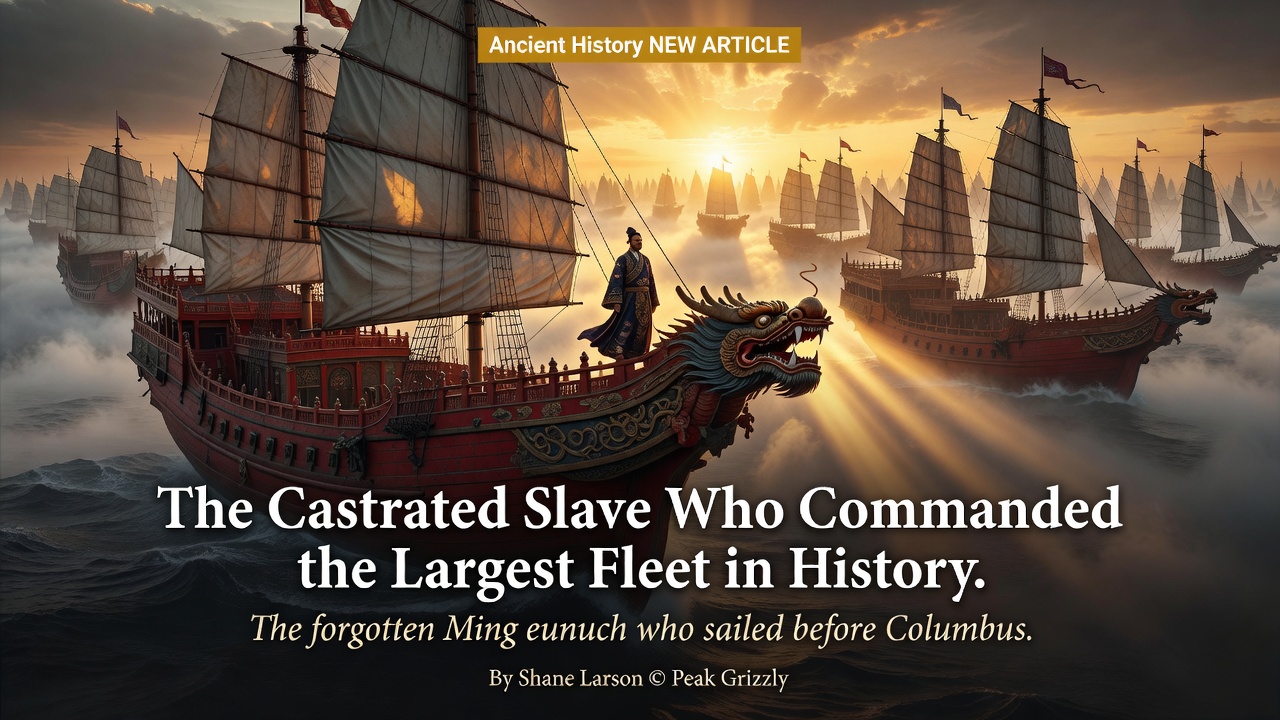
The fleet that assembled in Nanjing in 1405 comprised over 317 ships and 27,800 crew. The flagship — the treasure ship, or baochuan — was, according to the Chinese sources, roughly 400 feet long. That number has been debated by historians for decades. Some argue the sources exaggerate. Others point to the archaeological evidence from the Nanjing shipyard, where a rudder post was excavated that could only have belonged to a vessel of extraordinary size. But even the most conservative modern estimates place the treasure ships at well over 200 feet — still vastly larger than anything else afloat anywhere on earth.
For perspective: when Columbus sailed in 1492, his Santa Maria was about 60 feet long. He had three ships and 90 men. The scale comparison is not subtle.
The Voyages No One Teaches You
Between 1405 and 1433, Zheng He led seven voyages across the Indian Ocean. His fleets visited the Spice Islands, the Malay Peninsula, Ceylon, the Malabar Coast of India, Hormuz in the Persian Gulf, Aden at the mouth of the Red Sea, and multiple ports on the east African coast — Mogadishu, Malindi, and possibly further south.
These were not voyages of discovery in the way that term is usually used. The Indian Ocean in the early fifteenth century was the most dynamic commercial zone on earth. Arab, Indian, Malay, and Chinese merchants had been trading across these waters for centuries. The trade routes were well known. The ports were sophisticated, cosmopolitan, and prosperous.
What Zheng He brought was something different: the overwhelming presence of the Chinese state. His fleets carried soldiers — tens of thousands of them. They fought a war in Ceylon and captured a king. They destroyed a pirate lord who controlled the Strait of Malacca. They installed rulers and deposed them. They established a network of tributary relationships in which foreign kingdoms acknowledged the cosmic authority of the Chinese emperor in exchange for trade access and diplomatic recognition.
Was this peaceful? Not exactly. Was it the same as what the Portuguese would do when they arrived sixty years later? Not even close. The Portuguese came to conquer, to establish fortified trading posts, to monopolize the spice trade by force. Zheng He came to demonstrate that the emperor's reach was limitless — and then he went home.
The fleets brought back ambassadors, trade goods, geographic knowledge, and exotica. The most famous souvenir was a giraffe, brought from Malindi on the East African coast, which the Ming court interpreted as a qilin — a mythical creature whose appearance signified heaven's approval of the emperor's rule. For the Yongle Emperor, the giraffe was proof that the voyages were working: the entire known world was acknowledging his authority.
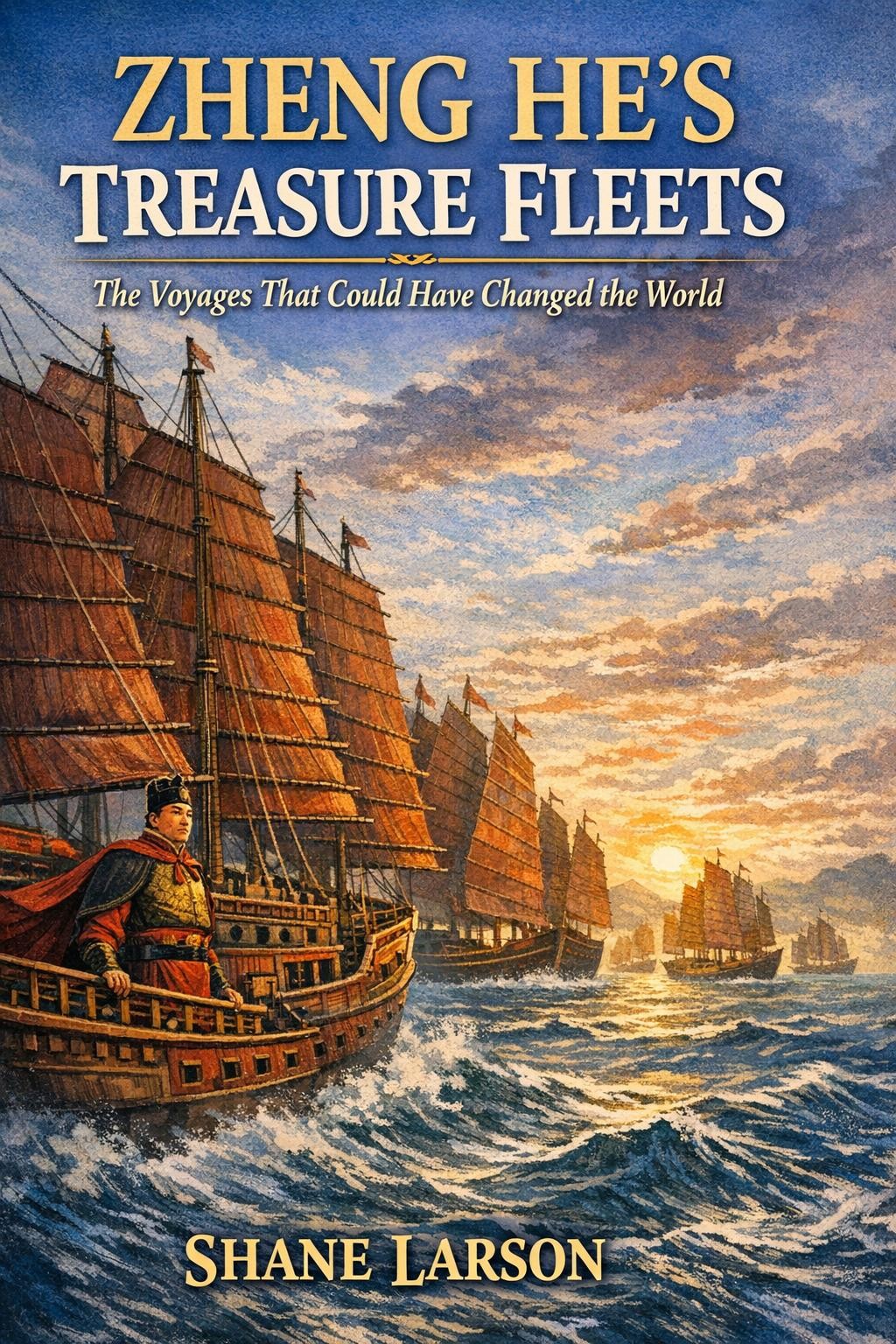
Zheng He's Treasure Fleets
The Decision That Changed Everything
The Yongle Emperor died in 1424. The voyages had always been his project — an expression of his particular brand of ambitious, outward-looking imperial vision. His successors did not share that vision.
The Confucian scholar-officials who dominated the Ming bureaucracy had opposed the voyages from the beginning. Their objections were ideological and practical. Agriculture, not commerce, was the foundation of civilization. Contact with foreigners was dangerous. The voyages were ruinously expensive. The eunuch faction that championed them — Zheng He's faction — was the Confucian establishment's political rival, and every success the treasure fleets achieved increased eunuch influence at court.
After the Yongle Emperor's death, the Confucians won. There was one final voyage, authorized in 1430 by the Xuande Emperor — perhaps as a last gesture, perhaps because even the skeptics wanted one more round of tribute and intelligence. Zheng He, now in his sixties, sailed one last time. He died during or shortly after the seventh voyage, in 1433.
And then something remarkable happened. The Ming court did not simply end the voyages. It actively destroyed the capacity to resume them.
Ships were broken up or left to rot. The Nanjing shipyards were dismantled. One vice-president of the Ministry of War reportedly burned Zheng He's logs and navigation charts — not out of carelessness, but deliberately, to ensure that no future emperor would be tempted to repeat the expeditions. By 1500, it was illegal to build a ship with more than two masts. Coastal communities that had thrived on maritime trade were pushed into poverty. China's coastline, which had been a gateway to the world, became a frontier to be defended.
The greatest naval power in human history took itself apart on purpose.
The Road Not Taken
This is where the story becomes haunting. Because when Zheng He's fleets were crisscrossing the Indian Ocean in the 1420s, no European had rounded the Cape of Good Hope. The Portuguese were still poking their way down the West African coast. Columbus had not been born. The Spanish, Dutch, and British empires were not even concepts.
When Vasco da Gama finally reached the Indian Ocean in 1498 — sixty-five years after Zheng He's last voyage — he brought four ships and 170 men. The people he encountered in East Africa and India had already seen the Chinese armadas. By every account, they were unimpressed by the Portuguese.
But the Chinese were gone. The power vacuum was total. And into that vacuum poured the Portuguese, then the Spanish, then the Dutch, then the British. The entire age of European maritime dominance — colonialism, the slave trade, the global empires that shaped the modern world — played out in an Indian Ocean that had been ceded by the only power capable of contesting it.
Was this inevitable? Absolutely not. It was a policy decision, made by identifiable people for identifiable reasons. The Confucian establishment was not irrational. The northern frontier was a genuine threat (the Mongols were still dangerous). The voyages were genuinely expensive. The eunuch faction was genuinely corrupt. But the consequences of the decision extended far beyond anything the Ming court could have imagined.
I am not interested in speculative fiction about what would have happened if the voyages had continued. Nobody knows. But I am interested in the fact that the European conquest of the world's oceans was not destiny. It was contingent. It happened because of specific choices made by specific people — and the most consequential of those choices was made not in Lisbon or Madrid, but in Beijing.
Why This Story Matters
Zheng He's story is not obscure among historians. Specialists know it well. But it remains remarkably unknown to general readers in the West — the same readers who can tell you about Columbus, Magellan, and Drake without hesitation.
That gap matters, because the story of the treasure fleets is not just a curiosity. It is a fundamental challenge to the way most of us understand the last six hundred years. It tells us that the world we live in — the world shaped by European maritime empires — was not the only possible outcome. It was the product of choices, some of them made by people who had no idea what they were setting in motion.
And at the center of it all is a man whose biography is almost impossible: a captured, castrated child who became the most powerful admiral on earth, who sailed further and commanded more than anyone before him, and whose legacy was deliberately erased by the very civilization he served.
That is a story worth telling.
Zheng He's Treasure Fleets
New posts and releases, straight to your inbox. No spam, unsubscribe anytime.