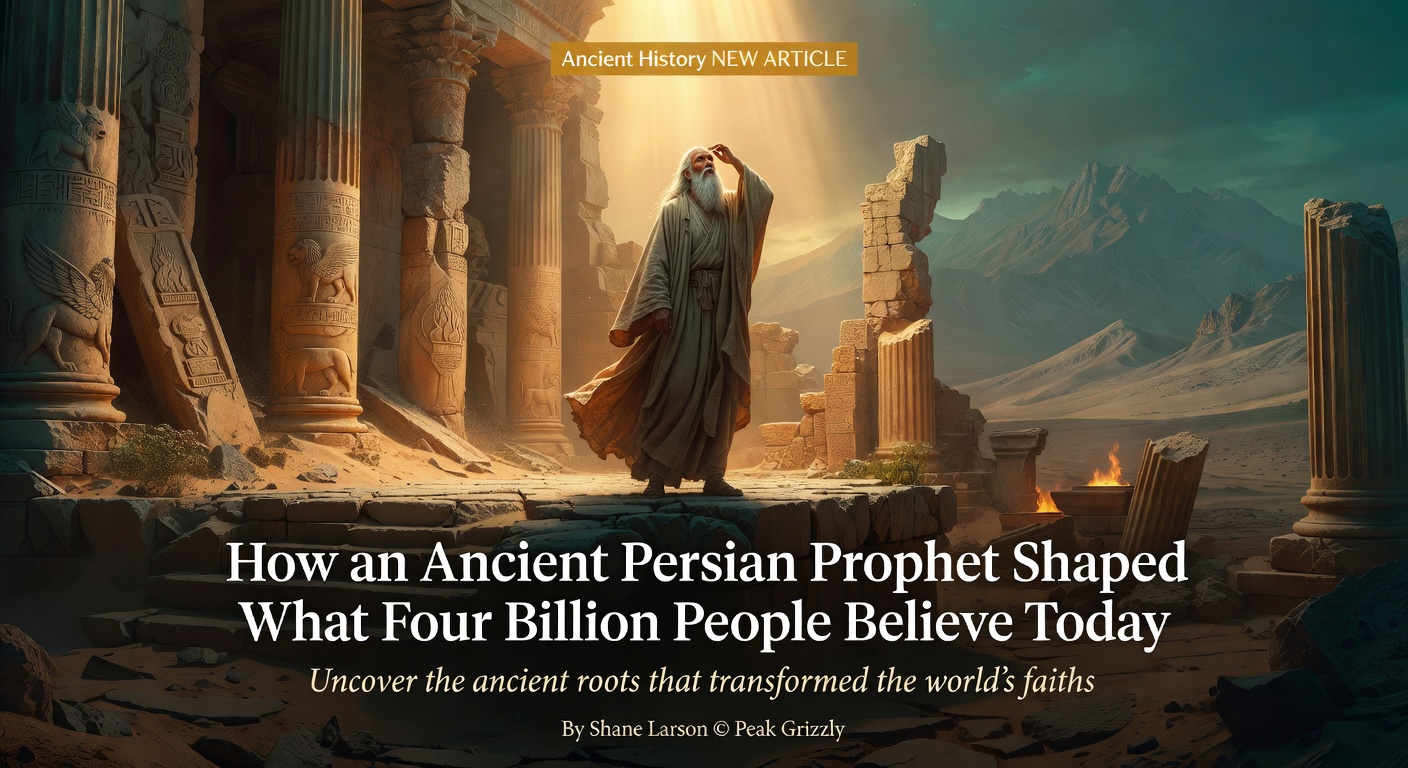
How an Ancient Persian Prophet Shaped What Four Billion People Believe Today
April 5, 2026 · 9 min read
You believe in heaven and hell. Or if you don't, you grew up in a culture so saturated with these concepts that you understand them intuitively — the righteous rewarded, the wicked punished, a final accounting at the end of time. Think about how these ideas permeate everyday life, from the moral lessons in children's stories like "The Little Engine That Could" to blockbuster movies such as "The Lord of the Rings," where good and evil clash in epic battles, or even in legal systems that emphasize justice as a cosmic balance. They're not just abstract theology; they've shaped art, law, and ethics across centuries, influencing everything from medieval art depicting the Last Judgment to modern debates on morality in philosophy.
These ideas feel ancient. They feel like they have always been there, baked into the foundations of Western and Middle Eastern religion. But they haven't. They entered Judaism, Christianity, and Islam through a specific historical transmission — and that transmission traces back to an Iranian prophet whose name most people have never heard. Born around 1500 BCE in what is now northeastern Iran, Zarathustra lived in a world of nomadic tribes and early agricultural societies, where his poetic visions challenged the status quo of polytheistic rituals. His teachings, preserved in the Avesta scriptures, weren't just religious reforms; they were a bold philosophical shift toward ethical monotheism, emphasizing personal responsibility in a chaotic universe.
Zarathustra — known in the West as Zoroaster — was a priest-poet who broke with the polytheistic religion of his ancestors and proclaimed the supremacy of a single deity: Ahura Mazda, the "Wise Lord." His followers built the theology that the Achaemenid Persian Empire adopted as its ideological framework, not as a tool for conquest but as a unifying force for diverse peoples. And when that empire conquered Babylon and freed the exiled Jews in 539 BCE, two centuries of close contact between Persian and Jewish culture began reshaping the theological assumptions of half the world. This interaction wasn't just diplomatic; it involved intermarriages, shared festivals, and the exchange of scribes and scholars, allowing ideas to flow freely across cultural boundaries.
Before Persia, There Was No Heaven or Hell
This is the part that surprises people. In the ancient world, concepts of an afterlife tied to moral judgment were rare, making Zoroastrianism's introduction a profound shift that addressed human anxieties about injustice and mortality in a way earlier religions did not.
Before the Zoroastrian transmission, the major religions of the ancient Near East had little interest in what happened after death. Mesopotamian religion, for instance, as depicted in the Epic of Gilgamesh, offered only Sheol — a shadowy, joyless realm where everyone, from kings to commoners, existed as mere shades, without distinction based on earthly deeds. This reflected a broader worldview where the gods were capricious and human actions had limited cosmic impact. Egyptian religion had a judgment of the dead, overseen by Osiris, but the emphasis was on proper ritual preparation (mummification, funerary texts) rather than moral conduct during life, as seen in the Pyramid Texts and Coffin Texts, which focused on ensuring the pharaoh's safe passage through elaborate spells and offerings. Early Hebrew texts show the same pattern, with books like Ecclesiastes and Psalms portraying Sheol as a place of forgetfulness, where "the dead do not praise the Lord," emphasizing communal worship of the living over any eternal rewards.
Zoroastrianism changed everything. It introduced the idea that after death, each soul crosses the Chinvat Bridge — the Bridge of the Separator — where its deeds are weighed, drawing on vivid imagery from Zarathustra's own hymns that describe the bridge narrowing for the wicked, symbolizing the precariousness of a life mislived. The righteous cross safely into the House of Song, a paradise of light and harmony, while the wicked fall into the House of the Lie, a realm of torment. Your afterlife destination is determined not by ritual observance or social status, but by your moral choices during life, such as acts of truthfulness, charity, and resistance to corruption — a concept that echoed the prophet's emphasis on free will in the face of evil forces.
This was a radical innovation, challenging the fatalism of earlier traditions by asserting that individuals could influence their eternal fate through everyday decisions, much like how modern ethical systems link personal behavior to long-term consequences. And it was only the beginning. Zoroastrianism also introduced the resurrection of the dead — not metaphorical, not spiritual, but physical, as outlined in texts like the Bundahishn, which describes bones reassembling and the earth renewing itself. At the end of time, the dead would literally rise from their graves, be reunited with their souls, and live in a perfected world, providing hope for justice in a history marked by oppression. It introduced angels and demons as organized hierarchies — the Amesha Spentas, benevolent spirits embodying virtues like good thought and purity, serving Ahura Mazda, while the daevas, deceptive entities promoting chaos, served the Destructive Spirit, offering a structured cosmic battle that paralleled human struggles. It introduced a savior figure, the Saoshyant, who would be born of a virgin and lead humanity in a final battle against evil, a prophecy that resonated with later messianic expectations. It introduced the concept that time is linear, heading toward a definitive conclusion where good triumphs permanently over evil, contrasting with the cyclical views of many ancient mythologies.
Every one of these ideas would become central to Judaism, Christianity, and Islam. The structural parallels are not vague resemblances; they are precise, detailed, and historically traceable, as seen in how Jewish apocalyptic literature began incorporating these elements to address the suffering under foreign rule.
The Transmission Was Not Mysterious — It Was Historical
The mechanism is documented, revealing a web of interactions that went beyond conquest to include diplomacy, trade, and intellectual exchange, which facilitated the blending of ideas.
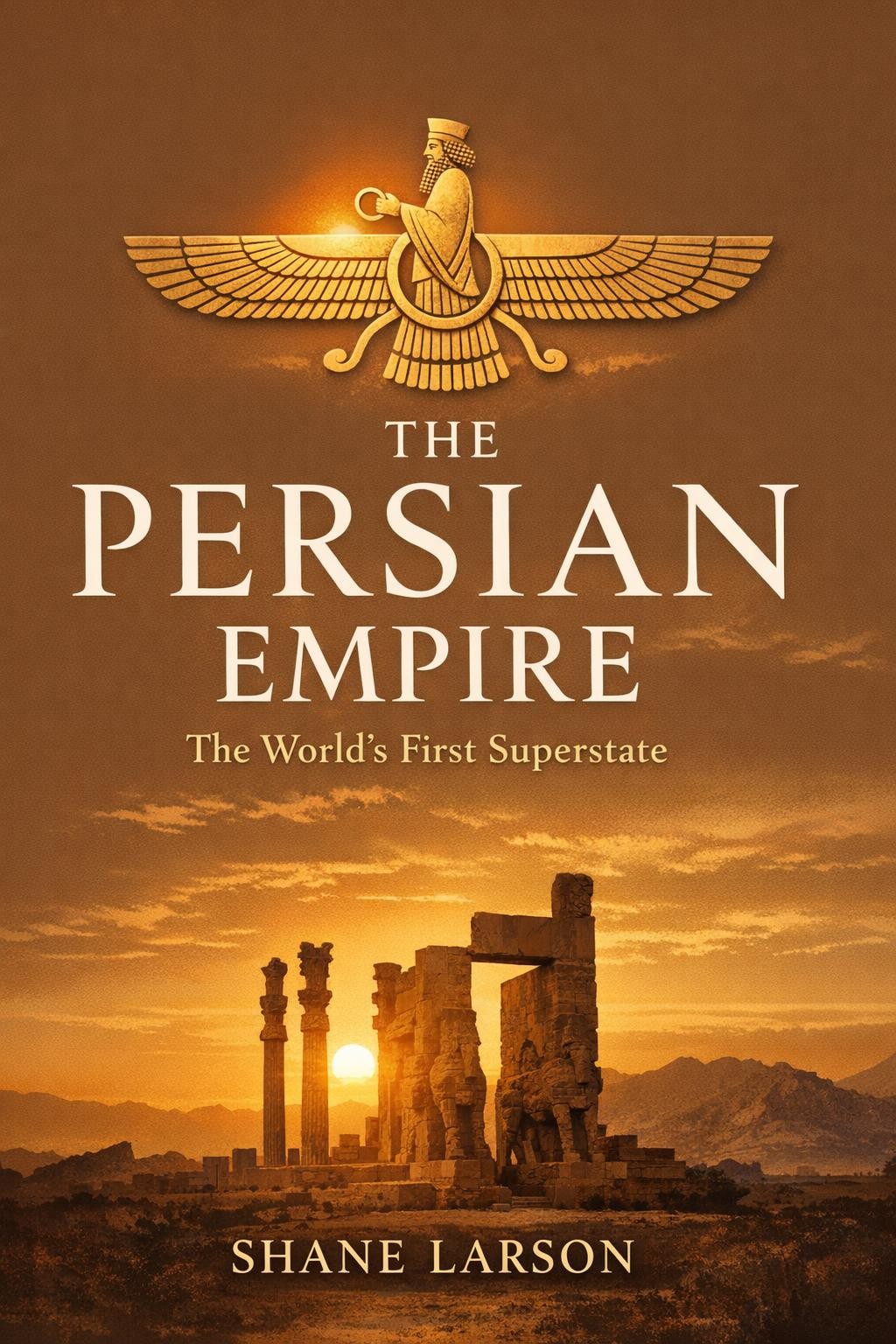
The Persian Empire
In 586 BCE, Nebuchadnezzar conquered Jerusalem, destroyed Solomon's Temple, and deported the Jewish elite to Babylon, scattering a people whose identity was tied to their land and traditions. Fifty years later, Cyrus the Great conquered Babylon and freed the exiled peoples, issuing the Cyrus Cylinder — an ancient declaration of human rights that allowed captives to return home — under Persian protection and Persian funding. The Jews returned to Jerusalem under this umbrella, rebuilding their community within a vast empire that spanned continents.
For the next two centuries — 539 to 332 BCE — Judah was a province of the Achaemenid Empire, with Jewish leaders serving as local governors under Persian oversight, fostering daily interactions through shared markets, administrative correspondence, and even interfaith dialogues. Jewish life was lived under Persian administration, Persian law, and within a Persian cultural sphere, where Zoroastrian festivals like Nowruz might have influenced Jewish observances, and Persian satraps consulted with Jewish elders on matters of governance.
This period corresponds exactly to the era in which transformative ideas entered Jewish theology. Before the Exile, the Hebrew Bible shows little interest in the afterlife, with texts like the Torah focusing on earthly covenants and laws. After the Persian period, heaven and hell, resurrection, final judgment, angels and demons, and end-of-time scenarios begin appearing throughout Jewish texts — in the later prophetic books, such as Isaiah's visions of a new heaven and earth, in the apocalyptic literature of Daniel and 1 Enoch, which describe angelic hierarchies battling demonic forces, and in the theological developments of the Second Temple period, where sects like the Essenes emphasized moral purity for the afterlife.
The book of Daniel contains the Hebrew Bible's clearest statement of bodily resurrection: "Many of those who sleep in the dust of the earth shall awake, some to everlasting life, and some to shame and everlasting contempt." This idea — absent from earlier Jewish texts — is structurally identical to Zoroastrian teaching about the fate of the dead, down to the imagery of awakening from the earth. While some scholars point to indigenous developments in Jewish thought, the timing and specifics align closely with Persian influence, as evidenced by archaeological finds like the Elephantine papyri, which show Jewish communities in Egypt adopting Persian administrative practices and possibly religious concepts.
The scholarly consensus is that Zoroastrian influence on Second Temple Judaism was real and significant, backed by comparative studies of ancient texts and historical records, though not a simple copy-paste; it was a genuine cross-pollination between two living traditions in close contact over two centuries, where ideas were adapted to fit Jewish narratives of covenant and redemption. Christianity then inherited the entire package from Judaism, with figures like Jesus drawing on these motifs in his teachings on the kingdom of God, while Islam inherited it from both Jewish and Christian tradition, and also had direct contact with Zoroastrianism through the Arab conquest of the Sasanian Persian Empire in the seventh century CE, where Muslim scholars engaged with Zoroastrian texts and incorporated elements into Islamic eschatology.
The chain runs: Zarathustra to Zoroastrianism to Judaism to Christianity to Islam. By that chain, the theological ideas of an Iranian prophet became the foundational assumptions of religions now practiced by roughly four billion people, influencing global culture from art to ethics.
The Empire Behind the Ideas
The Persian Empire was not just a vehicle for religious transmission; it was a pioneering force in governance that created the conditions for such exchanges through its vast networks and policies of inclusion.
It was the largest political entity the world had ever seen — stretching from Libya to India, governing perhaps forty percent of the global population, with estimates from ancient historians like Herodotus suggesting it managed over 50 million people through innovative systems. And it held together not primarily through terror, but through the most sophisticated administrative system of the ancient world, including cuneiform records that detailed tax collections, road maintenance, and diplomatic relations.
Cyrus the Great conquered three empires and governed them through tolerance rather than forced assimilation, as seen in his edicts allowing local religions to flourish, which not only stabilized his rule but also encouraged cultural blending. Darius I built the infrastructure — the Royal Road connecting Sardis to Susa, spanning over 1,500 miles with waystations for rest and resupply, a postal service that amazed the Greeks by delivering messages across continents in days, standardized coinage that facilitated trade from Egypt to Bactria, and a provincial system of satrapies where local leaders retained autonomy as long as they paid tribute — that made continental governance possible, creating a framework where ideas could travel as freely as goods.
Persepolis was not a capital in the administrative sense but the ceremonial embodiment of an empire's self-image, where delegations from every subject nation came bearing tribute in an annual display of ordered diversity, with relief carvings depicting ambassadors from places like Lydia and India, symbolizing a multicultural unity that paralleled the empire's religious tolerance. Most of what Westerners know about Persia comes from the Greeks — Marathon, Thermopylae, Salamis — but these accounts often overlook the broader context, as the Greeks were adversaries writing propaganda to glorify their own victories.
They were adversaries writing propaganda, framing Persia as a barbaric foil to Greek democracy, yet the empire that "lost" to Greece at Salamis continued to dominate Greek affairs for another 150 years, strategically funding Sparta against Athens in the Peloponnesian War, imposing the King's Peace of 387 BCE to enforce its will, and playing Greek city-states against each other with a sophistication that would have impressed later statesmen like Bismarck, using espionage and alliances to maintain influence.
The Persian story, told from the Persian side through inscriptions and artifacts, is the story of a civilization that built the first superstate — and whose most lasting export was not roads or coins or administrative structures, but a set of ideas about good and evil, heaven and hell, and the final destiny of the human soul that still shape how billions of people understand the universe, echoing through history in everything from Renaissance paintings to contemporary discussions on justice.
The Persian Empire
New posts and releases, straight to your inbox. No spam, unsubscribe anytime.