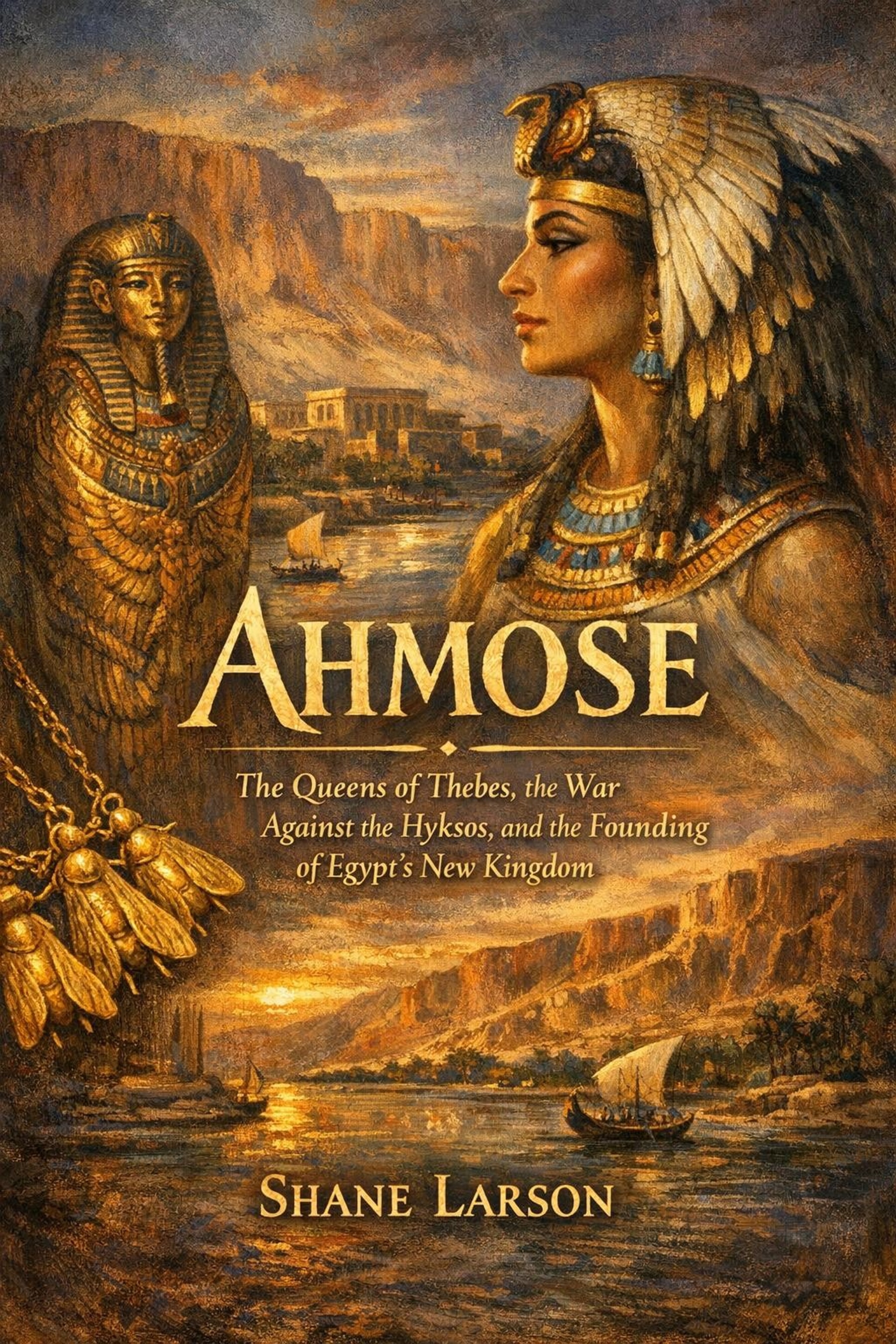
Ahmose
The Queens of Thebes, the War Against the Hyksos, and the Founding of Egypt's New Kingdom
By Shane Larson
About This Book
Four centuries after she died, the men who cut the royal tombs in the Valley of the Kings were still carrying her statue through their village. The village was Deir el-Medina, on the west bank at Thebes, and its workmen kept her festivals and brought their quarrels to her image to be settled. On the walls of their own tombs they painted her with black skin, the color the Egyptians gave to Osiris and to the soil the flood left behind: the color of rebirth. Her name was Ahmose-Nefertari. She had been a king's daughter, sister, wife and mother, and in the village's memory she was something more than any of those. She was a founder.
Her mother was buried with a soldier's decoration: three golden flies on a chain, each the length of a finger, beside the ceremonial axe and dagger of a king. Her grandmother was born to parents with no titles at all, and a king built her a pyramid.
These three women, and the dynasty that could not have survived without them, are the subject of this book.
The conventional account of how Egypt's New Kingdom began runs through three men: Seqenenre Tao, who fought the Hyksos and died of head wounds still visible in his skull; Kamose, who carried the war north and vanished after three years; and Ahmose, who took Avaris, broke Kerma in Nubia, and founded a state that lasted four hundred years. The sequence is accurate. It also has two holes in it. When Seqenenre died his eldest child was at most seven. When Kamose disappeared, the king who replaced him was a boy of about ten. Somebody kept the army fed, kept the nobles from cutting their own deal with Avaris, and kept the war alive until the child could fight it.
A stela Ahmose raised in the temple of Amun at Karnak names that somebody. Near its end the king turns from his own achievements and instructs Egypt to honor his mother Ahhotep, who looked after the soldiers, recovered the fugitives, gathered in the deserters, and put down rebellion in the south. No Egyptian king before or after credited his mother with holding an army together.
So the book follows the family rather than the war, across four generations from Tetisheri the commoner's daughter to Amenhotep I, who died without a son. Four times in sixty years the throne went to a child, a corpse or an outsider, and four times the dynasty held, because a king's mother or a king's wife was governing in the interval. Needing its women, the family gave them estates, priesthoods and public honors that outlived the emergency. A second Karnak stela records Ahmose-Nefertari acquiring the office of God's Wife of Amun, with an endowment, for her heirs in the female line; it outlasted her dynasty by nearly eight hundred years. When Hatshepsut took the double crown half a century later, every step but the last had been taken by the women of this house.
The war is here, told from Thebes and compressed on purpose. What came after it gets the room popular accounts deny it: the last pyramid an Egyptian king ever built, a storm stela that may or may not describe the eruption of Thera, and an army paid in gold and land until it became a class.
Why I Wrote This
I had already written the Hyksos war from the losing side, and I thought I knew it. Then I went back to the Ahhotep stela for an unrelated reason and read the lines about the king's mother again, slowly. A pharaoh, in the temple of the state god, telling the whole country that his mother had looked after the soldiers and put down the south. I went looking for the book about her and found historical novels.
What hooked me was not the flies, though the flies are a good story. It was the arithmetic. Four times in sixty years the throne went to a child, a corpse or an outsider, and four times the dynasty held. Something was holding it in between, and the Egyptians wrote down what. The evidence is thin, and I have said so wherever it is. A thin record handled honestly beats a thick one padded with warrior queens.
Frequently Asked Questions
Do I need to read The Hyksos before this book?
No. The two were written as companions and work in either order. The Hyksos tells the war at length from the Delta side, with the archaeology of Avaris and the soldier Ahmose son of Ebana quoted in full. This book compresses the same war into three chapters from the Theban side and spends its length on the family before the war and the state after it.
Was Queen Ahhotep really a warrior queen?
Nothing shows her commanding troops in the field. Her son's stela describes a regent holding an army together, not a general leading one, and the golden flies may have been his gift to her for that regency rather than for any act of arms. The book stops where the evidence does.
How are Ahhotep and Ahmose-Nefertari connected to Hatshepsut?
Ahhotep was the wife of Seqenenre Tao and the mother of King Ahmose. Ahmose-Nefertari was her daughter, Ahmose's sister and wife, and the mother of Amenhotep I. Hatshepsut was born half a century later into the same line: the God's Wife title came to her through the royal women, and her regency for a boy king was the position Ahhotep had filled.
How much of this rests on real evidence?
The written record for Ahmose himself would fit in a short pamphlet, and the book says so in its first pages. Every source is named with its nature: royal propaganda, a veteran's tomb autobiography, a tale written three centuries later, a skull read by forensic teams who disagree. Where the record is silent, the silence is stated rather than filled. There is no reconstructed dialogue and no invented scene.
If You Liked This, You Might Like
- The Hyksos: The Foreign Kings of Egypt — the same war from the other end of the river, with the siege of Avaris told in full and the archaeology this book only points to.
- Hatshepsut: The Pharaoh Who Disappeared — where the precedent this family built was finally used; it begins about where this book's conclusion stops.
- Thera: The Volcano That Shattered the Minoan World — the eruption that may, or may not, be the storm on Ahmose's Karnak stela.
- The Mitanni: The Hurrian Kingdom That Married Into Egypt and Vanished — the enemy the empire this family founded spent the next century fighting, then marrying.
Four generations, four dead or absent kings, and three women who held the gaps. Ahmose: The Queens of Thebes, the War Against the Hyksos, and the Founding of Egypt's New Kingdom is a history of the people the usual story leaves out.
What You'll Learn
- **A matriarch nobody's record explains.** Tetisheri, daughter of Tjenna and Neferu, who held no titles, and the Abydos stela on which Ahmose and his wife decide to build her a pyramid. He honored no other ancestor there.
- **The stela, read line by line.** What "recovered the fugitives" and "pacified Upper Egypt" might mean in practice: a mutiny, a desertion crisis, a revolt during the king's minority.
- **Which Ahhotep?** Whether there were one, two or three queens of the name, and whether the coffin of 1859 belongs to Ahmose's mother or to another woman entirely. Each case gets its evidence.
- **The Abydos fragments.** Ahmose's memorial complex, neglected after its first excavation in 1899, and the pieces Stephen Harvey's team began sifting from the old spoil heaps in the 1990s: the earliest chariots in Egyptian art.
- **A storm on a stela.** The Tempest Stela and the argument over whether it describes a volcano eight hundred miles away, a Nile flood, or a king's routine rhetoric of restoration.
- **A queen buys a priesthood.** The Donation Stela and the God's Wife of Amun: how a queen's household became a corporation, and how the office passed to Hatshepsut and, centuries later, to priestess-rulers of Thebes.
- **The finds as the scenes.** Mariette boarding a boat on the Nile in 1859, Currelly at Abydos in 1902, Habachi turning over a statue base at Karnak in 1954, Brugsch lowered by rope into the royal cache in 1881.
New Ancient History releases and free chapters — no spam, unsubscribe anytime.
More in This Genre
View all →