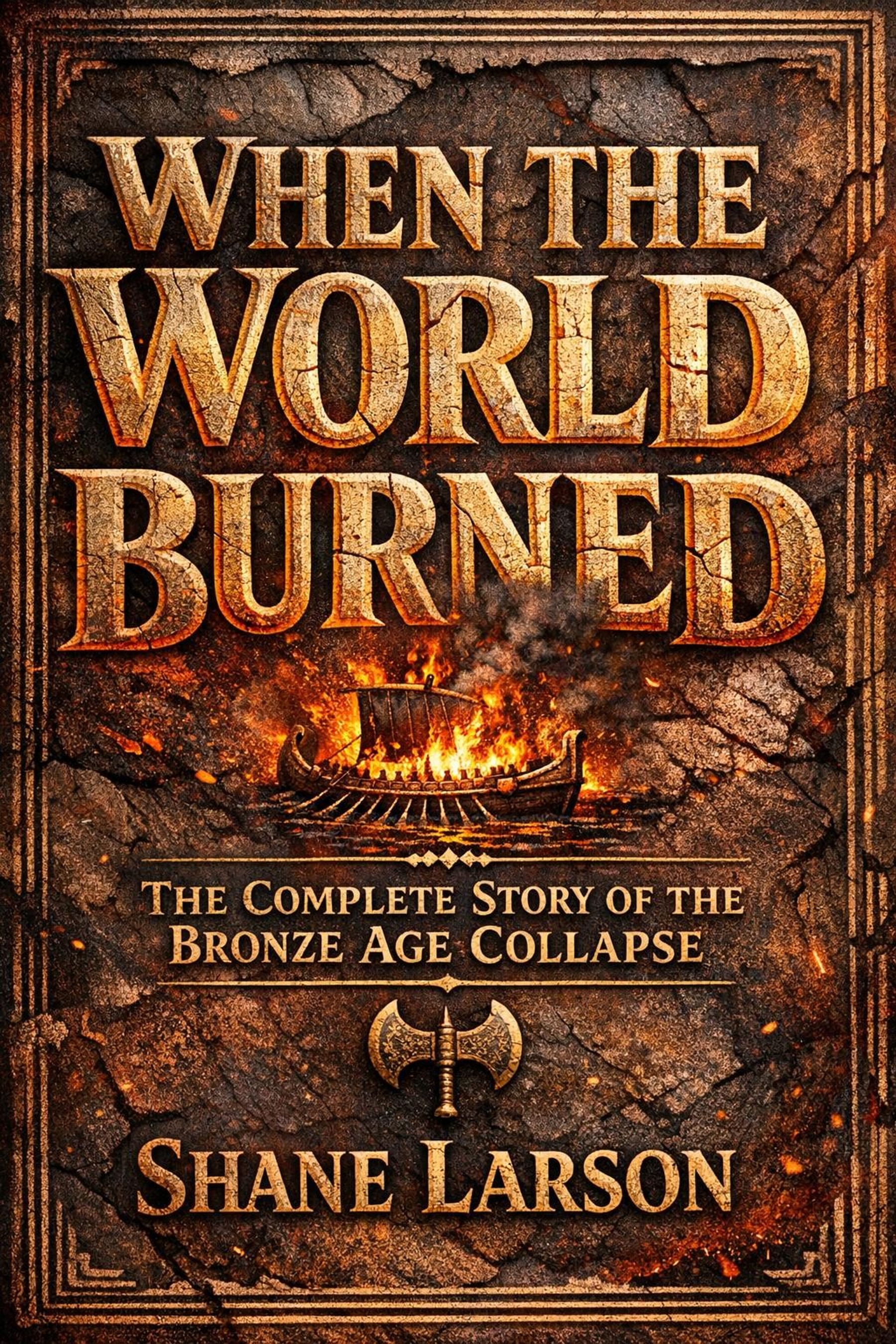
When the World Burned
The Complete Story of the Bronze Age Collapse
By Shane Larson
About This Book
In the spring of 1928, a Syrian farmer plowing near the coast struck a stone slab — the roof of a tomb. The archaeologists who followed found a fennel-covered hill, and under the fennel a city — palace, temples, libraries, merchant houses — that no Greek historian, no biblical author, and no local legend had ever mentioned. It was Ugarit, one of the richest ports of the ancient world, and the reason nobody remembered it is the subject of this book: around 1190 BC it was burned so completely, and its world ended so totally, that within a few centuries no one alive had heard its name.
Ugarit is not an isolated case. Dig almost anywhere around the eastern Mediterranean — Mycenae, Pylos, Hattusa, Enkomi, Emar — and you hit the same horizon of ash at roughly the same date. Within about fifty years of 1200 BC, nearly every major city in the region was destroyed, abandoned, or permanently diminished; the Hittite Empire vanished so thoroughly it had to be rediscovered from the ground three thousand years later, and Greece forgot how to write for four centuries.
Historians call it the Bronze Age collapse — the largest civilizational failure on record before the fall of Rome, and arguably larger: Rome fell alone and slowly, while eight interlocking civilizations went down together within a single human lifetime.
The Story This Book Tells
When the World Burned is the whole of that story in one narrative: the world at its height, the strain, the destructions city by city, the honest weighing of every proposed cause, and — the part most tellings skip — the four centuries of aftermath in which the alphabet, Phoenicia, Israel, iron, and a new Greece grew up among the ruins.
The book's central conviction is that the usual question — what caused the Bronze Age collapse? — is broken as posed. Drought, earthquakes, the Sea Peoples, internal revolt: each explanation covers some burned cities and dies on others — invaders who left no trace at most sites, earthquakes that cannot explain why nobody rebuilt, a drought that fell equally on kingdoms that collapsed and kingdoms that barely stumbled. What the evidence actually describes is a tightly connected international system — single-source tin, imported grain, centralized palace economies — hit by several serious blows in a short span and failing the way networks fail: fast, cascading, and all at once.
Running underneath the whole account is the observation the book keeps returning to: the telling fact is not that the palaces burned. Ancient cities burned and were rebuilt constantly. The telling fact is that nobody rebuilt them. At Pylos, at Hattusa, at Ugarit, the ruins stood in open country for centuries while people lived close enough to quarry the stones. Destruction is an event. Not rebuilding is a verdict — the survivors' judgment that the palace was no longer worth what it cost — and what grew in the space it cleared is where this book ultimately goes.
What's Inside
- Part I, The World That Worked, reconstructs the Late Bronze Age at its height through the Uluburun shipwreck, the Amarna letters, and the Linear B tablets, giving each great power — Egypt, Hatti, Ugarit, Alashiya, Assyria, Babylon, the Mycenaean palaces — its own portrait.
- Part II, The Cracks, follows the two generations before the fall: the exhausted stalemate after Kadesh, the paleoclimate evidence for megadrought, and the famine correspondence showing the strongest state in Anatolia one grain convoy from starvation.
- Part III, The Burning, walks the catastrophe site by site — the evacuated Hittite capital, Ugarit's final letters, the Aegean fires, the battle in the Nile Delta — and includes the cities that did not fall, because the survivors turn out to be the best clue to the mechanism.
- Part IV, Why It Happened, puts every serious explanation on trial, then delivers the verdict in three explicit tiers: what the evidence establishes, what it strongly supports but cannot prove, and what remains genuinely unknown.
- Part V, The Long Aftermath, spends six chapters on the centuries most accounts compress into an epilogue: the Greek Dark Age, the Neo-Hittite states, Phoenicia, the highland villages from which Israel emerged, diminished Egypt, and the iron-and-Assyria world that finally replaced the one that burned.
- Part VI, Memory, closes with two strange survivals — how a real catastrophe crossed four illiterate centuries to become the Iliad, and how archaeologists and decipherers recovered a world erased so completely no one knew it was missing.
- Four appendices: a parallel six-region timeline from 1500 to 800 BC, a gazetteer of every site in the book, a guide to how the evidence works, and a thread-by-thread further-reading route.
Why I Wrote This
This is my two hundredth book, and about twenty of the earlier ones were rehearsals for it. I have written whole volumes on the Minoans, the Mycenaeans, Ugarit, Troy, the Hittites, the Sea Peoples — and every one ran into the same wall: each had to stop at its own borders. The Ugarit book could gesture at the famine in Anatolia; the Hittite book could gesture at the ships off the Syrian coast; none could show the reader that these are not separate stories. They are one story, one connected system failing as a system, and cutting it into national histories quietly destroys the explanation. I wanted the version where nothing stops at a border — where the grain convoy, the drought, the raiders, and the burned archive sit in the same narrative, in order. This is that version.
Frequently Asked Questions
What caused the Bronze Age collapse?
No single thing — the book argues that hunting for one is the mistake itself. Drought, harvest failure, disrupted shipping, displaced populations, probable earthquakes, and opportunistic violence landed within a couple of generations on an interdependent system with no slack, and it failed as a network: fast and all at once. The book labels which parts of that account are established, which are strong inference, and which remain unknown.
Is this the same as Eric Cline's 1177 B.C.?
No — and Cline's book deserves its reputation as the excellent short standard that made the collapse visible to general readers; this book is openly in its debt. The difference is scope: 1177 B.C. is a compact survey, while When the World Burned is roughly three times longer, walks the destructions site by site, and spends six chapters on the aftermath. Read Cline for the short version; read this for the whole story in one place.
Do I need to know anything about ancient history to read this?
No. The first nine chapters build the Late Bronze Age world from scratch — the shipping lanes, the diplomacy, the palace economies — precisely so the collapse lands with full weight. Every name and date is introduced when it matters, and a timeline and gazetteer in the appendices keep the bearings straight.
Who were the Sea Peoples?
They are the raiding and migrating groups — Peleset, Shekelesh, Denyen, and others — named and depicted in Egyptian records attacking the Delta around 1177 BC. Their origin is genuinely unresolved, and the book treats them honestly: less an invading army than displaced populations, ox-carts and families in the columns, as much a symptom of the collapse as a cause of it.
Does this book say our own civilization is going to collapse?
No — and it deliberately declines that framing. The Bronze Age was not a warning addressed to us; it was a world with its own weather, kings, and reasons, and reading it as prophecy sands off exactly the particulars the book spends its length recovering. Readers will notice resonances in a tightly coupled world; the book trusts them to notice without being lectured.
If You Liked This, You Might Like
- Ugarit — the full portrait of the merchant city whose final letters form this book's most haunting chapter.
- The Hittite Empire — the complete rise-and-fall history of the superpower whose capital was emptied and burned in Part III.
- The Bronze Age World — a wider-angle tour of the civilization network whose failure this book anatomizes.
- Iron Age Dawn — picks up where the aftermath chapters end, in the world of iron, alphabets, and new empires.
The palaces went down thirty-two centuries ago, and the people who might have written their obituary lost the ability to write. This book is that obituary, assembled from the ground up — and it ends not with the ashes but with everything that grew in them.
Included with Kindle Unlimited — read it free if you're a member.
New Ancient History releases and free chapters — no spam, unsubscribe anytime.