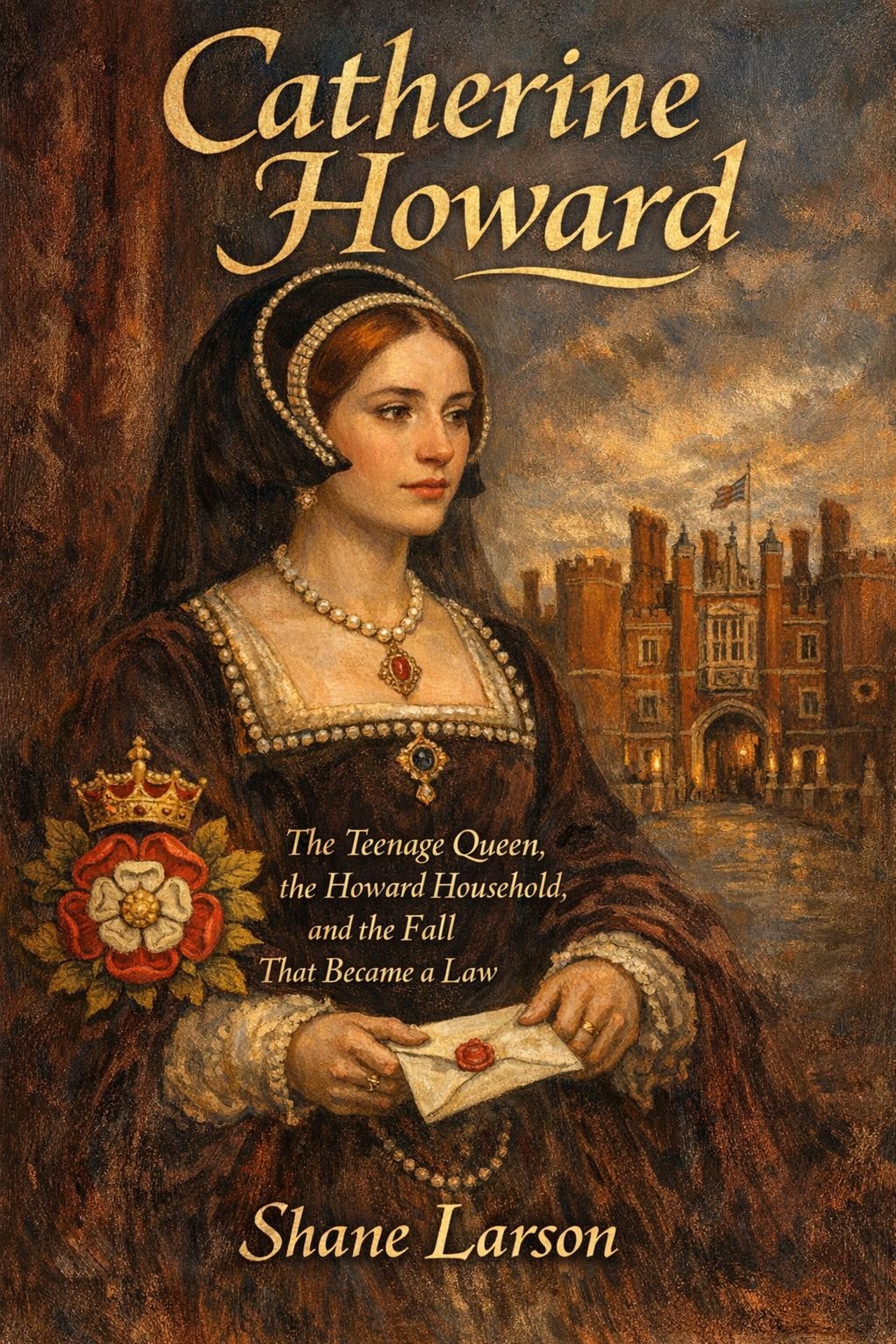
Catherine Howard
The Teenage Queen, the Howard Household, and the Fall That Became a Law
By Shane Larson
About This Book
On Saturday, 11 February 1542, a group of commissioners stood in the House of Lords and declared the king's assent to a bill condemning his wife to death. Henry VIII was not in the chamber. The bill carried a clause making his absence lawful, so that an Act could take effect on letters patent under the great seal without the king sitting through it. A procedure invented so that one man would not have to listen became the ordinary way English law has received royal assent ever since.
Two days later Catherine Howard was led to a scaffold on the green inside the Tower walls and beheaded. A London merchant in the crowd wrote to his brother that she spoke briefly, called her sentence just, and asked the people to pray for the king. Jane Boleyn, Lady Rochford, who had kept the door at her meetings with Thomas Culpeper and had broken down in the Tower, followed her onto the same straw. A separate statute had been needed to make that second execution legal.
She had been queen for sixteen months. There had been no trial.
A Life Known Only Through a Prosecution
Almost everything the sixteenth century set down about Catherine Howard was written between early November and the end of December 1541, by the king's council, in order to prove treason. Depositions, confessions, examinations, her own confession to Archbishop Cranmer: all of it was produced under questioning, with the Tower or the rack in the room, and folded into the Act that killed her. Against all that stands a single letter to Culpeper in her own large, unformed hand, the one document in the record with no interrogator behind it.
So the book names its witnesses. Francis Dereham, who described the bed he shared with her at Lambeth, was being examined for treason and was racked before he finished; his claim of a promise of marriage between them was his best hope of living. Henry Manox, the music teacher who pursued her around 1536, was never charged with anything. None of that makes the depositions false. It makes them evidence of a particular kind, and a reader who treats them as a camera will reconstruct a room no camera saw.
Beneath every judgment of her lies a year that was never written down. No document records her birth, and serious historians have placed it anywhere from about 1518 to about 1525. That span is the whole argument. On the early date she was a young woman at Lambeth; on the late one she was twelve or thirteen when Manox came to teach her the virginals, and the same depositions describe something modern law has a name for. The Victorians thought her wanton; the later twentieth century thought her foolish; Retha Warnicke, Conor Byrne and Josephine Wilkinson have argued since about 2010 that she was an exploited child. This book declines to choose a year, because the evidence does not license one, and carries the uncertainty forward in plain conditionals so the reader can see what each verdict requires.
Its own judgment is narrower and falls on the adults. A noble house that admitted grown men to a room full of sleeping girls, with the key borrowed from the woman meant to keep it, did wrong by every girl in it, on any birth date. The Duchess who found Manox with the girl struck the girl and kept the man. The family that knew put her where the king would see her, and when she fell, its head disowned them all in writing and kept his own neck.
Why I Wrote This
What stopped me was the Act. I had known the outline of Catherine Howard's story for years and had not known that Parliament answered it by writing three new treasons into law, one aimed at any future woman who married a king without confessing her past, or that it passed a second law so that it could execute a woman who had lost her mind. A statute is a strange monument to a girl from Lambeth. The other thing was the arithmetic. Three centuries of verdicts on her turn out to rest on a date nobody recorded, and once I saw that I could not read the biographies the same way.
Frequently Asked Questions
How old was Catherine Howard when she married Henry VIII?
Nobody knows, because no record of her birth exists. Historians have proposed years from about 1518 to about 1525; Gareth Russell favours 1523, and the older tradition settled around 1520 or 1521. That puts her anywhere from the mid-teens to the early twenties at the wedding in July 1540. The book never states an age as fact.
Did Catherine Howard commit adultery with Thomas Culpeper?
The record cannot say. No witness claims to have seen it. Under examination Culpeper admitted that he had intended it and denied that it had happened, and Catherine said the same; both denials were given under conditions designed to extract the opposite. The 1542 Act made the intention itself treason, so the question was never legally decided.
Did Henry VIII really call Catherine Howard his rose without a thorn?
There is no contemporary record that he did. The phrase appears in no letter, dispatch, chronicle, deposition or statute from her lifetime. It is a medieval image of the Virgin Mary, already borrowed for the Tudor badge, that attached itself to Catherine centuries later. The book treats it as a later tradition, not as his words.
Did she say she would rather die the wife of Culpeper?
That line comes from the anonymous Spanish Chronicle, a late account with excellent gossip and no discipline, and it is contradicted by the one eyewitness account of the morning, a letter from the merchant Ottwell Johnson. The book flags the Spanish Chronicle as unreliable every time it appears.
Do I need to read Anne of Cleves first?
No. This volume picks up the king's thread on 28 July 1540, the morning Thomas Cromwell was beheaded and Henry married Catherine at Oatlands, which is where Volume 4 ends.
If You Liked This, You Might Like
- Anne Boleyn — her first cousin, condemned on Tower Green six years earlier under the same uncle's eye; the lesson this book's family did not learn.
- Anne of Cleves — the volume before this one, which ends on the morning this one begins.
- Theodora — another empress known mainly through a hostile source, and the same problem of reading a life through a record written to ruin it.
- Catherine of Aragon — the queen who refused to submit; the comparison against which Catherine's submission at Syon is measured.
A record assembled to make a death lawful, a birth date nobody wrote down, and a law built around one girl's case: Catherine Howard: The Teenage Queen, the Howard Household, and the Fall That Became a Law follows the household, the family and the machinery, and names its witnesses on every page.
Volume 5 of a series on the six queens of Henry VIII.
What You'll Learn
- **The poor Howards** — Lord Edmund Howard, a younger son of the greatest family in England who spent his life hiding from creditors.
- **Chesworth and Norfolk House** — how a great dowager's household worked, what the maidens' chamber was for, and what the 1541 deponents said went on in it, each statement tied to its witness.
- **The pre-contract she would not claim** — the canon law that would have made her Dereham's wife and therefore no adulteress, and the debate over why she denied it.
- **Lent 1541** — the meetings at Lincoln and Pontefract as the participants later described them, and whether anything passed beyond intention.
- **All Souls' Day** — a paper left where the king heard mass, a quiet inquiry at Lambeth, and the fact that an unchaste past was not yet a crime when it was left.
- **The Act** — attainder in place of a trial, three new treasons, a statute to execute the insane, and the assent clause that outlived them all.
- **Three appendices** — the Howard family tree; a witness-by-witness guide to every deposition of 1541; and the age question laid out year by year with its proponents.
New Early Modern History releases and free chapters — no spam, unsubscribe anytime.
More in This Genre
View all →