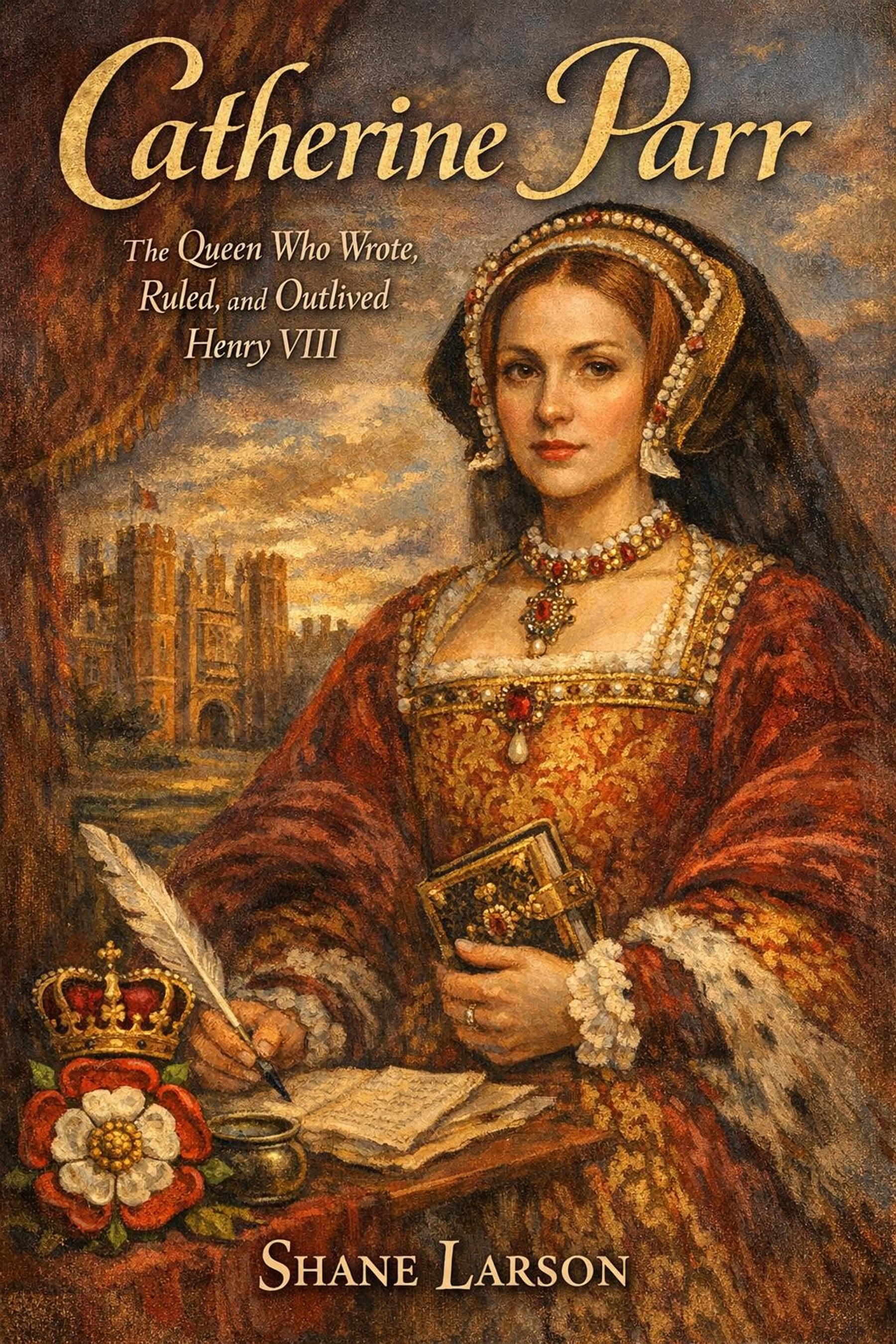
Catherine Parr
The Queen Who Wrote, Ruled, and Outlived Henry VIII
By Shane Larson
About This Book
In the first days of July 1544 a commission was drawn up at Henry VIII's court naming the queen regent and governor of the realm. On 14 July the king crossed to Calais, and for the next eleven weeks England's proclamations went out over his wife's signature. She ordered the musters on the Scottish border, signed the warrants that paid for the siege of Boulogne, and presided over a council of the realm's chief officers. On some of the papers she added one word after her title: regent.
Two and a half years later Henry made his will. It named sixteen executors to govern for his son and twelve assistants to advise them. The queen's brother was among the assistants. So was Thomas Seymour. The queen was not named at all.
Between those two documents lies the whole problem of Catherine Parr. The woman a Tudor king trusted with his kingdom for a summer is remembered by a jingle in which she merely survived, and by a Victorian picture of a kindly widow dressing a sick man's leg. This book sets both aside and asks what the documents say.
The Widow, the Queen, and the Nineteen Months After
She was born about 1512, probably in London and not at Kendal Castle, which was already a ruin. By thirty she had buried two husbands: Edward Borough, a young man and not the mad old baron the Victorians gave her, and Lord Latimer, whose castle at Snape the rebels of the Pilgrimage of Grace occupied in January 1537 with Catherine and her stepchildren inside. Latimer died on 2 March 1543. By then two men had noticed his wife, and the one who was king won.
For the first time Henry's three children lived as one household, and the Act that put both daughters back in the succession passed with their stepmother in the house. She governed the realm in the summer of 1544. And she wrote: a book of psalm-prayers turned from John Fisher's Latin, issued anonymously in 1544, and then in 1545 Prayers or Meditations, printed with the queen named on its title page and reprinted within months. Around the queen gathered a circle of reform-minded women, and in 1546 the danger of being known for it arrived.
Anne Askew, under torture in the Tower, was pressed for the names of the queen's ladies; she was burned at Smithfield on 16 July. Then comes the story everyone knows: articles against the queen, a signed warrant, a dropped paper, a night of submission, and a Lord Chancellor sent away in the garden the next morning. The book gives that scene as John Foxe gave it, in 1563, under Elizabeth, and states the problem plainly: no warrant, no articles, no council entry and no ambassador's dispatch survives. The chapter sets out what corroborates Foxe's outline, what does not, and why Susan James, Linda Porter and Elizabeth Norton still mostly accept it.
Henry died on 28 January 1547; Catherine's story runs on for nineteen months. By May, probably, she was the wife of Thomas Seymour, the man she had wanted before the king chose her, married in secret. The marriage brought a quarrel with the Protector's wife over precedence and over jewels the council never returned; a household at Chelsea and Hanworth holding both Elizabeth and Lady Jane Grey, later described in testimony gathered against Seymour in 1549, which the book reads from the depositions and no further; and a third book, The Lamentation of a Sinner, published in November 1547 with a preface by William Cecil, the one Henry's reign could not have borne. She moved to Sudeley Castle for her first lying-in. Her daughter Mary was born on 30 August. Catherine died six days later and was buried in the castle chapel with Jane Grey as chief mourner and Miles Coverdale preaching in English.
Why I Wrote This
Six books ago I started on Henry's queens with the rhyme in my head like everyone else, and this is the one that finally broke it. What hooked me was the gap between the two documents at the top of this page: in 1544 Henry handed Catherine Parr the kingdom for a summer, and in 1546 he wrote a will that did not mention her. The other thing was Sudeley. A queen of England lay under the floor of a roofless chapel for two centuries, and when people found her in 1782 they opened the lead and took her hair. I wanted to know how a woman who governed, published and raised two future queens came to be remembered that carelessly. She is where Henry's story ends and his daughters' begins, and the last word on her should not be survived.
Frequently Asked Questions
Did Catherine Parr really nurse Henry VIII?
Not in any sense the record supports. Henry had physicians and a privy chamber whose job was his body; Catherine was thirty-one at the wedding, with her own household and income. The sickroom picture is an eighteenth- and nineteenth-century invention that Agnes Strickland fixed.
Was there really a warrant for Catherine Parr's arrest in 1546?
The signed warrant exists only in John Foxe's Acts and Monuments, and only from its enlarged 1570 edition onward. What is independently documented is the conservative campaign of that summer, Anne Askew's own account of being questioned about the queen's ladies, and the timing. Most historians accept Foxe's outline on that basis; the book explains why.
Was Catherine Parr born at Kendal Castle?
Almost certainly not. The castle was decayed and the Parrs did not live in it; her father was a courtier with a house in the Blackfriars precinct of London. No record of her birth survives, so the book gives about 1512, in London, as a probability.
What happened to Catherine Parr's daughter, Mary Seymour?
After her father's execution in March 1549 she passed to Katherine Willoughby, Duchess of Suffolk, who complained to William Cecil of the cost of keeping her. An Act of 1550 restored her in blood, and after that the record is silent; she was not yet two. Later stories of her surviving to adulthood are legends.
Where is Catherine Parr buried?
In the chapel of Sudeley Castle in Gloucestershire. Her lead coffin was found in the ruined chapel in 1782 and opened more than once over the following decades; in 1817 what remained was moved into a vault. The marble effigy visitors see today dates from the Victorian restoration of the chapel.
If You Liked This, You Might Like
- Catherine of Aragon — the only other queen Henry made regent, in 1513 with the Scots on the border; the 1544 regency is measured against hers.
- Jane Seymour — Thomas Seymour's rise and fall from the Seymour side, and Henry's burial at Windsor.
- The Hundred Years' War — the English claim in France that put Henry at Boulogne in 1544 and left a queen holding the realm.
- Theodora — another woman whose reputation was fixed by a single partisan writer, and the same work of reading a life through him.
A regent the king left out of his will, an author no queen had been before her, and a death at thirty-six that the rhyme calls survival: Catherine Parr: The Queen Who Wrote, Ruled, and Outlived Henry VIII follows the record rather than the picture and ends where Henry's story does.
Volume 6, the closing volume, of a series on the six queens of Henry VIII.
What You'll Learn
- **The Parrs of Kendal** — a gentry family risen by service at court, a mother widowed at twenty-five who refused to remarry, and why the Kendal Castle birth cannot be true.
- **Two suitors** — the courtship Henry interrupted, and Catherine's own later account of what she had wanted.
- **Regent of England** — eleven weeks of proclamations, musters and war finance, set beside Catherine of Aragon's regency of 1513.
- **Summer 1546** — Anne Askew, the questions asked on the rack, and Foxe's account of the plot against the queen, its single-source problem argued in the open.
- **Sudeley** — the move west in June 1548, Lady Tyrwhitt's testimony of what Catherine said at her bedside, the deathbed will, and the funeral.
- **Three appendices** — family trees and a who's who of her circle; a finding list of everything she wrote; and a chronology closing with a table of all six queens.
New Early Modern History releases and free chapters — no spam, unsubscribe anytime.
More in This Genre
View all →